Dear Mr. Clemens,

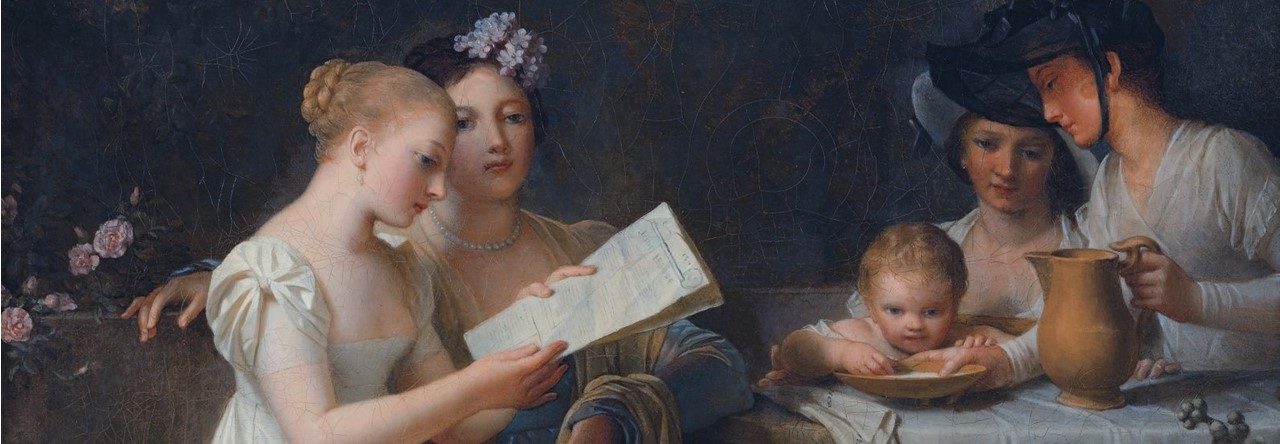
Elisabeth Vigee-Lebrun. A self-portrait. The late 18th-early 19th century French portrait painter was one of Marie-Antoinette’s favourite court painters
I am writing to ask if you will lend your considerable influence as one of society’s leading doyen in sponsoring a talented young artist I have taken a liking to.
Miss Laura Cappleman, you may have heard, made a successful debut in the Season of 1814, but the events after that time have been largely tragic.
You might think it quite selfish of me to make light of the poor girl’s misfortune, but it seems to have quite the unexpected outcome.
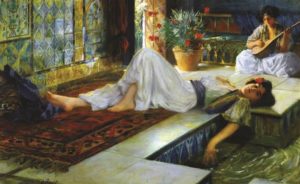
You see, her experience has made her art one of a kind. When she paints scenes of the Oriental marketplaces of Africa or of life inside the Ottoman harem, one is utterly transported.
One can feel the beating heat of the sun, smell the pungent aroma of the spices, shudder the menace of the large eunuchs and their scimitars, be awe-struck by the opulence inside these pleasure palaces.
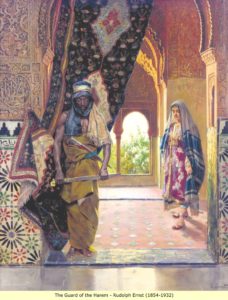 Miss Cappleman knows these places first hand. If her name didn’t ring a bell when I first mentioned it, I’m sure you remember hearing about her abduction in August of 1814 at the hands of white slavers. It was covered in The Times.
The story of her rescue two years later is one of the most remarkable tales I’ve heard. I’m trying to persuade her to draw on her experience more to create great art for the world to see.
The Royal Academy summer exhibition is the perfect opportunity for this young lady to make a debut of another sort – a launch into the artworld which is her due.
A word in the ear of the Royal Academy directors and sponsors to consider this impressive young artist would be considered a personal favour.
Yours,
Elisabeth Vigée-Lebrun
Revenge of the Corsairs
 Madame Vigée-Le Brun stood in front of the still life. She pulled a small pince-nez from her reticule to take a close look. After a minute or two, the great French artist left that painting without comment and examined the portrait of Victoria.
Pull yourself together, Laura! If she were to enter the Royal Academy’s exhibition, her works would be judged worthy or wanting in a heartbeat. If she were to exhibit at all, many people would be staring at her work. Yet this somehow, seemed different.
After a length of time, the French woman looked up from the portrait and spoke. “I understand from your sister-in-law that you have returned to England only recently.”
 “Yes. I spent time abroad.”
“Did you do anything? Did you see anything?”
Laura’s mouth dried. “I, ah, I mean, I spent time in Sicily and…”
The artist removed the glasses. “And you experienced nothing?”
“I beg your pardon?”
The older woman let out a long, put-upon sigh. “All I see is practiced technique, adequate color choice, and a schoolgirl’s sensibilities.”
Laura couldn’t help the gasp that escaped her mouth.
“I’m sure you are a delight to your friends and family, who no doubt praise you endlessly, but I am not here to coddle or to give you false flattery. I do not see the soul of an artist in these paintings.”
Laura fought a trembling of shame, and fear, and disappointment. It was a small miracle she was able to reply, “Then I am sorry to have wasted your time, Madame.”
The woman shrugged. “I said I would look at your works and I will.”
The third painting, she studied for a few seconds; the fourth, the landscape, received nothing more than a cursory glance. “I spent three years in Rome, I was inducted into the Accademia di San Luca,” she continued conversationally, either unaware or unconcerned Laura’s hope had turned to dust.
“How very nice for you,” replied Laura, bitterness dripping from each word.
“What I am trying to say to you, ma fille, is your work seems utterly unmarked by your time abroad. That, I fear, makes you a dabbler, someone who pretends to be an artist. If you can live on La Méditerranée and not be influenced by such histoire, people, and surroundings, then I’m afraid you will be nothing more than a very little talent.”
 Laura looked down. Her knuckles were white, but her face, she was sure, was puce. Her disappointment of a few moments ago was now a rage. How dare that woman say she was unmarked!
“How dare you?” she repeated out loud, unaware Madame Vigée-Le Brun had approached her final painting.
“You have no idea what happened to me there. No idea! I have been scarred to the depths of my soul. I was seized and imprisoned for nearly two years in an Ottoman harem. I was violated repeatedly by a man who had the power of life and death over me. The only good thing I have left is painting. Can you blame me for not wanting it tainted?”
When she looked up, Madame Vigée-Le Brun was not looking at her; she peered instead at the last painting, the Tunisian market scene. “La! That is it – c’est de cela que je parlais!”
Her face animated, the woman turned the easel around so the canvas faced them both. Laura could feel the desert heat of its colors from where she stood.
“You are afraid of this beast that is locked in your breast? Let it out, my dear! You cannot hide from it! I see hints of it in this painting here. In this work, I begin to see the world as you see it.”
Revenge of the Corsairs out now exclusive to Amazon
 Here is the report you requested. Of late, I’ve been exploring the rumors of gold to be found in the Wyoming territory of the former colonies. While the rumors are true, the location of the gold fields is on lands belonging to the Sioux nation. Relations are hostile between these aborigines and the somewhat more civilized government of the United States of America. In addition, the area of the gold fields, known as the Black Hills, is exceedingly difficult to access. Thus, few white men and fewer white women have traveled through the place. I have determined to do so, myself. Not for greed of gold, but for greed of experience. I have never denied my eagerness to see what is around the next corner, tree, rock, or river bend. Be that as it may, I am currently in the boomtown of Cheyenne seeking a guide of good reputation to shepherd my little party [Yes, despite her megrims, my maid Analisa is still with me, but more of her peccadillos at another time.]
 The third man, Mr. W. Hickock is also quite famous. He is very colorful wearing pistols holstered on each hip and having long, locks of hair, which were kept scrupulously clean, unlike Mr. Bridger. I had almost agreed to accept Mr. Hickock’s services despite his exorbitant fees when the most unruly and oddly dressed female I had ever seen burst into the room and drew her pistol, holding me and Mr. Hickock at gunpoint.
 This character, one Skinner Jones, I might have rejected instantly. Jones personal hygiene looked and smelled no better than Mr. Bridger’s. However, the educated speech that came from Jones’s mouth roused my interest, so I invited my guest to share tea with me as we discussed the possibility of escort from Cheyenne to the Black Hills.
 About the Book
 About the Author
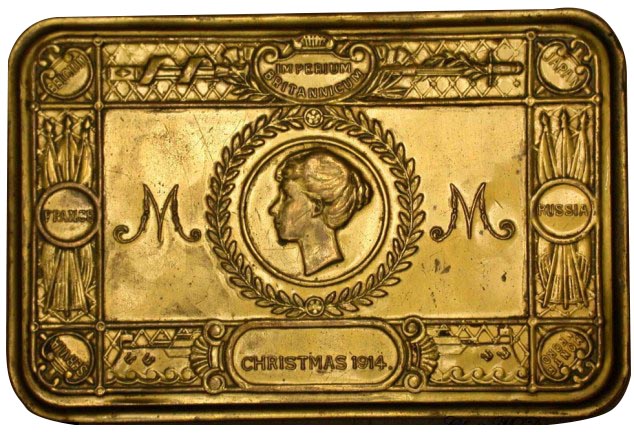 1914. The date, printed on a tin box got our attention. One supposes it could be an error of some sort, the date being one-hundred years in the future, but given the odd goings on at Vauxhall last week and at the Marquess of Dansbury’s estate—blue lights and claims of travel to distant times—your Teatime Tattler staff believes the date is correct. Besides, it purports to hold tobacco from “Princess Mary’s Christmas Fund,” and who, pray tell, is Princess Mary?


 A word of warning. Many would deem the scene I witnessed to be of a delicate nature. Some might say scandalous. Keep your smelling salts close if you choose to read on.
 Wulfstan pushed open the bedchamber door but hesitated on the threshold. Pale and wide-eyed, Jocelyn stood motionless in front of the gaping window. She stared at him as though he were the Devil incarnate.
 About the Book
 About the Author
 The boy—he thought his name was Brodie, but couldn’t remember clearly—sat up straight. “No sir! Harry is no drunkerd. At least it isn’t—I mean…”
 “The chit in the papers? The one that is marrying the Governor General’s nephew? What does she have to do with my son?” Will demanded.
 Harry awoke with a sick stomach and a head full of carpenters pounding hammers in his brain. Why did I wake at all? He wondered. A voice, calling his name, sounded far away. It was a man’s voice, not Elsbeth’s. At the thought of her he squeezed his eyes shut. He didn’t want to wake up ever again.
 It was long past dark when Harry returned, sober, safe, and unsmiling. Relief so strong he couldn’t even be angry flooded Will. Visions of Harry flinging himself into the Rideau locks had haunted him all afternoon.