Because history is fun and love is worth working for

Category: Historical Period Page 11 of 16

Heard on the Boardwalk of Camp Floyd

Camp Floyd, Utah, 1860

“Did you hear about the other night at the saloon?” Miss Mora whispered, then forced a smile that didn’t quite reach her eyes at a tall, dark, and handsome passing them on the boardwalk.

“No, whatever happened?” Miss Alamander, dressed in blue, sidled closer to her friend, if you could call her that, and together they took refuge behind her fan. Miss Mora’s lips made a moue at the back of the man who had just passed them without sparing the ladies, in their glittering (if slightly stained) dresses, another glance.

“I’d gone with Mr. Sorley for an evening of fun and cards at his cabin, entertaining him and his friends,” Miss Mora gave the other woman a wicked smile, “and—“

“I’ll bet you made a pretty penny for that night’s work,” Miss Alamander cut in, her lips tight.

She just smirked.

“Okay.” The woman in blue crossed her arms and waited, but Miss Mora just stood with one brow raised. Her curiosity eventually got the better of her, even over her annoyance at Miss Mora’s good fortune at the potential expense of hers. “What happened?” she finally asked.

“You wouldn’t think it, would you, but that big blond brute of a man, Jackson—”

“Yes?” she breathed, egging Miss Mora on.

“If you’d let me finish,” she harrumphed, “Jackson stumbled into the saloon late last night, drunk as a skunk, and…” She broke off and smiled over her fan at a man passing by, then resumed, “he stormed across the room toward this boy, and he so young he hadn’t a hair on his face.”

“And…?”

“Well, the young lad had his hat on, a big ten-galón hat, you know, like the caballeros from Mexico wear?”

“Get on with it,” Miss Alamander said crossly. We don’t have all day.” She smiled at a filthy man riding his horse past them, his stench following him, and swallowed hard.

“That boy, he got the best of him!” Miss Mora whispered.

Miss Alamander looked up from the blue bodice that just barely covering her bosom and blinked. “But no one gets the best of Mr. Jackson! That’s impossible, how did he do it?” She hissed as Miss Mora turned away from her to make eyes at a man walking down the street leading his mules not a yard away from them.

The gentleman’s accoutrements bespoke his success in the goldfields—not only his exquisite, if dusty, clothing, but the fine wood and leather cases piled high over his pickaxes, shovels, and pans. His waistcoat alone must have cost more than her wages for a month. She gulped and took a breath deep enough to nearly bust herself out of her bodice, but he never looked her way as Miss Mora strode boldly toward him.

“And how might you be today, sir?” she asked him in a throaty tone, somehow wiggling her top half at the same time she floated off the boardwalk and through the mud.

“All the better for seeing you,” he said, with a chuckle. “Will you ladies be here long?”

At least this time, he included Miss Alamander in his glance.

“That depends upon what you have in mind, sir,” Miss Mora continued, as she slithered up to him and stood between him and Miss Alamander, as if on purpose. Her gliding was made all the more difficult by the half-foot of slop which the locals deigned to call a “street” here in Camp Floyd. The soldiers didn’t seem to mind, but the ladies did.

“What do you say you come along with me for awhile,” he said, then nodded at Miss Alamander, still standing on the boards, “and then you can rejoin your friend afterward?”

The woman in blue took a deep breath and unclenched her hands and smoothed the silk down over her abdomen and joined them demurely before her. She gritted her teeth and forced a smile at him, then turned to face the other men passing her by as the stores closed for the day.

No one was up for a tussle at this early hour, at least the locals, and the soldiers would be at their mess up at the fort, so Miss Alamander cooled her heels for what seemed a month and fought back a smile.

This was going to be fun.

She schooled her features to look impatient as Miss Mora finally returned, a bit less tidy than when she’d left. She was missing a few hairpins, but wore a big smile. She jingled as she hopped up onto the boardwalk.

“So stop looking like the cat that ate the cream,” Miss Alamander said, pursing her lips, “and tell me! How did a mere boy best big old Jackson, especially when he was in his cups?”

“He cut him.” Miss Mora gave her a sideways smile. “Jackson stormed toward him, and you know how big he is, but this boy, his waist no bigger around than that brute’s leg, just stood up at his table, cool as a cucumber, knocked his glass on a table, even with his arms held behind his back by one of Jackson’s henchmen, and cut him. Sliced his arms and then those of the despicable man behind him, and bolted out the door! No one’s seen the boy since.”

“No.” Miss Alamander did her best to look shocked, but it would be nothing to what she was about to see on her friend’s face. She couldn’t wait.

“Yes,” Miss Mora said, nodding her head emphatically.

“You don’t say,” Miss Alamander said. “Now I remember. I heard something about that… I heard it wasn’t a boy at all… it was a girl!

Miss Mora’s chin dropped until it came to rest on her ample and exposed bosom. For once, she was speechless.

Wow, what a woman, if it was one! Who could she be? You’ll have to read A Long Trail Rolling to find out!

About the Book
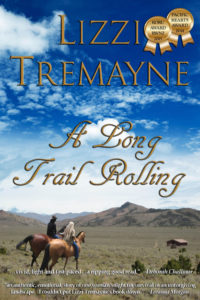
Camp Floyd

A Long Trail Rolling

She didn’t expect to become a target…but she is one now.

Just orphaned, Aleksandra holds the family secret her father died for. She hides by joining the Pony Express as a boy, where an alluring Californio sees through her guise and offers help—and more.

Xavier’s conviction that women cannot be trusted is deeply rooted in the reasons he left his birthright. But Alex is like no woman he has ever met.

With the killer getting closer and an Indian war brewing, Alex and Xavier must decide whom they can trust, and what they really want.

Lizzi is one of the newest Bluestocking Belles!
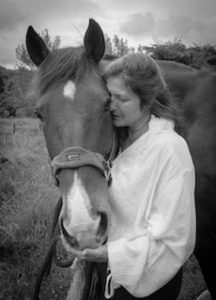
Lizzi

A Long Trail Rolling is the first book in

The Long Trails series, out now!

Find the book here:

#ReadforFreeonKindleUnlimited or buy it here in paperback or digital on Amazon

Lizzi loves to connect with her readers!

You can learn more about Lizzi and her books here or on these social media sites:

Subscribe to Lizzi’s Newsletter (with a free gift!)

Subscribe to Lizzi’s Blog

Friend Lizzi on Facebook

Follow Lizzi on Twitter

Follow Lizzi on Bookbub

Follow Lizzi on Instagram

Follow Lizzi on Goodreads

Follow Lizzi on Pinterest

Follow Lizzi on YouTube

Email Lizzi

Visit Lizzi’s Author Website


Sign Me Up!  

Sign up for Lizzi’s newsletter here, with a free gift!
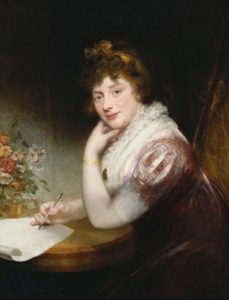
 

The Marquess’s Misalliance

Marquess WeddingExtract from the diary of Lady Caroline Chantry, sister to Giles, Marquess of Huntercombe. November 1803
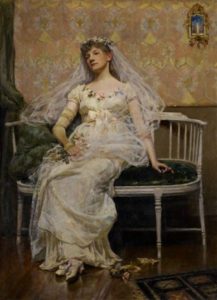
Dear Diary,

What a dreadful day! I write in absolute outrage. I have had no time to write the past two days, but after dear Letty and I had gone to so much trouble to furnish Giles with a list of perfectly eligible brides, our fool of a brother has married, actually married that dreadful creature who called herself Lady Emma Lacy. Well, it appears poor Lord Peter Lacy did make an honest woman of her, but no one can possibly have forgotten that she jilted Sir Augustus Bolt at the very steps of the altar eleven years ago, having refused to say her vows and walked out of the church. And she was seen not moments later embracing Lord Peter on the very steps of St George’s and leaving with him! One would hope the son of a duke would have known better than to become entangled with such a mi. Of course her family cast her off and poor Lord Peter had to drop out of society completely. No doubt he regretted making such a fool of himself before he died!

But unfortunately he did die, and this is the woman my poor brother has been hoodwinked into marrying. Worse, he has made an enemy of the wretched woman’s erstwhile father-in-law, the Duke of Keswick, by refusing to cede guardianship of the duke’s grandson and heir. We are given to understand that Emma had previously refused to hand the child over at Keswick’s very reasonable request and she had the gall to apply to my poor brother for help. She seems to believe that she has some right as a mother to be responsible for her own child. Fancy! A mere woman setting herself up above a duke! I think it very likely that she has been reading treasonous rubbish such as that dreadful Wollstonecraft woman’s A Vindication of the Rights of Woman, and so I shall warn Giles at the first opportunity!

Marquess WeddingMy poor, dear sister, Letty, and I attended the wedding at Huntercombe House only this morning. How I shall ever hold up my head again, I cannot say. But Giles has informed us that if we do not wish for a public breach we must recognise his bride and really, what choice do we have? But such a wedding! The bride’s father and mother were there, but did the poor Earl of Dersingham give his daughter away? He did not! Instead the bride’s children did so, if you please! I wonder the marriage can be considered legal with such a flagrant disregard for all decency. And all Giles would say when I mentioned it, and very tactfully! was that since Dersingham had apparently not shown up for Emma’s first wedding they had thought it wiser not to rely on him this time!

As if that were not scandal enough, the Duke of Keswick appeared at the last moment with his son, Lord Martin Lacy and a magistrate. I thought for a moment that they meant to forbid the marriage, but sadly it was not to be. Giles remembered his manners for long enough to bid them welcome and they sat down at the back. I believe Giles had some discussion with his grace afterwards, but apparently he has insisted on retaining guardianship of the two children. Really, it would be much more the thing if the boy and his sister were raised by their father’s family. Especially since the boy is now Keswick’s heir. It is none of Giles’s business after all. And as for the girl I consider her to be a pert little minx, and all the better for a sharp set-down and some discipline! But what can you expect when her mother defies all authority and sets up to know better than her own father and father-in-law.

I can only pray that my poor brother does not come quickly to realise his mistake, but I fear he is in for a sad disappointment and that we can expect nothing but sorrow and scandal from this appalling mesalliance.

Marquess WeddingAbout the Book: His Convenient Marchioness
After the loss of his wife and children, the Marquess of Huntercombe closed his heart to love. But now that he must marry to secure an heir, he’s determined that the beautiful, impoverished widow Lady Emma Lacy should be his…

Emma has vowed never to marry for money so must refuse him. But when her children’s grandfather sets to steal them away from her, she has no other option: she must become the marquess’s convenient bride!

https://www.amazon.com/His-Convenient-Marchioness-Lords-Altar/dp/1335051635

https://www.harlequin.com/shop/books/9781488086434_his-convenient-marchioness.html

https://www.barnesandnoble.com/w/his-convenient-marchioness-elizabeth-rolls/1126552293

https://www.millsandboon.co.uk/p54418/his-convenient-marchioness.htm

https://www.amazon.co.uk/Convenient-Marchioness-Mills-Historical-Lords-ebook/dp/B073TRS6T7/ref=cm_cr_arp_d_product_top?ie=UTF8

About the Author

Elizabeth Rolls lives in the Adelaide Hills of South Australia in a valley of apple, pear and cherry orchards. She considers tea bags the work of the devil, and has what many consider far too many books along with three dogs and two cats. She enjoys cooking, reading, walking the dogs and sampling the offerings of local wine makers.

http://www.elizabethrolls.com/books.html


A Famous Artist Asks For Help

Dear Mr. Clemens,

Elisabeth Vigee-Lebrun. A self-portrait. The late 18th-early 19th century French portrait painter was one of Marie-Antoinette’s favourite court painters

I am writing to ask if you will lend your considerable influence as one of society’s leading doyen in sponsoring a talented young artist I have taken a liking to.

Miss Laura Cappleman, you may have heard, made a successful debut in the Season of 1814, but the events after that time have been largely tragic.

You might think it quite selfish of me to make light of the poor girl’s misfortune, but it seems to have quite the unexpected outcome.

You see, her experience has made her art one of a kind. When she paints scenes of the Oriental marketplaces of Africa or of life inside the Ottoman harem, one is utterly transported.

One can feel the beating heat of the sun, smell the pungent aroma of the spices, shudder the menace of the large eunuchs and their scimitars, be awe-struck by the opulence inside these pleasure palaces.

Miss Cappleman knows these places first hand. If her name didn’t ring a bell when I first mentioned it, I’m sure you remember hearing about her abduction in August of 1814 at the hands of white slavers. It was covered in The Times.
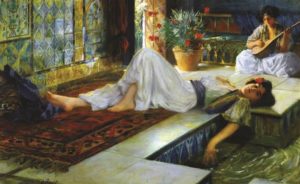
The story of her rescue two years later is one of the most remarkable tales I’ve heard. I’m trying to persuade her to draw on her experience more to create great art for the world to see.

The Royal Academy summer exhibition is the perfect opportunity for this young lady to make a debut of another sort – a launch into the artworld which is her due.

A word in the ear of the Royal Academy directors and sponsors to consider this impressive young artist would be considered a personal favour.

Yours,
Elisabeth Vigée-Lebrun

Revenge of the Corsairs

Madame Vigée-Le Brun stood in front of the still life. She pulled a small pince-nez from her reticule to take a close look. After a minute or two, the great French artist left that painting without comment and examined the portrait of Victoria.

Pull yourself together, Laura! If she were to enter the Royal Academy’s exhibition, her works would be judged worthy or wanting in a heartbeat. If she were to exhibit at all, many people would be staring at her work. Yet this somehow, seemed different.

After a length of time, the French woman looked up from the portrait and spoke. “I understand from your sister-in-law that you have returned to England only recently.”

“Yes. I spent time abroad.”

“Did you do anything? Did you see anything?”

Laura’s mouth dried. “I, ah, I mean, I spent time in Sicily and…”

The artist removed the glasses. “And you experienced nothing?”

“I beg your pardon?”

The older woman let out a long, put-upon sigh. “All I see is practiced technique, adequate color choice, and a schoolgirl’s sensibilities.”

Laura couldn’t help the gasp that escaped her mouth.

“I’m sure you are a delight to your friends and family, who no doubt praise you endlessly, but I am not here to coddle or to give you false flattery. I do not see the soul of an artist in these paintings.”

Laura fought a trembling of shame, and fear, and disappointment. It was a small miracle she was able to reply, “Then I am sorry to have wasted your time, Madame.”

The woman shrugged. “I said I would look at your works and I will.”

The third painting, she studied for a few seconds; the fourth, the landscape, received nothing more than a cursory glance. “I spent three years in Rome, I was inducted into the Accademia di San Luca,” she continued conversationally, either unaware or unconcerned Laura’s hope had turned to dust.

“How very nice for you,” replied Laura, bitterness dripping from each word.

“What I am trying to say to you, ma fille, is your work seems utterly unmarked by your time abroad. That, I fear, makes you a dabbler, someone who pretends to be an artist. If you can live on La Méditerranée and not be influenced by such histoire, people, and surroundings, then I’m afraid you will be nothing more than a very little talent.”

Laura looked down. Her knuckles were white, but her face, she was sure, was puce. Her disappointment of a few moments ago was now a rage. How dare that woman say she was unmarked!
“How dare you?” she repeated out loud, unaware Madame Vigée-Le Brun had approached her final painting.

“You have no idea what happened to me there. No idea! I have been scarred to the depths of my soul. I was seized and imprisoned for nearly two years in an Ottoman harem. I was violated repeatedly by a man who had the power of life and death over me. The only good thing I have left is painting. Can you blame me for not wanting it tainted?”

When she looked up, Madame Vigée-Le Brun was not looking at her; she peered instead at the last painting, the Tunisian market scene. “La! That is it – c’est de cela que je parlais!”

Her face animated, the woman turned the easel around so the canvas faced them both. Laura could feel the desert heat of its colors from where she stood.

“You are afraid of this beast that is locked in your breast? Let it out, my dear! You cannot hide from it! I see hints of it in this painting here. In this work, I begin to see the world as you see it.”

Revenge of the Corsairs out now exclusive to Amazon

A Flower of Scotland in Flight

The Forfar Inn

Forfar, Angus, Scotland

Roslyn Grant pulled her cloak tighter around her as she watched the coach pull away from the inn, her thin shoulders shivering in the cold air. What to do now? The coach fare to Forfar had cost every last penny of her small savings, and what had it gained her but a mere forty miles from her villainous stepbrother?

“Kin I help ye wit’ yer bag, miss?”

A boy about twelve in a torn jacket and brown wool cap pointed at the small valise at her feet.

Roslyn blinked and bent down to pick it up herself. “Thank you, but no, I can manage it myself.” No doubt he was wanting to earn a coin or two, not knowing that her pockets were as bare as his. In any case, the bag was light enough, as she’d had time only to stuff inside a spare gown, stockings and undergarments, and her nightrail.

The boy stared at her curiously and she realized she must appear a strange sight, standing immobile in the middle of an inn yard with a cold wind whirling about her.

“I’d best go inside,” she said hesitantly.

“There’s a first-rate fire goin’ in the public room,” he offered.

She nodded. “Yes, of course.” The worst they could do was throw her out again. So she took brave steps to the door and made her way inside.

Two men sitting at the bar eyed her with interest, but she walked past them with practiced ease toward the fireplace, where she put down her bag and stretched her hands out toward the fire.

“Kin I git ye somethin’, miss?” A weary-looking woman carrying a jug approached her.

She yearned for a cup of tea, but without coin to pay for it, she shook her head. “No, thank you.”

The door opened again, letting in a gust of icy air and about a half-dozen rough-looking men, cursing and behaving raucously. Roslyn ignored them, leaning closer to the fire, but the harassed serving maid could not.

“Liz-zie! Git yerself over ‘n wait on the new folk! I ain’t payin’ ye to stand there ‘n flap yer tongue!”

Lizzie reddened. “Ye don’t pay me to do the work o’ two,” she said under her breath. “When I see that Ellen girl agin, I’ll give her a piece ‘o my mind, ‘n that’s a fact.”

Roslyn perked up. “Are you short of staff then? I-I might be able to help.”

Lizzie looked her up and down. “Needin’ some o’ the ready, are ye?”

Roslyn nodded. “I-I’m looking for a position, yes.”

“Ye sure ye kin handle rough folk like these ‘uns?” She waved her hand toward the newcomers.

Roslyn set her shoulders back, untied her cloak, and hung it across a chair before making long confident steps toward the table of hooligans.

“Can I get ye some ale, gentlemen? Or is it food yer wantin’ We’ve some fine stew this evenin’,” she said with a look at Lizzie, who appeared to be stifling laughter.

“That so?” said one man, taller and bigger than the rest. “Ole Jack’s stew’s never bin called ‘fine’ afore. Jack git a new cook?”

“He did,” she fibbed. “Me. I cooked up the stew tonight.”

The innkeeper, ‘Ole Jack,’ stared at her incredulously from the kitchen door.

“In that case,” said the big red-headed fellow, “we’ll each have a bowl o’ the pretty gel’s stew. Won’t we, mates?”

They all roared their agreement, and Roslyn hustled toward the kitchen, shrugging sheepishly at the innkeeper. “Yer hired,” he said. “Fer tonight. Wot’s yer name?”

“Ros-er-Rachel,” she lied, using the alias she’d invented previously, in an attempt to cover her tracks.

“Rachel,” he said with a conspiratorial wink. “Git in the kitchen ‘n serve up the stew. Mebbe fancy it up a little. Lizzie! Git ’em some ale!”

Roslyn tied an apron around her waist and went to work on the stew, first siphoning the fat from the top and then adding in some finely chopped onion and thickening it with a little flour. The men, when they tasted it, declared it was the best stew they’d ever had. Roslyn brushed off their improper advances with such practiced good humor that their ringleader declared his intention to return the next night to wear down her resolve.

“Ye say ye need a job?” inquired the innkeeper. “Ye kin have Ellen’s. A lazier lass I never saw. Comes in late more ‘n half the time ‘n sometimes not atall.”

“I wouldn’t want to take Ellen’s position,” Roslyn said. “But I don’t mind helping out for a day or two, until I can find something permanent. In return for food and a place to sleep,” she added.

It would be too easy for Teryn to find her at the Forfar Inn, whatever name she used. Her most pressing need, however, was food and lodging. Once that was satisfied, she could work on devising a longer-term solution.

Roslyn Grant is fleeing the stepbrother who stole her inheritance and sold her to a brothel. Without money and facing the perilous Scottish winter weather, she has only her wits to keep her safe.

In search of one of the Flowers of Scotland, Quinn Murray finds her at his estranged uncle’s home, employed as a housekeeper. Slaying her dragons for her might not be enough, however. Can there be a happy ending for this earl’s heir and a long-lost descendent of Robert the Bruce?

This story will be coming out in the spring with the rest of the stories in the Flowers of Scotland series.

About The Flowers of Scotland series

Only The Marriage Maker can pull flowers from the ashes…

Few men are legends in their own time, great fame more often coming years, even centuries later, and by the pens of scribes who rely on long-told tales rather than fact. Even so, now and again, larger-than-life heroes appear, the sheer force of their personalities raising them above all others. These are the fabled ones, flesh and blood men whose lights blaze so bright they eclipse all who’ve gone before them, as well as those who follow.

In the early years of the thirteen century, when medieval Scotland was entrenched in the treachery and chaos of the Wars of Independence, one such man emerged from the tall shadow of the great William Wallace. This man went on to lead Scotland in a fierce fight for freedom that culminated with his 1306 crowning as King of Scots and then, in 1314, with his stunning victory against Edward II of England at the Battle of Bannockburn.

This man was Robert the Bruce, Scotland’s greatest hero king. Even after his triumph at Bannockburn, he railed against England for another fourteen years, finally securing full Scottish independence in 1328, one year before his death.
Extraordinarily beloved by his men, Robert Bruce was also known for his good looks and charm. Yes, he loved the ladies, and they flocked to him. Such adoration from beautiful women is hard for any man to ignore, especially a warrior king always on the move, long away from hearth and home. The Bruce was married twice and is known to have especially loved his second wife. Yet, medieval wars were brutal and it proved too great a temptation to decline the feminine comfort offered him at every turn.

In short, he succumbed. The hero king who came to be known as the Flower of Scotland for his chivalry, sired many bastards and, great-hearted as he was, he ensured that each one lacked for nothing.

But time rolls on, and after but a few centuries, glory-seekers claimed descent from Scotland’s most revered king. Fortunes turned, and some of his true descendants fell from favor. Eventually, no one remembered that their blood carried the richness of such a great and heroic man.

Of course, no one forgot Robert Bruce. His fame burns as brightly as ever. Some historians are obsessed with him, delving deep into history to uncover every nuance of his life and deeds, including the amorous tales.

When one such historian discovers four young women whose lineages trace directly to the Bruce, this man is deeply troubled. The Flowers of Scotland, as he views these Bruce descendants, should not suffer lives of hardship and obscurity as these women do.

Sir Stirling James

Something must be done and he knows just the man to help them; Sir Stirling James, The Marriage Maker. Sir James is a regular at the Inverness pub run by the hobby historian, an establishment named The Melrose for the final resting place of Robert the Bruce’s heart; Melrose Abbey.

Sir James, a true patriot, and history buff himself, agrees that the four young women deserve triumphs of their own. He knows just the four men worthy of them—men who, like the Bruce, possess charm, rank and standing. These heroes can sweep the lassies off their feet and into a world of happiness and love they never dreamed possible.

About the Author

Susana Ellis has always had stories in her head waiting to come out, especially when she learned to read and her imagination began to soar.

A former teacher, Susana lives in Toledo, Ohio in the summer and Florida in the winter. She is a member of the Central Florida Romance Writers and the Beau Monde chapters of RWA, Maumee Valley Romance Inc., and the (in)famous Bluestocking Belles.

Website: http://www.SusanaEllis.com

Blog: https://susanaellisauthor.wordpress.com

Facebook: https://www.facebook.com/Susana.Ellis.5

Twitter: https://twitter.com/SusanaAuthor

Newsletter Sign Up: http://eepurl.com/u5u3X

The Inverness Marriage Maker Strikes Again

“Lorena, my dear, you’ll never believe what I just read in this morning’s issue of The Teatime Tattler!

“That old rag? Sister dear, I’ve told you time and time again that Mr. Clemens’s newspaper is nothing but a scandal sheet. I don’t know why it is you waste your pocket money on such rubbish.”

Lavinia Forrester rolled her eyes. “Rubbish it may be, dear sister, but I’m quite certain there is something here you would find of considerable interest.”

Lorena Clapham put down her sewing and gave her sister a glassy stare. “I am equally certain there is nothing there that I care to hear, Lavinia. Do put it down before the servants see you reading it.”

The Tattler has it on good authority that Miss Cornelia Hardcastle, daughter of Admiral and Mrs. Cornelius Hardcastle was married on Friday last to Mr. Preston Warrington, brother of William, Viscount Warrington, of Cheshire.” She paused in order to witness her sister’s reaction.

She wasn’t disappointed. Lorena’s head jerked back and her sewing clattered to the floor. “Miss Hardcastle, you say? But that can’t be true!”

“After a seaside honeymoon at Brighton, the newlyweds will return to London to take up residence at the Hardcastle home on Leicester Square, which will soon be vacated when the Admiral and his wife sail for Canada where he will take up the post of Governor General of British North America.”

Lorena snatched the newspaper out of her sister’s hands and continued reading, her fury giving her words an angry intensity.

“Our confidential correspondent claims that this is the latest of a long line of successful matches coordinated by Sir Stirling James, popularly styled “The Inverness Marriage Maker” whose own marriage to a duke’s daughter was the result of one of his most challenging schemes. One has to wonder from whence this particular power emanates and how far it can be taken. It is the opinion of this writer that there will soon be an exodus of carriages of desperate parents taking to the Great North Road to avail themselves of Sir Stirling’s skills for their recalcitrant sons and daughters.”

“Miss Hardcastle swore to my son she would never, ever marry. She broke his heart and he’s never been the same since!”

It’s not her fault she didn’t return his affection. And who can blame her? He’s always been such a nitwit. 

“Perhaps now he’ll look for another young lady.”  Not a chance. A wife would interfere with his drinking, gaming, and whoring.

Lorena dropped the newspaper on the table, a faraway look in her eyes. “A marriage maker, eh? You don’t suppose…”

Lavinia’s eyes widened. “Surely you don’t intend to engage the Inverness Marriage Maker? Why, you don’t even know him—and he’s in Scotland.”

Her sister shrugged. “He must travel to London on occasion. How else did he manage to induce Miss Hardcastle into marriage when she has sworn against it? I daresay he won’t have half so much trouble with my darling Robin. Oh Sister, he will be ever so much more steady with a sensible wife.”

Lavinia groaned. Poor Sir Stirling. After this seemingly innocent piece in The Tattler, she suspected he was going to be inundated with mail from desperate parents all over the British Isles.

The Marriage Maker Goes Undercover

Fall 2017

Lady Elana Gallaway, known as master spy The Raven, has made a career of navigating enemy territory and risking her life in situations and places no gentlewoman should know exist. She possesses all the social graces, and is adept at sweeping into glittering royal courts on the Continent, then vanishing without a trace after she’s ferreted out the treacherous secrets that drew her there in the name of duty. She’s equally accomplished in London and Edinburgh, or wherever the British King requires her service. But never has a mission struck so close to her heart—or proved so daunting—as finding love for four retired spies.

These operatives have helped her many times, once or twice, even saving her from certain death at risk to their own lives. 

Now, they live solitary lives, lonely lives while surrounded by throngs. Luckily, Elana hasn’t forgotten them. Her career has introduced her to more than enemies. Among her close friends is Sir Stirling James, the famous Inverness marriage maker. He’s just the man she needs.

The Marriage Obligation by Susana Ellis

Cornelia Hardcastle has been determined never to marry since she was eighteen and discovered an ugly family secret. Now that she’s twenty-four, however, her parents want to see her settled so they can move to Canada for her father’s prestigious new government post. Not a chance!

The second son of a viscount, Preston Warrington is more than happy to leave the viscount business to his brother so he can travel the world in search of adventure. His recent stint as a spy for the British in the War with the French has come to an end, and he’s getting pressured to marry and settle down. Hell no!

How could the notorious Marriage Maker from Inverness all the way in Scotland possibly know that these two marriage-averse individuals are perfect for each other?

Inquiring minds want to know.

Page 11 of 16

Powered by WordPress & Theme by Anders Norén