They call me harlot.
For I got my belly full.
But I will survive.
They left me to die.
Fallen Lady in St. Giles.
A year on, I thrived.
Hunger, pain, and fear,
Kept me company at night.
My thoughts on revenge.
The prince who trained me
Coaxes vengeance in my heart.
Villains must be stopped.
This is my warning, to members of the Society for the Purification of England. We are coming for you.
Signed,
A Fallen Woman
London
5 May 1808
Have our standards truly sunk so low? Whereas once our superior paper printed articles on proper etiquette, interesting insights into the movements of Society, and important information regarding current events affecting our great nation. Must we now resort to reading the type of drivel that was posted on the 1st of May? And from a self-proclaimed Jezebel, no less? What is happening in this great nation, when the words of a fallen woman are being forced upon persons of superior standing and greater morals?
This type of behavior—nay, this type of voice—leads to women having ideas. Demands. Entitlements.
What’s next, then? Women voting? Wearing trousers? Going to school?
This must stop, before our great nation falls to ruin!
Signed,
Hester T. Smythe
4 Poston Houses
Little Nottingshire, Sussex
6 May 1808
Hester, you old hag. Put a stocking in it.
Signed,
Lady Harriett Ross
—Self-proclaimed Matchmaking Motley Meddler—Mistress of Destiny—Wielder of the Infamous Umbrella
Bloomfield Place Bath, England
I’m just an old woman with opinions. On everything.
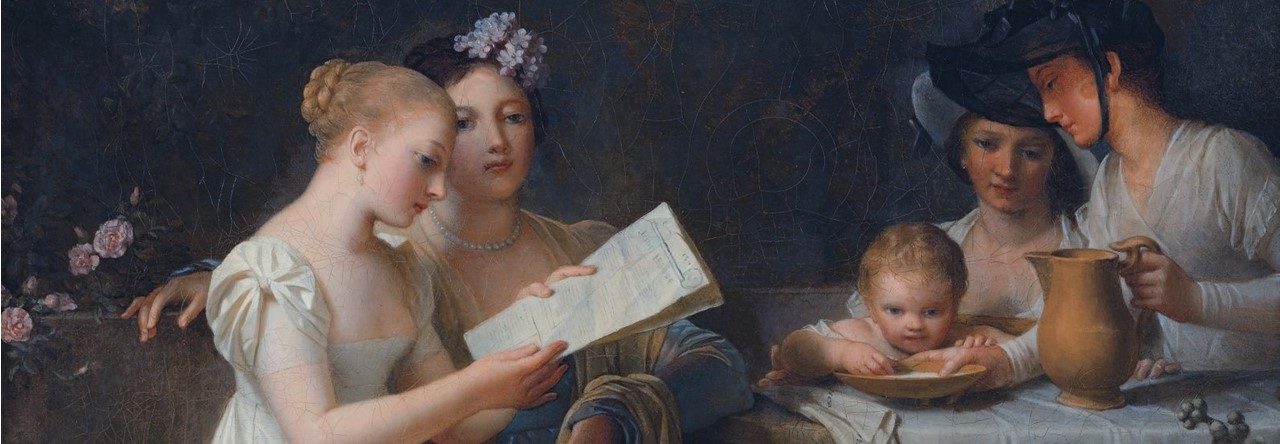
Woman Reading Book in Wooden Landscape Edouard Jean Conrad Hamman (Belgian, 1819–1888)
Editorial Note: This packet of correspondence came to the Tattler offices when one of our reporters shared drinks with a man at the Bull and Codfish pub. The young man, who seems to be a careless footman in the employ of Mrs. Andrew Mallet of Bedford Square, left it on the table. We of course forwarded the entire packet on to its correct destination.
Mr. Clemens made copies first, but given the involvement of
the Foreign Office, he declared they were not to be published. He must have
forgotten to lock his desk. Besides, nothing here relates to matters of
national interest.
To the Duchess of Sudbury,
Lily,I am in London, but not at home to callers, family excepted of course. Andrew remains in Cambridge, make of that what you will. When I tell you what has happened you will understand my need to live apart. I beg your support.
I know you send private mail to Richard via official couriers and the packet ships. May I ask you to send the enclosed message as soon as it can be arranged? I need his help and my son must be alerted. I trust him to inform his nephew cautiously.
Athena is gone to
Italy.
I know that shocks
you, but perhaps not is much as it ought. Since the Heyworths’ visit five years
ago she has spoken of nothing but Italy, reminding me daily that in Italy there
are medical schools that admit women. The desire to study medicine is
admirable; you and I would both cheer her on if the girl was, not to mince
words, normal. Even if she could cope with strangers…but of course she cannot.
She sailed from
Falmouth a week ago. Her brother Archie, who perpetrated this insanity,
accompanied her, which would be a saving grace if I thought he could handle her
in a crisis. Her father, the wretch, professes to be proud of him. For a
scholar Andrew can be remarkably obtuse. I can’t imagine how the poor girl
managed the ship to Rome, much less life in a foreign country. I dread the
condition we will find her in when she returns.
I discovered this
morning that Lochlin assisted Archie as well. I can forgive a young man— they
often think with body parts other than their brains—but I can’t forgive her
father. I suspect Andrew actually abetted the young fools. He denies it, but I
don’t believe him.
Enough! I will tell
you all when I see you.
Georgiana
Editorial Note: The young lady in question, Miss Catherine Mallet, known to her family as Athena, is a recluse who shuns society after some unfortunate incidents of panic and hysteria (this paper has reason to know one such incident occurred in the Pembrook’s ballroom). She rarely leaves the family home in Cambridge except to visit close relatives, and is reputed to have an unnatural interest in the anatomy of animals and humans. Rumors about this abound in that shire, where some consider her quite insane, but others merely the oddest member of a notably eccentric family.
The second missive, in the same hand, although entirely concerning a private matter, was sent through official channels to Cairo. One wonders if that is entirely ethical.
The Duke of Sudbury
Her Majesty’s Envoy to
the court of Muhammad Ali Pasha, Khedive of Egypt
Cairo
Dearest Richard,
Forgive me for presuming by sending personal mail through the foreign office channels, and troubling you when you are deep into affairs of state—although when are you not?—but time may be of the essence.
To get right to the
point, Archie has taken Athena to Rome from where she expects she can be
admitted to medical school. I don’t need to outline for you all the reasons why
this is nonsensical. Archie, the coward, sent a message from Falmouth saying
that once he had her safely settled (as if that might be possible!), he will
travel directly to Edinburgh and begin his own studies.
This will grieve
Aeneas mightily. He and Archie quarreled on the subject of Athena shortly
before he left for Egypt. Archie has the pudding-brained notion she should be
encouraged to pursue studies to be a physician. Aeneas, ever the level headed
one where his sister is concerned, knows she should be kept close where we can
protect her.
I send this in the hope that you will use your connections to ensure our officials in Italy watch out for them. If I can further impose on your kindness, please make Aeneas aware that this has happened. If it should go badly, he needs warning.
With gratitude,
Your loving sister,
Georgiana
PS
Since you have a way
of discovering things anyway, I will tell you that Andrew and I have separated
over this at least for now. Do not chastise me. I suspect Archie acted with his
father’s blessing. I am too angry to patch things over.
PPS
Aeneas may be sensible
about his sister but not his work. I count on you to keep him from doing
something foolish like plunging deep into Africa in pursuit of some previously
undiscovered crumb of knowledge. I want him back in one piece.
G.
Editorial Note: Our
readers who pay follow the doings of the haut ton know that there is little the
Duke will not manage on behalf of his family, his friends, or the Empire come
to that. They will note, however, how unusual it is to have a one of his circle
actually ask for help rather than having it thrust upon them.
About the Author
Caroline Warfield writes family centered historical romance, largely set in the Regency and Victorian eras. The saga of the Mallets, their friends, and their family began with Dangerous Works.
A
marquess who never loses control (until he does) and a very independent woman
conflict, until revolution, politics, and pirates force them to work together. (In
which Sudbury had not come into his title and was yet the Marquess of Glenaire)
When
Jamie fled to Rome to hide his shame he didn’t expect a vicar’s daughter and
her imp of a niece to take over his life, with complications from an
interfering nun, a powerful count, and a genial monk.
With
Christmas coming, can the Earl of Chadbourn repair his sister’s damaged estate,
and more damaged family? Dare he hope for love in the bargain? (A free
novella—prequel to both series)
The Children of Empire Series: the Scattered
Three
cousins (introduced in A Dangerous Nativity) torn apart by lies and deceit work
their way back home from the far corners of empire.
The Duke of Murnane expects work to heal him. He doesn’t expect to face his past and find his future in China (The heroine is Sudbury’s daughter)
The
Children of Empire Series: the Seekers
This series, expected in mid 2020 will pick up with the travels and adventures of Aeneas, Archie, and Athena Mallet as they pursue their own happiness.
From the journal of Sophie Hartford – the Tattler has received her PRIVATE Journal from Chateau de Fontanes, the Pyranees, 1818
Tuesday, 28th
April.
We returned to the chateau today. I was sorry to say goodbye to my friends in
Ax-les-Thermes but the marquise assures me we’ll go back there soon. For now,
we’re going to spend a quiet few days here in the mountains, and I’m going to
be watching my sister closely. I sense she’s attracted to Joachim. Indeed, who
wouldn’t be, so handsome and warmhearted as he is. With those big brown eyes
and that smile like sunshine, he’s most alluring. But Nell is Nell and she hides
her feelings behind a cool composure. On the other hand, Joachim is making it
plain he likes and admires her.
This afternoon we went down to the stables and the two of them started talking together. I may be four years younger than Nell, but I’m grown up enough to see that Joachim only had eyes for her. So I dawdled around, stroking my horse, petting the stable cat, and then sat down on a bench. Joachim’s lurcher dog, Flocon, came and sat by me. They didn’t notice they were alone as they wandered off down the paddock, talking all the time. At several points they stopped, I could see them waving their arms around as they discussed something. Surely they must be coming to an agreement. Indeed, all the stableboys and grooms found excuses to come out and watch them as well.
My romantic hopes were sadly dashed when
they returned, and I found they’d spent the entire time talking about educating
the poor children of the estate. But tomorrow is another day and I’ll think up
a scheme to bring them together. Why is my 22 year old sister resisting such
charm?
Wednesday
29th April. This morning Nell was in the music room, helping a
little boy with his lesson. I casually told Joachim of this and soon I saw him
rush along to the music room. The little boy came out, and I pretended to be
arranging flowers in a vase in the corridor, so as to keep an eye on the door, in
case anyone else tried to go in. Flocon has become attached to me and he sat
watching as I fiddled with the flowers. A rather long time went by and I began
to worry that our kind hostess might come in search of us. So I tiptoed up to
the door, which wasn’t quite shut.
The Chateau de Fontanes
Somehow I stifled a gasp on seeing them
locked in a very passionate embrace
on the windowseat. As I peeped, they
slid down until Joachim was lying almost on top of her. Oh, my stars! What
lightning progress from yesterday’s formal behaviour. But I had to stop them before
they forgot themselves utterly. Suddenly I had a brainwave. I nudged the door a
little further open and pushed Flocon into the room. He started barking and ran
to jump up at his master. I saw Joachim jerk his head up, so I pulled the door
shut again and fled.
This evening. At dinner I
was expecting an Announcement but they both behaved as usual. Such a
disappointment. And later, when we came up to go to bed, Nell didn’t say a word
about her relationship with Joachim. She’s being very sly but tomorrow I shall
tell her that I KNOW!
About the book: TheOutcasts
Joachim is the youngest of the three Montailhac brothers.
Always close to the land, he now manages his father’s estates and
livestock. Athletic and handsome, Joachim seems to have an
ideal existence. But he has a guilty secret and it suddenly reappears to
cause havoc. His life is further complicated by dealing with an accident at the
iron mine on the estate just as visitors arrive, bringing yet more problems.
Nell and Sophie Hartford are cousins of Joachim’s sister-in-law, Olivia [see Scandalous Lady]. In the Spring of 1818 they find themselves outcasts from their officer father’s home in Paris, and are forced to accept Olivia’s assurance that her mother-in-law, the Marquise de Fontanes, will make them welcome. After all, says Olivia, life in the family chateau in the Pyrenees will be a tonic for them. Two unhappy girls struggle to fit into the very different lifestyle of the large and slightly exotic Montailhac family. At the same time, danger threatens from a deranged criminal bent on vengeance against their hosts.
Read an excerpt from The Outcasts
Nell seemed to have grown even prettier while he was away. Joachim joined his family in the Assembly Rooms and gazed appreciatively at her while she exchanged greetings with several of her new friends. Her primrose yellow dress brought out the russet gleams in her hair. She looked elegant and appealing. Glancing towards his mother he found her watching him with a twinkle in her eyes. She raised an eyebrow and he stepped close.
‘Mother, you’ve wrought a miracle. When she first arrived, dressed all in grey, I called her ‘Miss Dismal’ to myself. Now, I wonder if even her own father would recognise her.’
The marquise squeezed his hand. ‘Poor girls. Cast out as they were, no wonder they were so dejected. It is a pleasure to see them thrive here.’ She smiled at the buzz of light hearted chatter coming from the group. ‘Now you can keep an eye on them. I want to talk to my friends for a while.’
‘Hey, Joachim,’ one of the young men greeted him with a horrified air, ‘Did you know what’s in store this evening? Old Deschamps is going to recite one of his endless poems.’
There was a general muttering and some groans.
Nell gave a choke of laughter and looked enquiringly at Joachim.
He crossed his eyes at her, which made her laugh aloud. He sobered suddenly, staring into her green-grey eyes. She really was lovely, especially with that wash of pink colouring her cheeks. He wanted to get her away from the others.
‘Do you play cards? Then we could escape to the card room.’
‘No, neither of us plays.’ She looked round for her sister, but Sophie had disappeared.
‘She doesn’t like poetry recitals, I take it?’ said Joachim, amused.
‘No, but this is rude. I must find her.’
‘I’ll come with you.’ They slipped off towards the other room. ‘Well,’ said Joachim, ‘it seems we don’t care for poetry recitals either.’
She gave him a glance full of mischief, and laughed again, making him want to get her right away from everyone. ‘Let’s hope we don’t find Sophie too quickly, then.’
However, ten minutes later, Sophie was nowhere to be seen and Nell was showing signs of alarm.
‘I’d better see if she’s returned to the recital,’ she decided. They stood in the doorway, peering in. The marquise saw them and beckoned. Nell went to her and sat down. The poet was in full flow, and Joachim shook his head at his mother, who shrugged. He turned back into the card room and came face to face with Sophie. She smiled naughtily.
‘I saw you looking for me,’ she told him. ‘Bertrand spotted me but he didn’t say anything.’
‘Bad girl.’
She tossed her head. ‘You had more fun looking for me with Nell than being bored to death in there. Let’s play cards.’ She spun away, towards a table at the back of the room, where Bertrand was shuffling a pack of cards. He rose to his feet and pulled out a chair. Sophie sat down, casting a look of triumph at Joachim.
‘Nell said you don’t play,’ he protested.
She bit her lip, looking shamefaced suddenly. ‘Not really,’ she mumbled, ‘but I can watch you.’
A few of the older players were casting disapproving looks their way, although there were other ladies in the room. It was simply that Sophie was so very young. His mother would give him an earful later but until the poet finished his recitation, they would stay here.
‘Vingt-et-un?’ suggested Bertrand, dealing. The luck went against him for several games. He slammed his cards down. ‘Let’s have a drink. It might turn the luck in my favour.’ He beckoned to a waiter and held up three fingers.
‘Have they still not finished next door?’ he asked. He smiled at Sophie. ‘There’ll be some folk-songs later. You’ll enjoy that.’
She agreed and glanced at the approaching waiter. She stared for a moment and gave a gasp of surprise.
Joachim heard her and looked up. It was that toothy lad, and something was wrong. He saw the boy’s face change as he looked at Sophie. He set the tray down awkwardly, keeping his head bent down.
Bertrand picked up a glass and offered it to Sophie.
‘Er, no, no, sir,’ spluttered the waiter, jerking his hand out, but Sophie had already raised the glass to her lips.
‘Don’t drink,’ said Joachim sharply. Too late.
She set the empty glass down and tossed her head. ‘I’m old enough to drink wine, you know.’ Then the blood drained from her face. She put a hand to her throat. ‘Aargh,’ she croaked.
Both young men were on their feet. Joachim seized Sophie by the arm. ‘Get Nell,’ he shot at Bertrand and pulling Sophie’s arm round his shoulders he half-walked, half-dragged her towards the back door, which was close by.
‘Open it, you,’ he panted.
The rabbit-toothed waiter darted to obey.
They barely made it outside before Sophie began to retch. Joachim pulled out his handkerchief and was turning to look for some water when something struck him on the back of his head. He saw a mighty flash of red and then nothing more.
About the Author
Beth Elliott
Beth Elliott loves speaking different languages and traveling to out of the way places. A Welsh mother and a Lancashire father mean she has a complicated mix of imagination and practical common sense. After a teaching career in several countries, she settled in the Thames Valley. Settled, that is, except when the traveling bug takes her. An excuse for this is that she has published a number of travel articles, and of course, she can use the settings for her novels.
Her Regency Tales are
stories of intrigue, adventure and romance, with a few real people in among the
cast of characters who find themselves caught up in events that rather upset
their normal lives. She hasn’t yet put Napoleon himself in a story, but he’s on
the waiting list. On the principle of ladies first, especially in the Regency
era, Lady Hester Stanhope played a small but vital role in ‘Scandalous Lady.’
From her own experience of life in Turkey, Beth likes to add a
touch of exotic to some of her stories. But adventure and romance can – and do
– occur just as easily in London, Bath or Brighton as in Constantinople.
For more information, visit her at the following links.
It will be no surprise to you that your grandson, Sir Perran Geoffrey, is once again featured in the street-corner scandal sheets such as that horrid Teatime Tattler. I realize that, living in Cornwall as you do, you like to believe that both situation and distance isolate you from scandal, but as your friend of some years, let me disabuse you of this notion.
It may give some in the drawing rooms of London comfort to think that, simply because the Countess Lieven and the other Patronesses have dubbed Sir Perran and his friends as the “Rogues of St. Just,” those gentlemen now possess the general approval of society.
Just this week I found myself in the position of having to explain to a social-climbing mama that this is not the case. You likely already know that dear Lady Mainwaring is sponsoring her Penrose nieces in their debuts this Season. I can see already that my work will be cut out for me in that quarter, since from your information, the young ladies are already acquainted with the Rogues.
This very evening, I am welcoming a number of select friends
and acquaintances for supper and dancing, and of course have sent Sir Perran
and his friends invitations. Part of the reason for my seeming inconsistency is
that suitable gentlemen are scarce upon the ground this Season. And part, of
course, is that he is your grandson, my dear friend, and I may have news of you
from him. While I myself have not witnessed any questionable behavior on his
part—he is always civil in his dealings with me—I am quite certain that he and
his friends alone could keep the scandalmongers scribbling all Season.
I beg you, dear Ghislaine, to write him a line or two and
urge him to curb his wild inclinations to drink, cards, and ladies such as the
Countess Eaton, with whom his name is linked. It will be difficult for him to
make a good match if he does not. No woman wishes to know for certain that she
is the consolation prize.
Your own,
Sally Pennington
About the Book
He is a penniless baronet. She is the wealthy great-granddaughter of a tradesman. Can these childhood friends find their way back to each other when scandal strikes them both?
Sir Perran Geoffrey needs a wealthy
bride to repair his family estate and to bring his sister out in Society. But
what woman with money and standing will accept him as a husband—practically
penniless, his title under a cloud thanks to his ne’er-do-well father, with an
estate far away in Cornwall?
Alwyn Penrose and her two sisters
are in London for their first Season. Imagine their surprise when they meet the
heirs of the neighboring estates—gentlemen whom they are barely allowed to
acknowledge. For to be seen with the Rogues of St. Just means the death of
one’s reputation.
Except that Alwyn is seen. More
than once. And the gossip spreads all the way to the sacred portals of
Almack’s, which close in her face and end her hopes for a good marriage
forever.
The ruin of her Season is Perran
Geoffrey’s fault. And when they are both forced to return to Cornwall, only one
thing is clear: One good ruination deserves another.
“Charlotte
Henry’s storytelling is nothing short of brilliant—Regency romance that will
sweep you away.” —Regina Scott
Excerpt from The Rogue to Ruin (Rogues of St. Just
#1) by Charlotte Henry
Hyde Park, London, Spring 1816
Sir Perran Geoffrey pulled up his
horse in such surprise that the sensitive animal danced in the path. “By Jove,”
he exclaimed, “isn’t that the Penrose sisters there, coming in at Lancaster
Gate?”
Captain Griffin Teague, formerly
commander of the sloop of war Artemis,
craned his neck, causing his own horse to sidestep. “Easy, boy.” He patted its
withers. “Where? On a fine day in London there are a thousand young ladies
parading about Hyde Park—how is one to tell one lot from another?”
“There.” Perran inclined his head
three degrees to the northwest. “The landau drawn by the pretty matched bays.
It is certainly the Penrose girls from home—bonnets or not, I recognize their
mother’s nose.”
“There you would be mistaken, old
man,” said the third member of their party. Jago Tremayne had probably never
mistaken a lady in his life. Or a bird, or the contents of a letter, or a hand
of cards. His memory was prodigious—as was his entirely undeserved reputation
as a flirt. “Mrs. Penrose died a handful of years ago. That, I suspect, is her
sister, Lady Mainwaring.”
“Help us.” Griffin did not quite
implore the skies for mercy, but he came close. “Have they come up to London
for the Season?”
There was only one answer. Of
course they had. “You know perfectly well we cannot renew the acquaintance.”
Perran spurred his horse down another path toward the Long Water. “Come!”
“Hold up—we cannot escape it now.”
Griffin raised a hand to stop him. “We have been spotted.”
“So? Better to cut a young lady
than ruin her.”
About the Author
Charlotte Henry is the author of 24 novels published by
Harlequin, Warner, and Hachette, and a dozen more published by Moonshell Books,
Inc., her own independent press. As Charlotte, she writes the Rogues of St.
Just series of classic Regency romances. As Shelley Adina, she writes steampunk
adventure, and as Adina Senft, writes Amish women’s fiction. She holds an MFA
in Writing Popular Fiction, and is currently at work on a PhD in Creative
Writing at Lancaster University in the UK. She won the Romance Writers of
America RITA Award® for Best Inspirational Novel in 2005, and was a finalist in
2006. When she’s not writing, you can find Charlotte sewing historical dresses,
traveling for research, reading, or enjoying the garden with her flock of rescued
chickens.
My first mission, as commissioned by, King Charles II, sounded simpler than the genuine affair. I wasn’t prepared to put my life in the hands of dastardly expatriates. While I was escorted by two fully armed compatriots they were of little assistance when establishing intimacy in the name of the crown. I had been given the directive to entreat William Scot, a rogue Englishman, to infiltrate the Belgium political corridors and report his discoveries to the King Charles II. In essence, I was to make a double agent of the man. It was with this request and whisper of a financial benefit that I should employ all my feminine wiles to subdue him into submission. I being in all ways, aligned with the King of England and a true patriot, never mind that I was broke, I took my task with fervor, as you are about to see.
It
was a lengthy journey and I had traveled by coach, horseback, and sea, with my
two fellow compatriots in search of William Scot. As I’m sure you can imagine, it
was an exhaustive journey to say the least. While we were subject to every ill
met experience of, sea sickness, fatigue, soured food, and dehydration, nothing
prepared us for the alehouse wherein we would find Scot.
I was told by King Charles II himself, that the likes of William Scot, would be found in Bruges, Belgium. Probably, in a pub, down by the river, where singing and lascivious dancing is practiced. Indeed it was true. The stench of spilled ale, over burnt meat, and bodily oils wafted through ale house as I entered. Immediately, I pulled a scented kerchief to my nose but the overripe smells of the alehouse drained all perfume from my nosegay.
Coughing and sputtering in the stale rancid air I unwittingly drew attention to myself and my companions. Since it was not customary, in Bruges, for reputable women to visit alehouses I garnered the attention of every patron in the building. The dancers stopped in misstep and the singers held their tongue in surprise.
A
stinging silence befell the room and I was at a loss to comprehend which of
these drunken lords was William Scot. My two companions were silenced to the
bone and I was left to my wits and my good graces to scrutinize the crowd of
twenty-five, thirty, or possibly fifty inebriated men.
You
understand my predicament, I’m sure. But I took the moment at hand and stood
tall enough to see the entire room. I spoke gently and I admit only batted my
eye’s just enough to get the gentlemen’s attention. I cleared my throat so my
best voice would rise to the occasion. I began.
“Dear
Sir’s,” was all I managed until the room broke out in loud jags of laughter and
hoots of folly. I was startled to the point of laughing myself.
“Ain’t
none of Sir’s, woman,” one man shouted above the din.
Understanding
my idiocy I made a second plea once the room had started to silence again.
“I
am in search of William Scot, might any of you know his whereabouts?” I said.
Silence again fill the alehouse. A man moved forward toward me, slowly and
distinctly. I admit until this time I had not ever considered that William Scot
would be as handsome as the ocean is wide. In an effort to maintain my
constancy, I once again pulled my kerchief to my mouth and batted my eyes. I
can assure you it was not to entreat him so much as it was to calm my own
nerves.
As
he approached me, I could feel my composure slip.
“Who
is it, that’s asking for my attention and why?” he asked, expressing a devilish
grin.
I
couldn’t lie at this point, but my intelligence reminds me that saying too much
in front of this crowd may lead me down the wrong path.
“I
come bearing news of a private nature, my good sir, and if we have a place to
talk then I can express more fully my duty to you,” I said with a slight bend
and upward glance.
It
wasn’t a moment before the room was again filled with hoots, whistles, and
howls of laughter. With a deep breath Scot, held out his arm, and in the most
courtly fashion ever displayed. I took his arm and we walked out of the
alehouse and embarked on the path by the river. We were followed at some
distance, by my two silent companions.
“Now,
M’Lady, what news do you bring to me?”
I
had to take a moment to clear my head and find the words to entreat him to our
political ends.
“”M’Lady,
your taking so long to tell me of your plans, I’m afraid I’m under arrest,” he
said with his broad smile.
“I
am waiting sire, until we are out of earshot of the crowd, this business I have
for you is delicate and not meant for all,” I said and couldn’t help but grin.
“Oh,
if it’s that important, then your appealing to a man who is half drunk. Are you
sure this will get the answer you seek?”
I
looked up at him, “We’ll then, I’ll only make my appeal to the sober half of
you, if you’re inclined to listen,” I said stopping on the path.
“With
a wit like yours I’ll happily listen to your plea. But understand, I’m not the
kind to easily sway my beliefs even for the prettiest of maids,” he said.
“Oh
dear, it’s been a number of years since I’ve been a maid, your kindness is
treasured. But, I have something of a delicate nature to put to you and need
your full attention,” I said.
“More
delicate than your neck,” he said reaching and touching her just below her
right ear.
His
touch was more seductive than anticipated and I felt a ripple of heat run the
entire length of my body. When I collected myself to the point I could speak he
outmaneuvered me again.
“Or
is it a subject more delicate than your sweet blushing cheek?” he said and this
time ran the back of his hand over my cheek and I could not stop the rising and
falling of my breasts.
“Or
maybe it’s the fine china of your décolleté
that is the delicate subject upon which you wish to speak,” he said
touching my cleavage in the most tempting way. By now, as you can assume I was
all a flutter. Hardly able to gasp a breath I was astonished at his boldness
and yet, I could see swaying him politically might be simpler than I had
assumed.
“Sire,
it is my rouged lips that bring you news directly from King Charles II,
himself.
Upon
hearing the news that the King had directly sent me on this errand he backed
away in suspicion.
“That
is a high honor indeed, and here I am thinking you were here to empty my pockets
with your feminine charms. Tell me more,” he said.
“It
is a high honor he would like to bestow upon you, Sire Scot. I am humbled to
bring a request from the King, that you might, sway your intellectual ideals to
include the Crown,” I said and waited a moment for him to respond. He was only
still and quiet.
“His
Highness, has requested to entreat you to bring news of Belgium to Britain,” I
said with more misplaced enthusiasm than intended.
“What
is your name?”
“Dear
Astrea, does your Highness have such a short memory? The Crown had sentenced my
father to death only one year ago. Now they ask for my allegiance?” he said in
such a harsh tone it was difficult to hear.
“ I am Astrea,” I said hoping to regain my station.
“That was a matter most regretful. The Crown was only protecting the King, after all your father, good sir, had planned to murder his Highness in the dead of night. Retribution is customary in a case such as that,” I said.
He
stood ponderously looking out at the passing river then turned slowing to face
me with eye’s glowing like embers from a fire and he spoke his final words. “If
the King could see his way to pardon my father and rename the misdemeanor, then
I would consider aligning with the crown once again, but never until the King
honors my father. Upon this, I am settled.” He said and walked away.
At this point, I could tell my duties were going to be considerably more difficult than I first understood.
About the Story and the Author
This memoir is based on a fictitious conversation between Aphra Behn and William Scot. Aphra Behn, when she was actually working as a spy for King Charles II went by the name, Astrea, as listed in the story. It is believed she is the first woman to make her living as a writer, as a playwright and novelist. Prior to taking up the pen, she worked as a spy for the King Charles II, among other things. The portrait above is Aphra Behn, painted by Mary Beale (1639-1699).
Daphne Masque writes contemporary romance set in the theatre. Currently she’s giving away an Autographed copy of Haunting Indiscretions, the second book in her series, “Romance at the Empire Theatre”. She plans to begin writing historical fiction.
Daphne has spent a good number of years acting, directing, teaching and writing for the theatre. And she loves romance, what better way to combine her two passions. To signup for her newsletter go to http://www.daphnemasque.com/contest/