A Lady Correspondent had not intended to eavesdrop. Truly. She was just sitting in an alcove catching her breath and, it must be admitted, admiring the two Grenford brothers who were leaning on a pillar just in front of her. She could not help but see Miss de C accost them. She could not help but overhear all that transpired. At one point, she nearly spoke up, as horrified as the target of the brothers’ focused attention, but no. Surely Miss de C would be most embarrassed to know anyone else had witnessed her humiliation. She sank back into the shadows. But was she not planning to write the story for the Teatime Tattler? No. No she was not. However she disguised the name and circumstances, everyone here tonight would recognize the event to which she referred. The brothers had been careful of the silly girl’s reputation. She could not destroy it.
Miss Miranda de Courtenay took one last look into the mirror, adjusted her domino mask, and left her room. There was no turning back now. Her mind made up, she prayed her brother Adrian would not remove her from the ball the moment he set eyes upon her scandalous costume of a Greek goddess. If she were to win her bet with her sister Grace, she needed to make an impression on the man whom she had chosen as her target. She had no desire to lose that wonderful bonnet her brother had brought her from Paris and she already looked forward to winning the bottle of perfume from her sister.
Entering the ballroom, she had a moment of hesitation as her eyes quickly scanned the occupants of the already overflowing room. She took a deep breath, wondering if she could truly pull off an outside appearance of confidence when deep inside she was a nervous wreck. I can do this and must remember my purpose, she thought, whilst her gaze continued to flit across the crowd. Ah ha! There he is. There was no mistaking the handsome form of none other than the Marquis of Aldridge, along with his brother, the equally devastating Lord Jonathan. ‘Gren’, he had asked her to call him, and surely such an intimacy must mean he intended to propose?

She shrugged. Either man would do. She pushed back her shoulders and began advancing toward the two gentlemen, one of whom was leaning upon a pillar looking utterly divine. Neither man had a costume other than their evening attire and the masks placed upon their handsome faces; one white, the other black. Perhaps this is what set these two gentlemen apart from any other within the room, for they needed no other enhancement to draw attention to themselves. She had chosen wisely when she set her cap. Inwardly she sighed, wondering how she would feel once she actually received a proposal of marriage from the man known as the Merry Marquis.
Grace’s warning that she should stay far away from this man in particular flashed through her mind, but she ignored it. She dropped down into a proper curtsey, hoping against hope that the men found her attractive as she knew she appeared.
“Good evening, my lords,” she purred. “Were you perhaps looking for me?” She was unprepared for the smile that made her insides churn in a wave of nervous jitters. Being on the receiving end of the Marquis’s charm was deeply disturbing.
 His voice was pitched to carry just as far as her ears. “Why, Miss de Courtenay, how delightful you look. Aphrodite herself come to enthrall us with her beauty.”
Her cheeks flushed with heat causing her to question her own stupidity for wearing such a daring gown. But it obviously had the desired effect and could only serve as one step closer to winning her bet. “You are too kind, my lord,” she said offering her hand.
Gren leaned forward to whisper in her ear. “What a charming blush. I would love to see how much of you it covers, my dear.”
A gasp escaped her. How could it not? For all she pretended to act as if she knew all there was to know about men, she was an innocent at only twenty years of age. Miranda instantly became aware that Grace may have been correct when she warned her about this pair. She could feel the warmth of the man’s breath as he lingered near her ear.
She glanced down at her gown and was shocked at how much of her cleavage was there for his viewing pleasure since he towered above her. Good heavens, she really was a fool to have chosen this costume but the die was cast and she had no one else to pursue in her attempts to win what she was now thinking a silly and foolish bet.
Raising her chin, she took hold of her fan and playfully slapped the gentleman’s arm. “My you are a bold one, are you not?” she teased, all the while wondering how she was going to get herself out of this mess she was in and still save face with her sister.
“As are you, my sweet,” Gren said. “And I admire boldness. Do not you, Aldridge?”
“Indeed. Boldness in a woman is highly desirable,” Aldridge agreed, his lids half closed, his voice husky. “Exactly how bold is she, Gren, do you think?”
Miranda glanced between the pair. This was not exactly how she thought this conversation would be leading. Perhaps, if she could just get the marquis alone for a moment, she might still be able to get him to offer for her. Surely he would be swept away by her beauty and propose on bended knee in no time at all.
She turned her full attention to the gentleman, all but ignoring his brother. Rude, perhaps, but this was a matter of grave importance. “My Lord Aldridge, perhaps you could spare me a moment to have a private word with you, just there, by the alcove?”
“Oh no, my dear,” Aldridge said, lifting one aristocratic eyebrow over twinkling eyes. “We must be more careful of your reputation. I would not for the world risk your good name ─ or your brother’s good health.”
“Fie, Aldridge,” Gren scolded. “How would the child know the way these things are done? She is very young still.”
“It will be my pleasure to school her,” Aldridge murmured, his words for his brother, but his eyes captivating Miranda’s and not letting them go. “Very much my pleasure. And hers, too, of course.”
Eyes wide and turning scarlet, she could barely breathe at the implication of his words. Right here, of all places, on the sideline of the ballroom for any and all to hear. Good heavens!
“My Lord, I─” Her lips snapped shut. Any further response was beyond her, as she felt, not just Aldridge, but his brother as well step closer, one to each side of her. When had this situation become completely out of her control?
 “But you will share, Aldridge, will you not?” Gren asked. “After all, Miss de Courtenay’s lures have been as much for me as for you. And we have shared a mistress before”
Aldridge nodded. “It is only fair to the lady. The duties of the duchy will prevent me from giving her the devoted attention I used to be able to pay my lovers.”
Miranda’s head swiveled between the pair of brothers. She opened and closed her mouth several times before she was at last able to squeak out some form of a response. “Sh-share?” she stammered. Her hand rose to her throat as if that would cover her embarrassment and heaving bosom.
“I assure you, good sirs, that I am not yours to be,” she quickly looked around so she was not overheard and whispered, “shared between you.”
“Aldridge has grown stuffy,” Gren assured her. “If you were our mistress, my love, I would make sure you never felt neglected.”
“Mistress? Between you?” she cried out in alarm. All thought of trying to squeeze a marriage proposal out of either man was gone as she tried to wrap her thoughts around their outrageous proposition.
Both men frowned, straight eyebrows drawn down over identical hazel eyes. “You would prefer just one of us?” Aldridge asked.
“I suppose that’s fair,” Gren said to his brother. “I dare say she is still an innocent, despite the way she has been pursuing us. She might struggle to meet the needs of us both.” He turned back to the gasping maiden. “You choose then, Miss de Courtenay. Whose mistress would you like to be?”
“I will not be any man’s mistress but a wife,” she huffed, stamping her foot as though that would drive her point home. She looked between the pair and still could not believe they would offer such a proposition as to actually be their mistress. What a fool she had been!
“Grace was right about you,” she whispered gazing directly at Aldridge, as if he were the root of all her problems. She hated to admit she had knowingly brought this whole ghastly situation upon herself with her own sense of arrogance and pride. Humiliation consumed her even as tears welled up in her eyes, both from embarrassment and frustration that she had lost the stupid bet with her sister. At least she still had her virginity intact. God help her if she stayed any longer with this dangerous pair before her.
With tears rushing down her face, she mumbled an apology and dashed from the room, barely even acknowledging Grace when she entered the ballroom. She would have been appalled if she had witnessed her sister’s silent toast with her glass of wine to the gentlemen she had just left.

Aldridge and Gren returned Grace’s salute with a nod and a smile, but Gren’s eyes are clouded. “Poor innocent,” he commented. “I didn’t expect it to upset her so much.”
Aldridge pursed his lips. “She might act like a vixen on the hunt, but she is no more than a foolish kitten. Our agreement with her sister had us honour-bound to offend but not injure.”
Gren grinned. “I kept to my lines, Mr. Propriety. The frown returned to crease his brow. “But I am sorry for the silly chit.”
“Better hurt feelings and pride than ruination,” Aldridge said. “If she’d tried her tricks in London some rogue would have had her out in the garden or off in some secluded library before her brother or sister knew she was on the loose. Yes, and flat on her back with her skirts up whether she wanted or not, with some of the people you and I both know. We have done her a favour, Gren.”
“We’ve won Grace her bet, that’s certain,” Gren concedes. “Though I imagine she is happier to have her sister safe than whatever fribbet they wagered.”
Mission accomplished, the two brothers begin to move through the ballroom, still talking. They were sons of the hostess, and Mama would expect them to mingle.
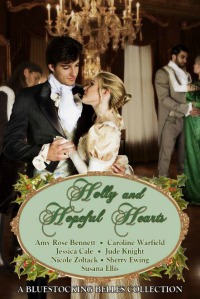
ABOUT HOLLY AND HOPEFUL HEARTS
When the Duchess of Haverford sends out invitations to a Yuletide house party and a New Year’s Eve ball at her country estate, Hollystone Hall, those who respond know that Her Grace intends to raise money for her favorite cause and promote whatever marriages she can. Eight assorted heroes and heroines set out with their pocketbooks firmly clutched and hearts in protective custody. Or are they?
Holly and Hopeful Hearts is a Bluestocking Belles Collection is on sale now through December for $0.99.
25% of the sales benefit the Belles’ mutual charity the Malala Fund!
Buy Links:
Amazon US | Nook | iBooks | Kobo | Smashwords
Amazon AU | Amazon CA | Amazon UK
This is an original piece by Bluestocking Belles Sherry Ewing and Jude Knight.
Miranda and the Grenford brothers can be found as secondary characters in the Bluestocking Belles’ 2016 holiday box set entitled, Holly and Hopeful Hearts. Miranda, in particular, is in A Kiss for Charity by Sherry Ewing. Aldridge and Gren are interwoven in several of the novellas and are written by Jude Knight. They also appear in Jude’s latest release, Revealed in Mist. You can learn more about Jude and Sherry and where to find their published work by clicking on their names on this website.


 Becky is the envy of the courtesans of the demi-monde – the indulged Rose of Frampton, mistress of the wealthy and charismatic Marquis of Aldridge. But she dreams of a normal life; one in which her daughter can have a future that does not depend on beauty, sex, and the whims of a man.


 Ella survived an abusive and philandering husband, in-laws who hate her, and public scorn. But she’s not sure she will survive love. It is too late to guard her heart from the man forced to pretend he has married such a disreputable widow, but at least she will not burden him with feelings he can never return.
 Dear Editor
 I speak, Sir, about the recent Whitsunweek Assembly at Chipping Niddwick. The committee who organised the event did us proud. Imagine the delight of our young ladies when not one by two earls attended the affair, both single gentlemen. A baron and viscount were also in attendance, with their respective wives. Such illustrious company for a small country town.
 The other earl. Lord Chby. returned from Canada claiming to be a widower, though rumour has it that his first wife, if the union was in fact blessed by the church, was a native woman. Fortunately for his esteemed name and title, the woman died several years agoand her brats with her.
 Finally, a cousin of Lord Chby. caused a stir in an invalid’s chair, and inadvertently uncovered the clay feet of the last of our cast of peers. Major A. R., injured in the line of duty, was not content to merely watch the dancing from the sidelines, but insisted on joining in. When his chair collapsed under the unaccustomed exertion of the dance, its maker proclaimed herself. Imagine our shock when we discovered she was none other that Lady A., viscountess of Lord A.

 Sebastian Beringer covered his notes with one arm, trying to do so in a way that would not draw fire from his angry employer. If need be, he would claim he was writing a love letter. The Merry Marquis, whose love affairs were legendary, would surely not snoop further.
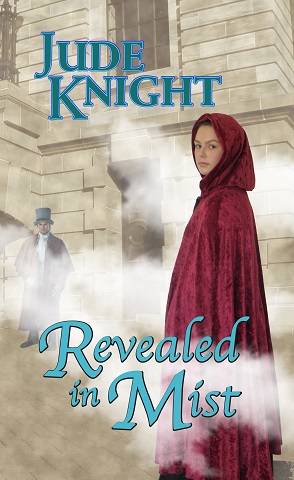 Prue’s job is to uncover secrets, but she hides a few of her own. When she is framed for murder and cast into Newgate, her one-time lover comes to her rescue. Will revealing what she knows help in their hunt for blackmailers, traitors, and murderers? Or threaten all she holds dear?