 The Season is off to an excellent, if early, start. Lady S., daughter-in-law of the Duke of W. must be delighted with the attendance at her soirée, though perhaps less than pleased with the behaviour of some.
While this year’s crop of debutantes has not yet been served up to the marriage mart, those remaining from previous seasons were in eager attendance, every mother hoping to steal a march on all the others in attracting the attention of wealthy or titled bachelors or widowers with a mind to wed, while avoiding fortune hunters and those with more sinister intentions.
In corners of the main reception rooms, the powerful decided the disposition of whatever pawns they controlled: brokering treaties between nations, political parties, trading enterprises, families, or potential marriage partners, depending on the interests of the negotiating parties.
 But the affairs of the great are far from the only business conducted at such an event, and last night was no exception.
In rooms set up for the purpose, gentlemen and ladies with a yen for such things offered up the evening to fate represented by the turn of a card.
In the ballroom, fashionable gentlemen eyed one another in the endless struggle for elevation in the eyes of those they are pleased to call friends, while those more given to energetic pursuits danced or stood in small groups discussing horses or hunting or pugilistic exploits.
Ladies spoke sweet flatteries to one another’s faces and shredded appearances and reputations behind one another’s backs. Maidens sought husbands, wives sought lovers, poor widows sought protectors, and wealthy widows amusement. Everywhere, couples—as they have since the beginning of time—bargained for affection: temporary or bound by vows before a cleric; some under the eyes of stern chaperones and others in less well-lit corners on the dance floor or the chilly terrace.
In small darkened rooms throughout the mansion, those desiring a tryst found a few moments of privacy. Among them, we are assured, was Lord S. himself and also his son, Lord E., who was seen to absent himself from public places on two separate occasions, each time with a different companion.
Our informants also observed Lady G., the duke’s spinster daughter, meeting with a much younger man who is believed to have been Mr. W., widely rumoured to be the unclaimed and unwanted base-born son of the Duke of H.
One can hardly imagine that a lady of such pristine reputation would be indulging in an amorous encounter, but that leaves only the possibility that she is employing Mr. W. in his capacity of thief-taker. Has her ladyship lost a valuable item, perhaps? Is she acting on behalf of Lady S. to investigate the activities of her brother or nephew? Or both? We will watch developments and keep you informed.
As if that were not enough, Mr. W. and an unidentified woman, possibly one of the army of companions in attendance on various matrons, were involved in the most shocking event of the evening. They combined to effect a rescue of a foolish damsel who allowed herself to be enviegled into one of the aforementioned private rooms.
 One would expect a maiden in her second season to show more sense than to respond to a note from a man, and certainly the girl’s protectors to display more awareness of their charge’s whereabouts. Was the title ‘Earl’ a lure that caused her and her chaperone to cast discretion and rational thought to the wind?
We could have advised the young lady that this particular earl has been known to ruin and abandon foolish young women who go apart in his company. His recent ascent to the title on his father’s death has clearly not changed his character.
Fortunately for the damsel, the man (we hesitate to call him a gentleman) was interrupted in his evil pursuit, and she was delivered intact, having had a salutary scare, to Lady G., a well-known defender of the innocent. And her own family name and fortune mean that any sanctions against her from the arbiters of social standing will be mild.
As for the Earl in question, we are assured that he has been banned from ever entering the household again. And where Lady S. leads can other hostesses be slow to follow?
Yes, the Season is off to an exciting start indeed!

The Sutton soirée is the scene of the first chapter in Jude’s new historical mystery, Revealed in Mist, currently available on pre-order and to be released early in December. Mr. W. and the unnamed companion appeared in The Prisoners of Wyvern Castle, a novella in Hand-Turned Tales, as the rescuers of the blind earl and his countess who were the hero and heroine of that novella. You may also have met them (as David Wakefield and his mysterious woman partner) investigating a crime for the hero of Farewell to Kindness.
Their pasts could bring them together or separate them forever
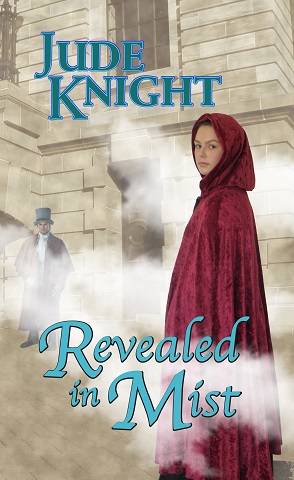 Prue’s job is to uncover secrets, but she hides a few of her own. When she is framed for murder and cast into Newgate, her one-time lover comes to her rescue. Will revealing what she knows help in their hunt for blackmailers, traitors, and murderers? Or threaten all she holds dear?
Enquiry agent David solves problems for the ton, but will never be one of them. When his latest case includes his legitimate half-brothers as well as the woman who left him months ago, he finds the past and the circumstances of his birth difficult to ignore. Danger to Prue makes it impossible.
Revealed in Mist is on pre-order at most eretailers. Sadly, not on Amazon, since Jude is in Amazon jail for getting the final version of Gingerbread Bride to them two days late, only eight days before release. Circumstances beyond Jude’s control doesn’t cut it with the Amazon guards, so no pre-order. But if you want the book in Kindle format, pre-order from Smashwords, iBooks, or Barnes and Noble, or follow Jude on Amazon for an email the day the book goes live.
Smashwords * iBooks * Barnes and Noble * Follow me on Amazon
About Jude Knight
Jude Knight’s writing goal is to transport readers to another time, another place, where they can enjoy adventure and romance, thrill to trials and challenges, uncover secrets and solve mysteries, delight in a happy ending, and return from their virtual holiday refreshed and ready for anything.
Website and blog * Facebook * Twitter * Pinterest * Email
 The boy was gone when I got back from the funeral. Little bastard. I told him I’d kick him to next Tuesday if dinner wasn’t on the table, but nothing was prepared, and he was nowhere to be found. And he’d let the fire go out. He’ll come back when he’s hungry, and I’ll have the skin off his back, see if I don’t.
 We didn’t find the lad till we was near Avonmouth. ‘E was hid in the coal, but we saw ‘im when ‘e tried to escape over the side. ‘E fair wriggled when we caught ‘im, begged us to let ‘im go. But ‘e owed us ‘is passage, and so I told him.
 He was a mystery, young David. Turned up in a snow storm, he did. Bessie the dog found him when Matthew went out after the sheep, huddled up in the midst of the flock where they’d taken shelter in the lee of the old stone wall.
 My tiger? He’s taken off. Ungrateful brat. Good boy with the horses, too. But there you go. That’s what I get for taking a boy off the streets. I found him in Oxford, you know. Oh yes, I told you before, didn’t I. He made sure I got back to my inn after a rather exciting evening. Didn’t rob me, either, though he could have. I was somewhat—er—elevated.
 Last time spy Prudence Virtue and thief-taker David Wakefield worked together on a case, they parted in bitterness. When different employers send them to investigate a spying ring that blackmails aristocrats for access to secrets, they need to decide whether to combine forces.
 Honoured Sir
 This vignette precedes the events in Magnus and the Christmas Angel by six months. Magnus and the Christmas Angel is a short story that tells about the final reconciliation of Magnus and his wife, after months of misunderstanding.