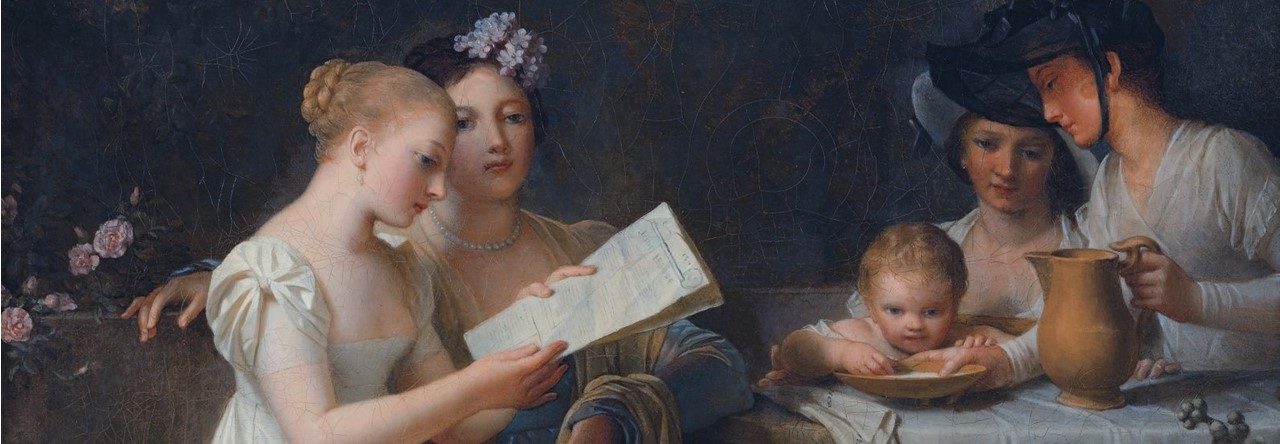

English Drawing Room of the Georgian Period, 1800. Art Institute of Chicago.
London, 1815
One would think that finding and keeping a governess would not be a difficult thing, but apparently it is for Lord Preston Ambrose, Viscount Melcombe. He has had three in less than a year but is hopeful that the fourth will prove to be suitable for his household and settle in nicely to guide his nieces for the next few years.
 The trouble with governesses started last spring when Lord Melcombe became the guardian of his five nieces, ages five to fourteen. They’d had a governess at the time, but she was sacked and we’ve yet to discover why.
Once the former governess had departed, Melcombe made no effort in finding a replacement, though he knew that he should. Then, one bright winter day, Miss Althea Claywell stepped off the mail coach. Melcombe was also aware that she was running and offered her the position within his household, which she gladly accepted.
All worked out well, until the two fell in love and married. Thus, Melcombe was in need of a governess again. This time he placed an advertisement, and was hopeful when the perfect candidate replied, a Miss Katrina Carrick. In fact, he and Lady Melcombe were quite pleased with the interview, and Miss Carrick was hired. But, before she could begin her duties, love arrived to claim her.
Lord Melcombe has now contacted an employment agency and is hopeful that the woman scheduled to arrive for an interview will be the fourth and final governess to be employed for some time. However, if that does not turn out to be the case, I might suggest that any miss wishing to wed become a governess in Viscount Melcombe’s home. No doubt, you will barely be unpacked before the love you have been waiting for finds you.
LINKS FOR THE LOVE OF A GOVERNESS SERIES: https://www.amazon.com/gp/product/B09R26VG3L/
RELEASE DATE OF PURSUING THE GOVERNESS: April 26, 2022
EXCERPT from PURSUING THE GOVERNESS:
Regina started at the pounding on her door and stepped away.
“Regina, open this door.”
All hope of Alec thinking she was someone else fled. Or, had Lord and Lady Melcombe broken their promise and confirmed her identity?
“Open the door, Regina,” he called again.
If she remained silent, perhaps he would think she was somewhere else and go away.
“The girls told me you are in here,” he said.
She still didn’t move or answer him. It wasn’t as if he could do anything if she refused to unlock her door.
There was a sudden thud against her door and then it splintered, flying open. Regina quickly turned her back on him.
“I know it is you, Regina,” he said. “I simply wish to know why you have let me believe you were dead for a year.”
She bit her lip, not certain what to say.
“Please,” he begged in a softer tone. “Why won’t you look at me?
Tears sprang to her eyes. He couldn’t see her.
“Why?” he asked.
“It is for the best,” she finally answered.
“Best!” he yelled. “I loved you. Was in love with you. Do you know I wanted to die when I learned what happened?”
“I am sorry,” she whispered. What more could she say?
“Sorry?” he asked. “That is all you have to say! I thought you loved me as much as I loved you.”
Oh, she did. She still did. Even though Regina Rutledge died, her love for Alec had not. But she needed him to go away. “What we had is over. Please go.”
“That’s it? You are rejecting me without an explanation? One day you’re across my lap you cry out my name, and now you want nothing to do with me.”
“Please lower your voice. The girls will hear you.” She didn’t care what he thought of her, but her charges did not need to hear such talk.
“I now understand how misses and ladies feel after they have been ruined and discarded.”
Pain and anger merged within his tone, but Regina held her tongue. It was best for both of them if he hated her.
“At least face me while rejecting me after everything we shared.”
“I cannot. It’s best that you go.”
“Cannot, or will not?”
“Both.”
“If you want me to go, then you need to turn around and tell me. Swear that what we shared meant nothing to you.”
Regina had been dreading this moment, and hoped the day would never come, but Alec was going to be stubborn.
She took a deep breath and slowly turned around.
ABOUT THE AUTHOR
 USA Today bestselling author Jane Charles is a prolific writer of over fifty historical and contemporary romance novels. Her love of research lends authenticity to her Regency romances, and her experience directing theatre productions helps her craft beautiful, touching stories that tug at the heartstrings. Jane is an upbeat and positive author dedicated to giving her characters happy-ever-afters and leaving the readers satisfied at the end of an emotional journey. Lifelong Cubs fan, world traveler and mother of three amazing children, Jane lives in Central Illinois with her husband, two dogs and a cat. She is currently writing her next book and planning her dream trip to England. Be sure to join Jane on Facebook @JaneCharlesAuthor for Wine Pairings Wednesdays.
FOLLOW JANE:
Website: https://www.janecharlesauthor.com/
Facebook: https://www.facebook.com/JaneCharlesAuthor
Goodreads: https://www.goodreads.com/author/show/4879172.Jane_Charles
Bookbub: https://www.bookbub.com/authors/jane-charles
Jane’s Reader Group – Romance & Rosé: https://www.facebook.com/groups/778180209460172
 Composer and pianist John Sutton has been taking European audiences by storm for years, and we are thrilled that he is to make his British debut here in York. We are assured this will be a delight not only to music lovers, but to the ladies in general, for Mr. Sutton is rumoured to be most handsome and gentlemanly. But are we imagining the mystery surrounding Mr. Sutton? Why is he so famous in Europe, while in his home country, we have yet to hear him play a note? We await sight and sound of the great man with bated breath!
 After years of tolerating her late husband’s rowdy friends, Honoria, Lady Twisden, has escaped to York where she can paint, investigate antiquities, and enjoy freedom. Then her stepson appears with a long-lost relation in tow, the perfect image of a long-ago relation whose fierce portrait made her shiver with mad imaginings.
 ‘Tis a question we shall be pondering as we wait with bated breath to see what the earl will do in reply. After all, the gentleman is not known as a man who gives up easily, in fact his tenacity is both admired and to be feared. The lady would do well to be cautious, very cautious, indeed. Though we’ve heard rumors that this particular lady in question is unlike other ladies; apparently, she prefers to she throw daggers, not dinner parties…. How delightfully wicked!
 The Duke of G__ arrived in town this week with a highly irregular guest. A Mr. K_, a Welshman with three children stays at the duke’s elegant townhouse where he is being treated almost, dare we say it, as family. Our usual sources—servants do talk, especially when in their cups at certain taverns—imply the men act like brothers.
 Madelyn assumed marriage as an old man’s ornament would be better than life with her abusive parents. She was wrong.
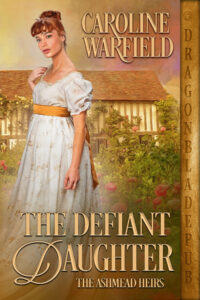
 When the old Earl of Clarion leaves a will with bequests for all his children, legitimate and not, listing each and their mothers by name, he complicated the lives of many in the village of Ashmead. One was his defiant daughter. He left her nothing.