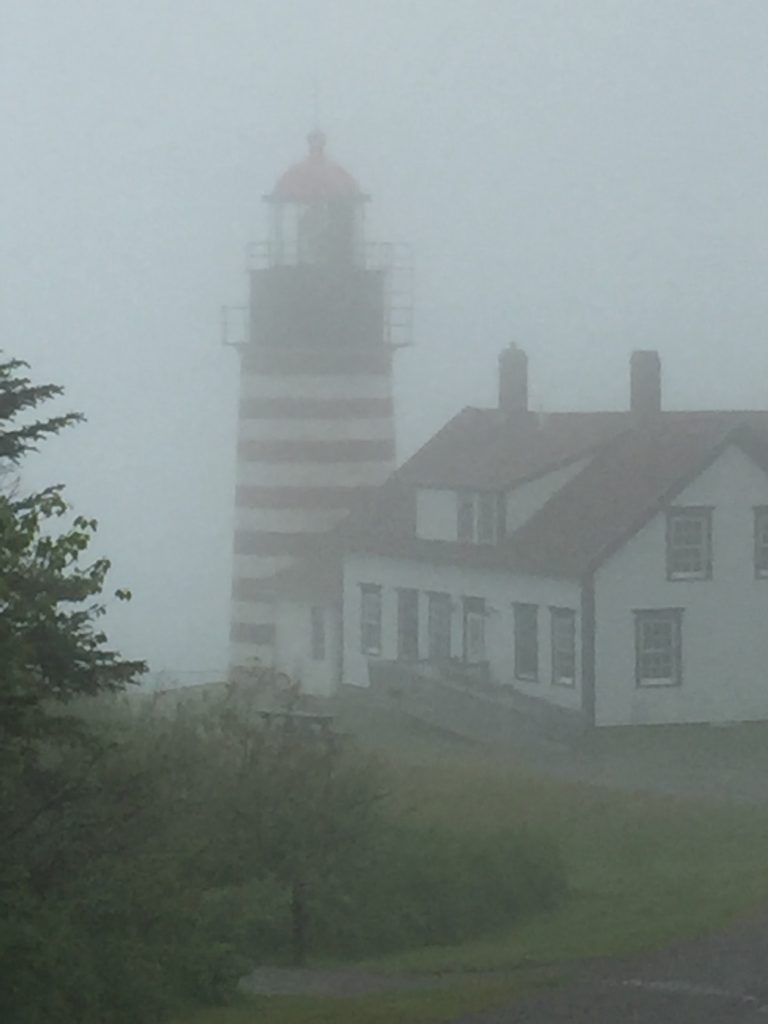
It has come to our attention here at the Teatime Tattler that in a certain town in Maine, there is a widow in charge of the lighthouse. Perhaps the population there is so sparse that they must press ladies into occupations better suited to gentlemen?
We have investigated this untoward circumstance thoroughly, to see if there is some suitable explanation. Perhaps she holds domestic sway while a son does the more — muscular, dare we say, — duties? While there is a son, he is to attend medical school, leaving the widow to attend the lighthouse, her home, and take care of the raising of two younger girls.
Those in town report the widow has taken the duties of lighthouse keeper upon herself. We can only imagine her grief at the loss of her husband has rendered her incapable of understanding her feminine limitations. Why, much mechanical work must be done to keep the lens in order. And much courage is needed to keep the light burning during stormsy weather. Reading the list of instructions for a lighthouse keeper, it becomes clear that only a man is up to the task.
You may suggest that we, who do not live in this town, have no business reporting on their lighthouse keeper. But you forget that the lighthouse is all that prevents ships from foundering in the dark, in the fog, and in stormy seas, where Mother Nature wreaks her bad temper on unlucky sailors. Do we want our sailors coming near a lighthouse where a widow is in charge? We think not.
It has been reported, but we can scarcely credit it ourselves, that the widow had attended the lighthouse well, in all her duties and the town wishes her to remain in place.
If so, we have a suggestion for them: please find that widow a husband, forthwith.
An excerpt…
The sight of her new home stole Betsy’s breath away. The lighthouse perched like an ancient warrior goddess atop the throne of rocks that acted as a bulwark against the relentless surf. The sound and scent and feel of the water permeated through everything, enfolding her in its powerful embrace. She breathed in, closed her eyes—then opened them and carefully picked her path up toward the entrance.
The front door was constructed of heavy, unpolished wood, as though it had been salvaged directly from the waves. Its austere beauty reminded her of the duke’s ancient manor home, stalwart and secure. The cracks and peels in the dirty white paint around the base of the massive structure became clear as she approached, but they only added to the picture of a home that would stand through a storm and show little damage for it.
She frowned slightly, looking around. Not that a woman’s hand wasn’t needed here, she was relieved to see. What scrubby grass had managed to pry its way through the stones was left untended. A child’s faded toy ball sat lonely in the center of the footpath, half-deflated. She would make her mark on her new home. Her husband would see that she was a worthwhile addition to his life.
Betsy paused. She gazed at the sun-bleached, wind-worn outer walls, at the two crumbling steps leading up to a bare stoop. The light above the doorway was clouded with grime. She glanced over her shoulder, but the driver was long gone. All she had left by way of companionship was the lighthouse and the sea. Where was her new family? Why had they not come outside to greet her yet.
She sighed, hoping that this lonely doorstep wasn’t the beginning of a huge mistake. Then she steeled herself once more, climbed the stairs, and knocked. It was cool in the shadow of the building; she felt a chill run through her. The crazy notion of running away, simply turning and bolting down the long ocean road, flashed through her mind—but right behind it was something Kate had said to her as they parted — the only impossibility is the possibility you fail to see.
The door began to open. In moments, it would be too late to flee.
Betsy squared her shoulders and plastered a smile on her face. Emile Laverdiere was a possibility she must see before she let fear chase her away.
A wraith of a man stood just inside the threshold, his pale eyes huge in the gaunt frame of his face. Betsy bit her tongue just in time to keep a gasp of surprise from escaping her lips. Though she had not chosen to follow the healer path her mother had taken, with her herbs and potions, she knew this man was gravely ill.
“Betsy Lawton?” he asked in a voice that matched the rest of him—thin, frail, reedy.
“Emile Laverdiere?” She looked into his eyes and saw that he had registered her dismay. No doubt he had been expecting it.
He smiled, and his cheekbones stood out like mountain ridges underneath his sunken eyes. There was humor there, despite the ravage of illness. “The one and only. We have been counting the minutes until your arrival. Though it may be impolite, we must ask what you think of your new home?”
Betsy somehow kept her smile in place as she took his offered hand and stepped into the lighthouse. Her soon-to-be-husband’s fingers were cold and bony against hers; she feared that if she squeezed at all, his hand would break. “You have a magnificent landscape at your command,” she answered honestly. He had said nothing of illness in his letters. Nor had those who had attested to his honest character and true desire to wed. Could it be recent? Or had she been duped?
His air of acute attention told her he waited for more. There was an air of patient acceptance in his waiting eyes, as if she could tell him the truth. That she did not want to wed a dying man. Did not know if she truly wanted to immure herself on an isolated jut of rock like Rapunzel in one of the duchess’s favorite fairytales.
But she had come all this way, she would not be her practical mother’s daughter to throw everything away without discovering all she could about this place. Her eyes roamed the interior of the lighthouse’s living space, and she found it plain but comfortable. The rounded room was cozy, softly lit, warmed by a small stone hearth. A spiral staircase formed its centerpiece, climbing up and up through the ceiling. Her eyes could not help following it upward into the unknown. She could hear a slight scraping sound, some rustling, a whispered exchange so low she could almost dismiss it as the sound of the wind.
She looked at her soon-to-be-husband. “What is up there?’ Her eyes swept back upward, toward the sound.
He seemed to approve of her question. “Take a look for yourself, if you like.” He gestured upward. “But forgive me for not accompanying you. I will only slow a young woman like you down. It takes me a while to climb up and down, thought I do it three times a day.”
Of course, Betsy thought. That was why he had not been down to greet her quickly. He had come from the top of the lighthouse. She felt a sympathetic ache in her own healthy joints at what he must endure to do his duty three times a day.
She looked upward, walked to the iron railing, and grasped the cold metal. She began to ascend. On the first landing, she paused at what sounded like sudden whispers, but she saw nothing, so she continued upward.
At the very top, she found her answer. The view that had seemed magnificent when she first arrived, had become almost godlike here, above the sea. She could see for miles. She could pick out the people in the village going about their business, but also the sea life in the ocean. Her breath caught. She leaned closer to look. A whale. She could see a whale in the distance, breaching repeatedly like a child at play.
She was careful not to touch any of the instruments that controlled the light. Emile would teach her to use them, she was certain. She had always been an apt pupil. Living in a duke’s household had exposed her to many lessons not always provided to a governess’s daughter. Living with the Fenster siblings had provided her with lessons that went beyond what was possible even in a duke’s household. She had seen one Fenster sister start a business making beautiful high fashion buttons with a cottager, another become an artist of repute, and one a card sharp that others admired. Kate, her best friend and youngest Fenster sister, had won prizes for the roses she created in her greenhouse.
The gleaming brass of the instruments called to her, but she did not touch, except for one, loving stroke. If she accepted the dying man downstairs as husband, this could be hers.
About the Book: The Lighthouse Keeper’s Bride
At long last, Book 8 in the Once Upon a Wedding series has arrived

Raised almost as a sister in a duke’s household, Betsy Lawton has let the duchess’ love of fairytale endings lead her to believe she has a chance at true love with a man far above her station.
Betsy Lawton, the governess’ daughter, dares to give her heart to an earl. When he crushes it under his heel to marry according to his family’s expectations, she turns her back on England and departs for America, where rank and station are no impediment to her dreams. Not that Betsy desires true love any longer. Instead she will be the mail order bride of a lighthouse keeper. It is the lighthouse she will love, she vows.
Matthew Thigpen, Earl of Battingston, had always regretted not fighting hard enough to marry the woman he loved, despite her lack of rank and family. But now he needs to find her. The woman he jilted is the only woman who will understand his predicament and keep his daughter safe.
Now a widow, Betsy must marry again to keep her job at her beloved lighthouse. Matthew offers her a devil’s bargain that will allow her to keep her job at the lighthouse she loves and keep his daughter safe as well. But is his bargain worth the lighthouse, if he breaks her heart all over again?
Find buy links here: https://kellymcclymerbooks.com/book/lighthouse-keepers-bride/
About the Author
Kelly McClymer fell in love with Cinderella, Sleeping Beauty, and Snow White as a child. Her most prized possession is her copy of The Complete Tales of the Brothers Grimm. These are the stories which gripped our ancestors as they huddled around the fire at night, which taught countless children to persevere through hardship and succeed against the odds. Her favorite fairytale remains “The Six Swans” — where a young sister must not speak a word for six years in order to save her brothers from their stepmother’s evil spell.
 Lady Bell invited Mr. Tilson to tea not because she likes him, but to hear about a ghost. I had learned a little about the specter from friends in Carlisle, and she wanted to know more. Unfortunately, Mr. Tilson didn’t want to discuss ghosts. He preferred to backbite about living people.
 Her ladyship glowered at him. “What nonsense. No innocent maiden would say anything of the kind.”
 “Miss Warren knows full well that she is unmarriageable,” Mr. Tilson said. “Her conniving father tried to trap me into wedding her. Much as I pity her, I was fortunate to escape before I found myself tied to her forever.” He was enjoying himself, which is in frightfully bad taste. How vile to denigrate the former object of his affection!
 About the Book
 Now you owe me because there’s more. It isn’t just the boy that washed up in Macao. A girl followed him—Sudbury’s oldest girl, the uppity one too proud to so much as dance with any gent lower than a duke, the one with the weird Arabic name. Superintendent Eliot and his wife put it out that they’re hosting her on Sudbury’s behalf, but I doubt Sudbury even knows where she is. I saw her myself going in and out of Eliot’s house as swanky and stuck up as ever she was in London, every inch the duke’s daughter, but I heard rumors.
 I got myself an invitation to dinner by one of the China traders, Harold McIlroy. It cost me a pretty penny in drinks at the club where they all congregate, but it was worth it. The ladies of Macao dig dirt with the best of them. I got an earful, I can tell you. I don’t see how it can all be true, but where there’s smoke, there has to be at least an ember or two.
 The Chit has nerve. All Macao knows what she is, but she parades around town while a little servant hops along behind her holding some fancy parasol on a bent handle to keep the sun off her like she’s some short of rajah’s female. I cornered the little weasel, a Chinese boy who looks like at least one Portuguese tomcat got at his great-grandfather’s tabbies. Name’s Filipe. The boy talked about the trollop like she’s the queen herself. Calls her “Lady Zamb.” I think he’s half in love with her. Wouldn’t say a bad word. Talked about her like she’s some kind of saint, and I know for fact she isn’t that. He told me to ask the woman who runs the mission school. One of the Quakers. He had to be lying. I can’t see a prune-faced female missionary tolerating the sort those women at McIlroy’s described.
 Crushed with grief after the death of his son, Charles Wheatly, Duke of Murnane throws himself into the new Queen’s service in 1838. When the government sends him on an unofficial fact-finding mission to the East India Company’s enclave in Canton, China, he anticipates intrigue, international tensions, and an outlet for his frustration. He isn’t entirely surprised when he also encounters a pair of troublesome young people that need his help. However, the appearance of his estranged wife throws the entire enterprise into conflict. He didn’t expect to face his troubled marriage in such an exotic locale, much less to encounter profound love at last in the person of a determined young woman. Tensions boil over, and his wife’s scheming—and the beginnings of the First Opium War—force him to act to rescue the one he loves and perhaps save himself in the process.
 Your reporter fears that Lady Samantha Winston gazed over the Duke of Ravensmere’s shoulder and caught sight of said reporter leaning against a tree scribbling on my small pad of parchment. She was heard to whisper to a friend, “Who was he and was he a friend or enemy? If a foe, what evil intent did he have? And who was the victim?” Forced to move away, I gave up. What indeed happened at the so-called charitable auction? And what will be the outcome?
 Raven rose from the chair, handed the appropriate bank voucher to the Reverend, and stepped lively to Samantha and her picnic basket. “Shall we?” He extended his arm. Samantha clung to his left arm, and he became cognizant of her quaking. He took her expensive picnic basket in his right hand. “Stay calm. I’m here and you are under my protection. No harm will befall you.” Raven escorted her to a secluded table, which he had prearranged, and his name appeared on a place marker. It adhered to propriety while offering privacy.
 When a spirited woman disrupts the world of a duke who follows the rules, sparks fly, passions ignite and planets collide.
 About the Author, SANDRA MASTERS

 The earl and his countess hosted a perfectly adequate wedding breakfast at their London town house, a much-admired edifice for all it is overrun by unruly children. Among those in attendance, the Duke and Duchess of Sudbury took precedence. The Duke’s sister (who chooses for reasons that no person of correct thinking understand to be plain Mrs. Mallet) sat along side with her husband, the schoolmaster’s son. The bride’s family, of gentry stock, were surrounded by no fewer than two dukes, four earls, three viscounts, and several barons. One felt sympathy for the people who were quite out of their element, though the manners of the parents were well enough.
 What can one say of the bride? For all the correctness of her parents’ manners (they obviously understood their place) she is a pushing little thing. She flirted shamelessly with Viscount Corkinwall and several of the rakish young men during the wedding breakfast while her new husband appeared not to notice. One was forced to recall rather vile rumors Lady Elsbeth Willknott had from Cambridge regarding the young woman, rumors not to her credit. It appears she had been close to both of the young dukes cousins, one after another, rather too close. I suppose one cannot blame her for nabbing a duchess’s coronet, the cousins being plain misters, but the stories of her behavior lead to Rampant Speculation that breach among the young men resulted directly from her machinations.
 About The Unexpected Wife