Because history is fun and love is worth working for

Tag: Gossip Page 24 of 40

The Wanderer Returns

We are delighted to report that Lord Wayshaw’s younger brother, Rafe, has returned to the magnificent Taverslow estate after his travels in Europe and a stay at the family’s villa in Umbria.
The great and the good of Somerset will no doubt look forward to hearing tales of his continental adventures, while the young ladies will surely hang on every word of the county’s most eligible bachelor. It is said that the dashing Mr. Wayshaw is even more handsome than when he left these shores almost a year ago, and that his already fine skills in riding and dancing have been greatly enhanced by his time in foreign lands.

The debutantes of Somerset and London will have to compete for his affections, however, which are apparently taken by his two charming Yorkshire Terriers, Pepe and Paolo. They may also have to win the approval of Mr. Wayshaw’s faithful valet, Simpkins, from whom he seems quite inseparable. Indeed, some have hinted that they may be more intimate than one would expect of a servant and master. Of course the Tattler would never spread such gossip, but if we hear more of Mr. Wayshaw’s romantic attachments, rest assured dear readers, you will be the very first to know.

About The Book

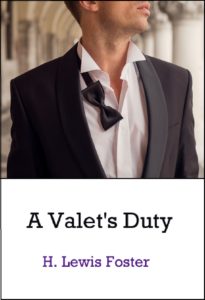
A Valet’s Duty

At the turn of the twentieth century, Henry Simpkins is a valet at Taverslow, the Earl of Wayshaw’s Somerset home. When the Earl’s younger brother, Rafe, arrives from his villa in Italy, Henry is given the task of caring for his mischievous dogs, Pepe and Paolo. As part of his duties, he also goes to Rafe’s room each night to tidy away his clothes.

One night Rafe asks Henry to go beyond his valet’s duty, to relieve his sexual tensions. Henry enjoys their increasingly intimate encounters, but he’s soon disturbed to find he feels more for Rafe than mere physical attraction. Now Henry faces a difficult decision. Can he remain in the same house as Rafe if his affections are not returned?

A Valet’s Duty is available at Amazon: https://amzn.to/2n1Ei0A

Excerpt

When he followed Lord Wayshaw up the grand marble staircase, Henry wondered what sort of man the brother might be. He seemed to have a sense of humour, since he hadn’t chastised Henry for scolding his precious dogs. Henry only hoped he required as little attention as the earl. Each night, he sorted his lordship’s clothes when he undressed, and took his orders for the following day. His night-time duties were over in a matter of minutes, and he could go outside for a smoke before he turned in.

Henry knocked on Rafe’s door and was somewhat taken aback, when the ornately carved oak opened to reveal Rafe already in his dressing gown.

“Come in, Simpkins. I won’t keep you long.” Henry followed Rafe into the bedroom. “Just tidy my clothes away, would you?”

Rafe settled himself on a sofa and chattered away, as some gentlemen do, while Henry picked up his garments from the floor, sorting those that could be worn again from those that needed to be washed. He listened to Rafe describe his villa in Italy, where he obviously spent much of the year. It sounded enchanting, with its endless sunshine and olive groves, but Henry couldn’t properly picture the place—he’d never been farther south than Dover.

The next few nights passed in a similar way, with Henry nodding and smiling, and sometimes laughing, when Rafe talked of his life in Umbria. Falling to sleep each night in his narrow bed, Henry found himself dreaming of orange trees and vineyards. Sometimes he even dreamt of Rafe wandering among them in the Mediterranean sun, but on the fourth night when Henry went to Rafe’s room, something had changed. Rafe seemed on edge as he opened the door, and he sat on the sofa in silence as Henry carried out his tasks. Henry started to leave, when Rafe spoke at last, an unfamiliar tension in his voice.

“Simpkins, could I ask you something?”

“Of course, sir.”

Rafe gazed intently at his fingernails, giving Henry no clue as to what he might ask. His eyes remained lowered as he made his enquiry.

“Simpkins, are you—are you the same kind of man as Oscar Wilde?”

About the Author

H. Lewis-Foster lives in the north of England and has always worked with books, in one form or another. A keen reader and writer of gay fiction, she is now the proud author of several short stories and a debut novel ‘Burning Ashes’.

Lewis-Foster likes to create characters that are talented, funny and quite often gorgeous, but who all have their faults and vulnerable sides, and she hopes that you’ll enjoy reading their stories as much as she loves writing them.

You can find out more about H. and her books on her website.


A letter of retraction

Mr. Clemens:

I can stand silent no longer, Sir. The recent flurry of activity in your paper with regards to the Bluestocking Belles has been not only outrageous but without cause. To see their name tarnished by closed minded individuals has caused me to rise to their defense!

One might think of me as one of those forward speaking women, and if this includes the Belles then I know I am in good company. There is nothing scandalous in their novels and I have even heard they give part of their sales to a charity. A charity, Mr. Clemens! Now how can anyone complain about people who will give their hard earned monies to those who are less fortunate?

I pray that those who previously published such unkind words regarding the Bluestocking Belles will make a retraction in the Teatime Tattler. I, for one, will be looking forward to their next release.

Sincerely,
Lady Elinor Lacey


To our esteemed readers:

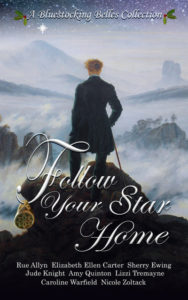
In case you wish to see for yourself what all the fuss is about, be sure to check out the Bluestocking Belles’ page for information on their next box set, Follow Your Star Home.

S. Clemens


Do Not Censor Our Reading Beg the Ladies

censorMy Dear Mr. Clemens,

I am a frequent reader of your publication, and you may imagine my horrified astonishment when I came upon the recently published letter to the editor (your esteemed self) from one Claudius Blowworthey—though one begs to question just how right, honorable, or reverend the wretch actually is–suggesting we censor a certain forthcoming book.

As a well-loved wife, modestly well-educated mother of three young women, and a Christian, I protest this horrid man’s dismissal of novels, of romance, and indeed of love itself. How does he dare dismiss my sex so carelessly? Has he not a mother? As to his poor wife, he dares to tell the world he does not love her. What pathetic creature would choose “esteem” over love?

He dares quote Saint Paul on the subject of marriage being preferable to burning. Did the apostle not also admonish husbands to love their wives as God loves the Church? How does he expect those wives to acquire husbands if not love? And is not love the very nature of the Deity?

Those ladies—if not ladies call them heroes—among the Bluestocking Belles provide us with hours of joy. Never say you will suffer them to be censored, Mr. Clemens.  I have spoken about this matter with Mrs. Cornelia Lumberton and Mrs. Annalisa Waldo, my bosom bows and fellow regulars at the Chapel of the Faithful, and they quite agree. This Blowworthey horror must not be allowed to prevail, sir.

Never say you will encourage this outrage or give further space in your fine publication to such nonsense. We await your response even as we anticipate the next boxed set of stories from our beloved Belles,

Respectfully,

Mrs. Maud Goodbody

For more about the box set, keep an eye on the Belles’ website. We’ll be putting the details of the book up on the Joint Projects part of the site as soon as we reveal the name and cover. Or come to our cover release party, on Facebook on the 8th September 2pm to 9pm Eastern Daylight Time.


A  Guillotine Widow Takes Tea on the Isle of Guernsey

widowThere I was, sipping tea in the Donets’ lovely parlor, decorated in the warm colors of the gardens and filled with sunlight, trying to forget the horrors I had left behind in Paris. Sitting across from me was my savior, Mademoiselle Zoé Donet, and her English aunt, Joanna, comtesse de Saintonge. Zoé’s question stirred me from my reverie.

“Do you have in mind a place to settle in England, madame?”

“I have friends in London we can visit. After that, I’m not sure. I rather like the countryside. For many years, I lived in a small country palace in the Bois de Boulogne near Paris.”

“Then perhaps you should consider West Sussex,” offered Zoé’s aunt. “There is plenty of room at The Harrows, my family’s estate, and my brother, Richard, the Earl of Torrington, would welcome you and your children. It would be a fine place to recover from all you have been through at least until you decide. But, if you prefer, Richard could arrange for you and your children to travel with him the next time he goes to London.”

“That is so very kind of you, Madame Donet.”

“Not at all. It is settled. When my husband sails to England, you shall accompany him. Perhaps we’ll all go. I have not visited my brother in a while and he worries about me even though I am on Guernsey.”

I set down my teacup, trying to imagine the anxiety this woman must face each time her husband and niece ventured into the port towns in northwestern France to help the fleeing émigrésof which I had been one. “You must fear for your husband and niece going into France to rescue people like me. How ever do you stand the agony of awaiting their return?”

A subtle smile crossed Madame Donet’s face. It was the look of a woman who had long ago conquered her demons.

“I knew when I married Jean Donet I was marrying adventure itself. Oh, perhaps not the terrifying kind he now faces, defying the revolution’s madmen. For that, I think he and my niece are quite brave. But I have always known such a man would not be content to sit in his parlor and gaze at his vineyard, though he has—or rather, had—an excellent one. No, once he discovered the sea, there was no other life for him.”

I considered the niece. At twenty, Zoé was a beautiful young woman attired in an elegant gown, so different from the soot-covered peasant she had been days ago. “I can see why Monsieur Donet would undertake the rescues, but why you?”

“I made a vow to a friend that I would do all I could for the royalist cause, no matter the peril I must face.”

Zoé’s aunt smiled. “Anyone who marries my niece will be making the same decision I made when I wed Jean Donet.”

About the Book

WidowA Fierce Wind: Donet Trilogy, book 3
Love in the time of revolution
France 1794

Zoé Ariane Donet was in love with love until she met the commander of the royalist army fighting the revolutionaries tearing apart France. When the dashing young general is killed, she joins the royalist cause, rescuing émigrésfleeing France.

One man watches over her: Frederick West, the brother of an English earl, who has known Zoé since she was a precocious ten-year-old child. At sixteen, she promised great beauty, the flower of French womanhood about to bloom. Now, four years later, as Robespierre’s Terror seizes France by the throat, Zoé has become a beautiful temptress Freddie vows to protect with his life.

But English spies don’t live long in revolutionary France.

Buy links for A Fierce Wind:
US: https://www.amazon.com/dp/B07FYPFVRL
UK:  https://www.amazon.co.uk/dp/B07FYPFVRL
Canada: https://www.amazon.ca/dp/B07FYPFVRL</a

Amazon link for the award-winning Donet Trilogy: https://www.amazon.com/gp/bookseries/B071JPXTT5/

About the Author

I didn’t start out as a writer of historical novels. Although I wrote stories as a child, by the time I got to college, and at the urging of my professors, I became a lawyer. After years of serving clients in private practice and several stints in high levels of government, it seemed time for a change. Becoming an award-winning author was the subject of dreams when I first began writing, but dreams sometimes do come true.


Find Regan:

Website (Newsletter signup, Books, Reader Extras and more!): http://www.reganwalkerauthor.com/
Facebook: https://www.facebook.com/regan.walker.104
Regan Walker’s Readers on Facebook: https://www.facebook.com/groups/ReganWalkersReaders/
Pinterest (storyboards for my books): https://www.pinterest.com/reganwalker123/
Twitter: https://twitter.com/RegansReview
Regan’s blog, Historical Romance Review: https://reganromancereview.blogspot.com/

Lord Parkington Speaks Out

You’d think that all would be well, what with Napoleon now exiled to the distant tropical island of St. Helena, but Paris in July 1815 is a deuce of a mess. So now I must assist Lord Forgall, Wellington’s most secret spymaster, to quell any resistance while we get King Louis XVIII’s fat old backside firmly re-settled on the French throne.

“Of course, always glad to do my duty,” I told Lord Forgall (Forgall the Wily, as we diplomats call him). But under my breath, I added, “though we’d be a damned sight better off without that Irish fellow.”

The Irish fellow in question is Captain Stephen Killian. One of the Inniskilling Dragoons – they did their job at Waterloo, I’m not saying they did not, but like any other soldier, he’s only suited for rough and brutal tasks. So why on earth would he want to be a spy? Killian is a devil of a fighter in battle, they say, even though he’s not one of your huge, hulking types. He’s just of middling height, rather lean, and not even that good-looking. Average at best, easily lost in a crowd. Yet women fawn over him. Of course, they go completely giddy over any man with a strong jaw and a thick head of hair – let him cut a fine figure, and nothing else matters. Utterly frivolous!

Not that I would object to a touch of frivolousness in the lovely Miss Emma Forgall. Her inky black tresses and jade green eyes are fetching indeed, and her figure is perfection.  She’s got that cold and regal air, but her father likes me. Given time, she’ll warm up to me, too. One would naturally prefer that such a beautiful young lady not be aware of State Secrets—you know how the ladies love to chatter, bless them!—but her father insists that she is the most skilled cryptographer he has ever taught. Still, there will be no more of that, once she’s married to me.

I don’t deny I was dismayed when Wellington made such a fuss over Captain Killian’s “heroism” for standing his ground on that Parisian bridge that General Blucher was trying to blow up. Wellington took such a shine to him, he ordered Lord Forgall to teach the Irishman spycraft and code-breaking. Naturally, the particulars of that task would fall to his daughter, Miss Emma.

However, old Forgall told me that his plan is to pretend to take Captain Killian under his wing while ensuring that the fellow is an utter failure at the job. I’ve heard Killian’s a wild man in battle – so he hasn’t got the self-control to be a spy.  With any luck, he’ll be killed by that devilish Prussian assassin Wolfgang. I’ve seen Wolfgang dangling after Miss Emma, too, blast the big blonde brute’s eyes.

Maybe the two of them can slaughter each other, and leave Miss Forgall to me – now there’s a happy prospect!

One day, she will be mine. Until then, I’ll just have to keep my eye on her…

HER WILD IRISH ROGUE-coming October 2018

~an excerpt~

Miss Emma Forgall waved her fan lazily. “Where in Ireland are you from?”

“I’m from Macha’s Brooch,” Captain Killian replied, hands clasped behind his back and feet set sturdily apart. Somewhere in the back of the elegant Parisian ballroom, the orchestra struck up a tune.

Lord Parkington snorted. “Impossible. Macha’s Brooch isn’t a place.”

It’s a riddle, you fool, Emma wanted to say. Why wouldn’t Lord Parkington go away? Just because Emma’s father approved of him, that didn’t give him permission to act like he was her keeper.

She ignored him and thought about the riddle. In Celtic legend, the goddess Macha used the point of her brooch-pin to scratch the boundaries of the city of Ulster into the ground and made her vanquished enemies dig its fortifications for her.

Macha’s Brooch meant Ulster.

“Ulster is a great distance from Paris,” Emma remarked casually, watching Captain Killian’s face for signs that she’d gotten it right. “Where did you stop along the way, when you traveled here?”

He shrugged his wide shoulders. “We stopped in the home of the man who herds the cattle on the plain of Tethra.”

“The what?” demanded Lord Parkington, who still hadn’t gone away. The man simply never could take a hint. “What are you talking about?”

Another riddle. She was beginning to enjoy herself. Good thing she knew her myths – Tethra was an ancient guardian deity ruling over the waters, and the “plain of Tethra” was the sea. Therefore, the cattle of the sea were…fish. Captain Killian had stayed at the home of a fisherman.

“So your host was a fisherman,” she said coolly. “No doubt you had excellent fish for dinner?”

He grinned at her. “Most excellent fish.”

Right, again! Emma’s heart gave a little hop of excitement. She smiled back at him and asked, “And where did your travels take you then?”

“Simple enough,” replied Captain Killian. “We went over the Great Secret of the men of Dea,  down the Great Crime, across to the Land of the Red Dragon, to the Ford of Oxen, and then to Caer-Lud. Then on to Lutetia.”

“What nonsense are you spouting?” Lord Parkington howled. “Surely you can’t pretend that you understand him, Miss Forgall!”

Emma waved a dismissive hand. She knew her Celtic mythology and her ancient Roman history. Besides, it was worth it just to see Lord Parkington’s purple-faced frustration.

“So, down the Boyne, over the River Delvin, across the sea to Wales, and then through Oxford to London. And here you are in Lutetia—or, as we call it, Paris.”

“Exactly.” Captain Killian nodded. “Now tell me about yourself.”

About the Author

Saralee Etter is the author of three traditional Regency romances. Her next book, coming October 2018, will be HER WILD IRISH ROGUE. It is part of the LEGENDS TO LOVE Regency romance series, with a protagonist based on the legendary Irish hero Cuchulain. She is working on A SHORT SHARP SHOCK, the first book in a Victorian-set mystery series featuring sleuth Lucy Turner and her friends, William S. Gilbert and Arthur Sullivan

You can visit her on the web at www.saraleeetter.com

Artwork:

Portrait of William Cathcart, 1st Earl Cathcart,  by Thomas Gainsborough,

Duchess of Richmond’s Ball, by Robert Alexander Hillingford

Both in the public domain via Wikimedia Commons


Page 24 of 40

Powered by WordPress & Theme by Anders Norén