A few nights ago there was a delightful surprise at the
Raven. The notorious gambling establishment premiered its new singer, an auburn
haired beauty named Charity Walsh. Little is known about the new girl, aside
from her talent. She stunned audience members with her Gaelic tunes and stolen
a few hearts with her angelic face. The lack of history only adds to the
mystery my readers!
After the show I went backstage to see if I could find out a
little bit more about the lovely Songbird, only to be turned away. It wasn’t
just this humble reporter getting rejected. I heard the owner himself say that
the lady was refusing all visitors. That is almost unheard of in the world of
performers. I immediately became intrigued.
Turns out the lady is adamant in her refusal of all
gentleman company and from the sources I talked to she has been turning away
gifts since her debut. I found out that there is one young man who has at least
managed to spend time in her company, but he is only a musician looking for a
chance to play. There couldn’t possibly be anything to speculate about there.
The owner has decided to use the little charmer’s refusal to
his advantage, encouraging the wild gentleman of his club to try harder. I can
confirm that there is both an entry in the betting book at White’s, as well as
at least one private wager among a set of young lords, as to who might be the first to win the her
coveted affection. The anticipation of finding out has only made her show that
much more popular. It is standing room only and she now plays to a packed house
every night.
Will she be able to resist the temptation of a charming, handsome (not to mention rich) protector? Or will she hold fast to her word of swearing off all men, even those with deep pockets? Perhaps she will find her heart being pulled in an unknown direction. Rest assured, dear readers, I will make sure to find out and keep you apprised of what occurs.
About the Book Song for a Scoundral
Jasper Heade was the second son of the second son of a baron, which meant very little in the world. He was a sharp man, with big ideas and lots of ambition but could only get as far as being secretary to his cousin, the earl. One day, his cousin offers a contest with a sum of money larger than Jasper would ever see. The goal: woo the pretty little songbird that sang at the Raven Club.
Charity Walsh had grown up a dirt poor nobody and she refused to live her entire life that way. The Irish redhead had convinced the owner of the Raven Club to let her perform and she was a success, but she wanted more. She longed to sing for a bigger stage and a more distinguished audience. To reach that goal, she will need to prove not only her musical skill but also her spotless reputation. That becomes difficult when she is bombarded with suitors.
Jasper decides to assume a secret identity to win the money, but what does he do when he loses his heart?
Sinners Club Novellas, Book 2
About the Author
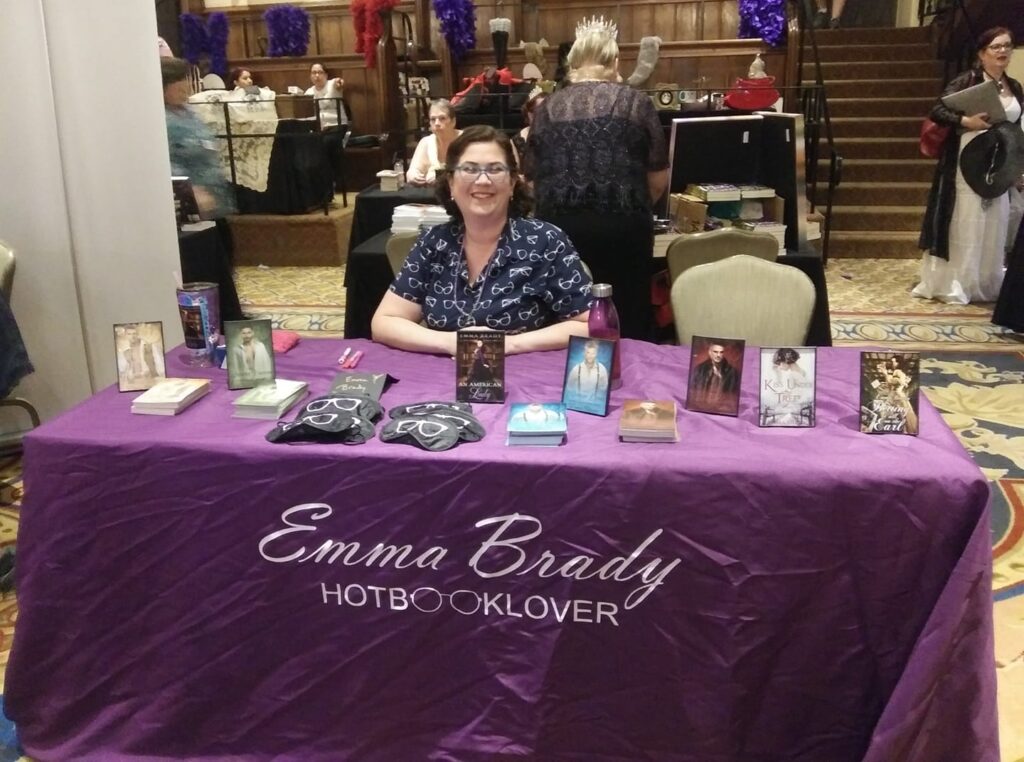
Emma Brady is an author of historical romance set in the Victorian period. She currently has a series about naughty gentleman that get their just desserts in the Sinners Club. She is also working on a group project, a series of Victorian Fairy tales with a great group of authors to release this summer called Lady Goosebury’s Tales. She loves too cook and play with her two dogs, Brady and Jack. For her, romance is all about being willing to take a risk.
Loose lips and reckless accusations ‘ll get us in trouble every time. Best hold off.
I went to the Marquess of Wellbridge’s townhouse as you said, but I couldn’t get past the butler. When I asked after Lord Ethan Alcott, all I got was a cold stare, and “His Lordship is as well as can be,” before the door shut in my face.
I set up in the pocket park in the square behind some bushes. You’ll owe me extra for this one. Cold it was. The watch caught me making a small—really very small—fire and almost took me in. Anyway, the Earl of Chadbourn, you know—the one with his paws in all the charities for the raggedy parade of veterans being shipped back from the Peninsula—came and went every day. A couple of times I saw two ladies I later figured out were the earl’s sister and—get this!—Lady Georgiana Hayden, daughter of a duke and the sister of the Marble Marquess hisself. Yep. I mean Glenaire. I’m guessing the whole bunch of them’ve made a project of Lord Ethan, that’s what I think.
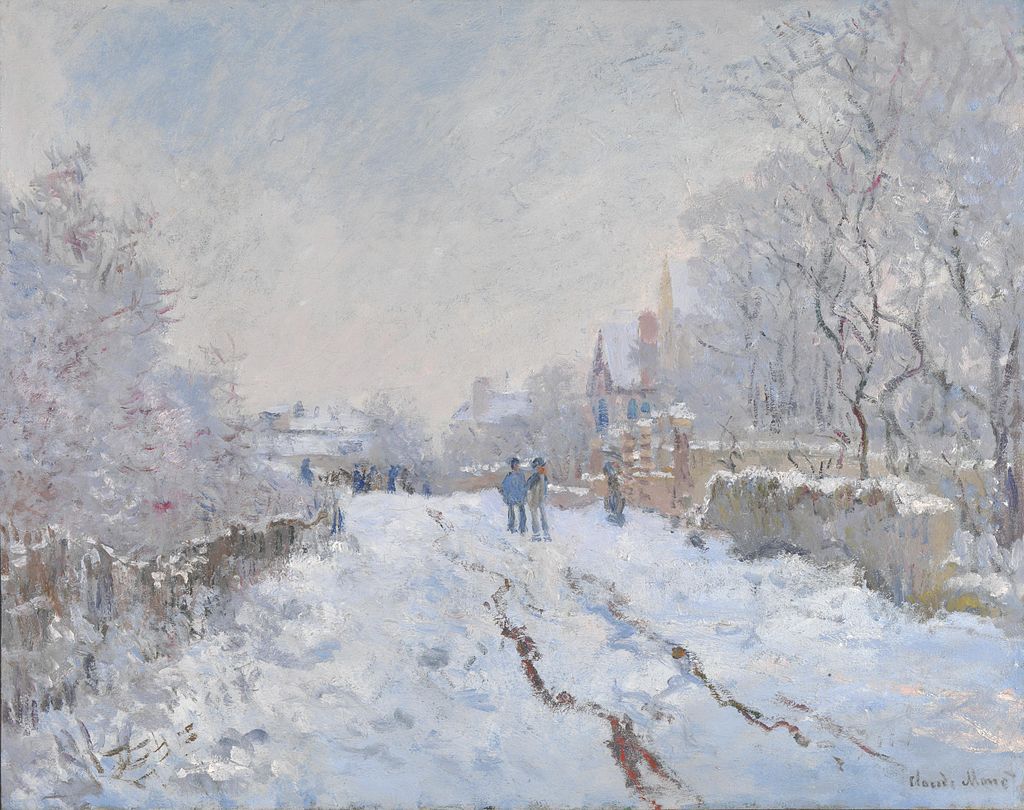
Monet, Snow at Argenteuil
I tried the nearby pubs and all I got is that the lost sheep had returned. He’d been missing all right, but I couldn’t find anyone who could confirm he deserted after Badajoz. I know your man Baker got wind he disappeared from his unit, but here he is in London as free as you please.
Before you go calling the man a deserter in print, Sam, we need something solid. With a Marquess for a father and with Glenaire and Chadbourn involved, they’d be able to cover it up, even if it was true and thrash you in the process. Besides, what if it turns out your boy here was actually a certified hero? Have you thought of that? You don’t want to get on the wrong side of this one, I’m telling you. I’ll sniff around the mews at Lords and Horse Guards but no more freezing my arse in front of Wellbridge House. I’m done with that.
Yers most sincerely, Horace Coffee
Horace is right to tell Clemens to be cautious. Just how Ethan found himself transported with the enlisted men and unidentified remains a mystery. You can bet his father will keep it that way—unless the facts make the son look like a hero.
When a young woman marches into an alley full of homeless
former soldiers, Ethan Alcott feels something he thought dead stir to life: his
sense of honor. Effort at charity put the chit in danger; someone needs to take
her in hand.
Lady Flora Landrum discovers that the mysterious one-armed ruffian she encountered in a back alley is Lord Ethan Alcott, son of the Marquess of Welbrook; her astonishment gives way to determination. As Ethan comes to admire Flora’s courage, perhaps he can reclaim his own.
About the Book
Join The Ladies’ Society For The Care of the Widows and Orphans of Fallen Heroes and the Children of Wounded Veterans in their pursuit of justice, charity, and soul-searing romance.
The Napoleonic Wars have left England with wounded warriors, fatherless children, unemployed veterans, and hungry families. The ladies of London, led by the indomitable Duchess of Haverford plot a campaign to feed the hungry, care for the fallen—and bring the neglectful Parliament to heel. They will use any means at their disposal to convince the gentlemen of their choice to assist.
Their campaign involves strategy, persuasion, and a wee bit of fun. Pamphlets are all well and good, but auctioning a lady’s company along with her basket of delicious treats is bound to get more attention. Their efforts fall amid weeks of fog and weather so cold the Thames freezes over and a festive Frost Fair breaks out right on the river. The ladies take to the ice. What could be better for their purposes than a little Fire and Frost?
Celebrate Valentine’s Day 2020 with six interconnected Regency romances from the Bluestocking Belles.
You can learn a lot in pubs and cafés. Your Teatime Tattler
has long had a policy of lingering in such establishments on the fringe more
posh neighborhoods—the sort of places servants might gather on their off days.
The Little Brown Hen Pub has been particularly useful
lately. It seems one of our “better” squares, one populated by two earls, a
wealthy baron, and a dowager duchess to name a few, has had an abundance of
havey-cavey behavior lately—enough to make a debutante blush.
First off an upstairs maid from the Earl of W—’s house and a footman from Mr. M.C.’s both were at pains to tell our man on the spot about strange arrangements in the Earl of C—’s fashionable townhouse—he who came into his title just last summer.
“Y’don’t see them servants here, do ya? They keep to themselves they do. Downright unfriendly,” complained the footman.
“That butler o’thern looks more like a prize fighter than a
butler, if you ask me,” the little maid sniffed. “And have you seen that
footman missing one ear? His visage has an ugly scar. What kind of earl hires
ugly servants?”
They scurried off to fetch more ale when an older woman, dressed in black, and obviously an upper servant shooed them away. She introduced herself as Her Grace’s dresser—that would be the dowager—and insisted on tea. “Only tea,” she said with a sniff. This bird seemed a bit high class for this pub, but then maybe widowed duchesses don’t pay as well as others.
“If you’re interested in the Earl of C—, I can tell you more
interesting things about that house than deformed footmen,” she said, rubbing
two fingers together. We’re always willing to spare a few coin for a woman who
can use ‘em. We obliged.
“To begin with the man doesn’t live there. He has rooms at the Albany, and God only knows what bachelors get up to there. When the old earl died, the older sister—she who is the Duchess of M— came to look after the younger girl, a flibbertigibbet of the first order, in my opinion.” She drew breath and our man quickly suspected she had many opinions loosened by coin.
“Now the Duke of M— is a fine man, but his wife is a pale shadow of a thing, utterly incapable of minding the hoyden. They must have gotten fed up with her foolish starts and outlandish taking because they up and left. Closed up the house but for a few servants.”
She leaned over and dropped her voice, those fingers moving. Another coin may have slid across the table. “I saw them leave. Saw the carriage pull round, the duchess get in, the duke pull their boy by his collar and toss him in, and then they left.”
Our man waited, and not in vain. “I did not see the younger sister get in that carriage. Nor the one with the maid, valet, and baggage,” she went on. “Neither one. I watched the whole time.” He took her meaning, but to be sure he asked, “Are you telling me the Earl of C—’s young unmarried sister is living on her own in a house that’s supposed to be closed?”
“Well I know I didn’t see her leave with ‘em, and more.” She
leaned in again. “I’ve been watching a girl her size wearing the clothes of a
scullery maid but walking with the bearing of a countess coming and going
through the tradesmen’s door. That chit is up to something, no doubt about it,
and heading for ruin.”
“Is that it?”
“Well. The Earl of C— feeds anyone who come to his kitchen. Her Grace has complained mightily that it attracts all sorts of unsavory types. This very morning I saw a particularly horrid specimen—a filthy one-armed ruffian—parade through their garden as free as you please, and get taken in. Taken in and that girl in residence! Not an hour later he was out on the street. Did they toss him on his fundament? No! One of those deformed footmen was giving him directions. I ask you, is that how a respectable household conducts itself?”
________________
The Earl of Chadbourn makes it a policy to hire as many
veterans in need of work as he can. The result has been a rather unusual
collection of servants. As to his sister, perhaps he wasn’t watching as closely
as he should.
When a young woman marches into an alley full of homeless
former soldiers, Ethan Alcott feels something he thought dead stir to life: his
sense of honor. Effort at charity put the chit in danger; someone needs to take
her in hand.
Lady Flora Landrum discovers that the mysterious one-armed ruffian she encountered in a back alley is Lord Ethan Alcott, son of the Marquess of Welbrook; her astonishment gives way to determination. As Ethan comes to admire Flora’s courage, perhaps he can reclaim his own.
About Fire & Frost
Join The Ladies’ Society For The Care of the Widows and Orphans of Fallen Heroes and the Children of Wounded Veterans in their pursuit of justice, charity, and soul-searing romance.
The Napoleonic Wars have left England with wounded warriors, fatherless children, unemployed veterans, and hungry families. The ladies of London, led by the indomitable Duchess of Haverford plot a campaign to feed the hungry, care for the fallen—and bring the neglectful Parliament to heel. They will use any means at their disposal to convince the gentlemen of their choice to assist.
Their campaign involves strategy, persuasion, and a wee bit of fun. Pamphlets are all well and good, but auctioning a lady’s company along with her basket of delicious treats is bound to get more attention. Their efforts fall amid weeks of fog and weather so cold the Thames freezes over and a festive Frost Fair breaks out right on the river. The ladies take to the ice. What could be better for their purposes than a little Fire and Frost?
Celebrate Valentine’s Day 2020 with six interconnected Regency romances from the Bluestocking Belles.
The
landlord’s wife saw it all. What do you make of this? Is she guilty? I rather
think she is.
Overheard
in the Ferry Inn, Flushing August 15th 1796.
‘Honest
to God, it’s the absolute truth.’
‘Slower,
please. Start from the beginning. They entered together? What time was this?’
‘Must
have been about ten. She came in first – not even a backward glance. Went
straight to the table near the door. The place was laid like I was told to lay
it, and she just sat there with her baskets in front of her. Straight away I
could tell it weren’t right. Not at all.’
‘In what way wasn’t it right?’
‘She kept her cloak tight around her – tight like she was cold – an’ it was that hot in there. An’ then I saw why. She was one of them Society of Friends – the ones that visit prisoners.Now, you tell me, what would she be doing waiting for a man at that time of night?’
‘Describe her, please.’
‘Brown hair, high cheek bones. Couldn’t
see much under her wide-brimmed bonnet. Black cloak. Softly spoken – local
accent.’
‘She sat at the table and you gave her a meal
– one that had been ordered by a man the night before?’
‘Yes, as God’s my witness. My best
rabbit pie it was. Yet she didn’t eat it. Just sat there waiting for the man to
come.’
‘She was definitely waiting for a
man?’
‘Yes. He left a message – I was to
tell her he’d be along later.’
‘And the man who came in with her, or
rather, just after her – the one she left with? Describe him for me.’
‘Tall, handsome, fine-boned in a
gentlemanly sort of way. And polite, yes, very polite. I’d say he was
definitely a gentleman, though he was wearing working clothes – a coachman’s
coat an’ hat. Pulled so low ye couldn’t really see his face.’
‘And he sat separately?’
‘Yes. He was sat by the back door –
watchin’ out for her. But I can tell you one thing. He couldn’t take his eyes
off her. Kept staring at her when she weren’t
looking. Even in the dark I could see the love in his eyes.’
‘And you can swear, on oath, that
they showed signs of surprise when the fire was sighted?’
‘Yes, I’d say so. But maybe more anger
than anything.’
‘And yet that could have been
fabricated?’
‘I’m sorry, sir. What do ye mean by
that?’
‘Their surprise and anger might have
been made up. In other words they might have pretended to be
surprised. To fool you. To make you swear, on oath, that they were innocent,
when really they were guilty?’
‘Well, I don’t know about that.’
‘No. Well, never mind. Thank you. You’ve been very helpful.’
About the Book
The Cornish Lady
Educated, beautiful and the
daughter of a prosperous merchant, Angelica Lilly has been invited to spend the
summer in high society. Her father’s wealth is opening doors, and attracting
marriage proposals, but Angelica still feels like an imposter among the
aristocrats of Cornwall.
When
her brother returns home, ill and under the influence of a dangerous man,
Angelica’s loyalties are tested to the limit. Her one hope lies with coachman
Henry Trevelyan, a softly spoken, educated man with kind eyes. But when Henry
seemingly betrays Angelica, she has no one to turn to. Who is Henry, and what
does he want? And can Angelica save her brother from a terrible plot that
threatens to ruin her entire family?
The fourth novel in a stunning series set in eighteenth-century Cornwall, perfect for fans of Poldark.
Henry
stood against the taproom bar, nodding to the man beside him. The landlord was
red-faced and bald-headed, drying a pewter tankard with a cloth, turning the
tap on the barrel. The men who had stared at my arrival turned back to their
ale and I settled against the hard wooden bench, trying to stop my heart from
hammering. A woman in a tight bodice and large mobcap saw me and smiled. She
made her way towards me, holding aloft a plate and jug of wine.
‘Pie an’ wine fer ye, my love,’ she said,
wiping her brow with the cloth hanging from her apron. ‘’Tis that hot in here,
but he likes it like that fer they drink more. Yer friend left a message – said
he’d be along soon. Ye just sit tight an’ enjoy that rabbit.’ She smiled and
turned and I stared down at the huge crust of pie with carrots and cabbage
spilling from the plate.
Henry must have ordered food. He made his
way round the tables, sitting nearest the back door. His hat and coat made him
merge with the crowd but even so, he looked out of place. He was sitting
slumped forward, his arms on the table, his elbows wide, but there was no
hiding his manners. No hiding the charm with which he thanked the landlord’s
wife, the elegant way he unfolded his napkin, the shy nod to his fellow diners
as he began his meal and I looked away. I glanced back. He seemed somehow
vulnerable, a rather charming man doing the wrong job.
Any other circumstances – any other time or
place – and I would have enjoyed his company. I would have enjoyed dining with
him, enjoyed discussing his choice of poetry, asked him what he had done in
America, how his mother was…which of my plays he had liked the most. I pushed
my plate away untouched. He was my brother’s gaoler, yet no man drew me so
completely. It was as if I became alive in his presence. The touch of his hand
on my cheek making my heart beat faster.
Sweat trickled down my back, the tight wig
making my hair itch. I wanted to take off my cloak, but no woman would sit in a
tavern in a prudish grey gown with stiff white collar and cuffs and I pulled
the cloak tighter. Henry had finished his meal and was stretching back against
the hard bench, cradling his jar of ale in both hands. He was staring straight
ahead as if too tired to talk, yet the moment the man took my baskets, he would
clasp him in handcuffs.
The tavern slowly emptied, only a number of
men left scattered among the tables. Thin curls of smoke coiled from the
guttering candles, the room growing darker. Two men had fallen asleep on their
folded arms, two others staring moodily into their empty pint pots. Martha
Selwyn had said the man could keep her waiting for hours; it must only have
been an hour, yet it seemed so much longer. I glanced at Henry and caught my
breath. He was staring at me so intently, the ferocity in his eyes making my
heart jolt. I had never been looked at like that before. It felt like pain.
Like my body was on fire.
About the Author
Nicola Pryce trained as a nurse at St Bartholomew’s Hospital in London. She loves both literature and history and has an Open University degree in Humanities. She’s a qualified adult literacy support volunteer and lives with her husband in the Blackdown Hills in Somerset. She and her husband love sailing and together they sail the south coast of Cornwall in search of adventure. If she’s not writing or gardening, you’ll find her scrubbing decks.
‘Pengelly’s Daughter’ is her first novel, ‘The Captain’s Girl’ second, ‘The Cornish Dressmaker’ third, and The Cornish Lady comes next. Her fifth novel will be published next summer.
I’ve been given permission to share a most interesting letter received by a dear friend from a lady in York regarding a topic most appropriate as we approach the Eve of All Hallows. Without further ado, I include the letter in its entirety.
My dear Lady S,
We’ve excitement in these parts–an actual haunting! My dear
husband is beside himself, wishing to cast off his responsibilities and rush to
the coast because of news received from the esteemed Reverend N. F.—pardon me,
he is now Sir N. F.! Do you remember the dear man? He is at present compiling
an encyclopedia of northern folklore. You were visiting us when he came through
York with his daughter, Miss M.F., on his way to the manor he inherited.
Oh, but now I recall, you were unable to join us for dinner
that night, and you would so have enjoyed such amiable guests. Miss F. is
rather a great galloping spinster, hopelessly on the shelf, and shamelessly
skeptical of her father’s inquiries, but entirely delightful. Sir N. is blessed
to have her to care for him in his old age, and she’ll inherit the manor, as
there isn’t an entail. The possibility of wealth (if the enterprise can be made
profitable as he hopes) might increase the poor dear’s chance at marriage (though
whether any worthy man can be found in that part of the county is questionable).
But I digress from the most exciting news. My husband has
always believed that the Manor’s legendary ghostly guest is a Popish priest enclosed
within the walls. However, Sir N has written that the general speculation of
the villagers is that the culprit is the late Squire, who was a scandalous
fiend. Sir N. inquired whether we might assist with finding servants willing to
relocate to the wilds of Yorkshire, and unafraid of the resident ghost.
For indeed, there does appear to be a ghost! The priest it might
be, but more than likely the villagers have the right of it—oh, you have heard
the story, have you not? The last Baron, Sir N’s distant cousin, died there
terribly. Of course, there’s also a very old rumor about bigamy and a stolen
inheritance—a generational curse, as it were, but I cannot quite remember the
details of that story.
I can only imagine that Miss F is beside herself, what with
needing reliable staff. A more practical and grounded woman…a confirmed
spinster, you know…could not be found. She must be such a great help to her
father as he tromps about chasing goblins for his book. And yet, even while
researching the supernatural, one needs the comforts of a good cook and a few
maids.
I shall write more as I Iearn of it. My love to the
children.
Does that not whet your appetite to learn more, dear readers? Read on!
About the Book
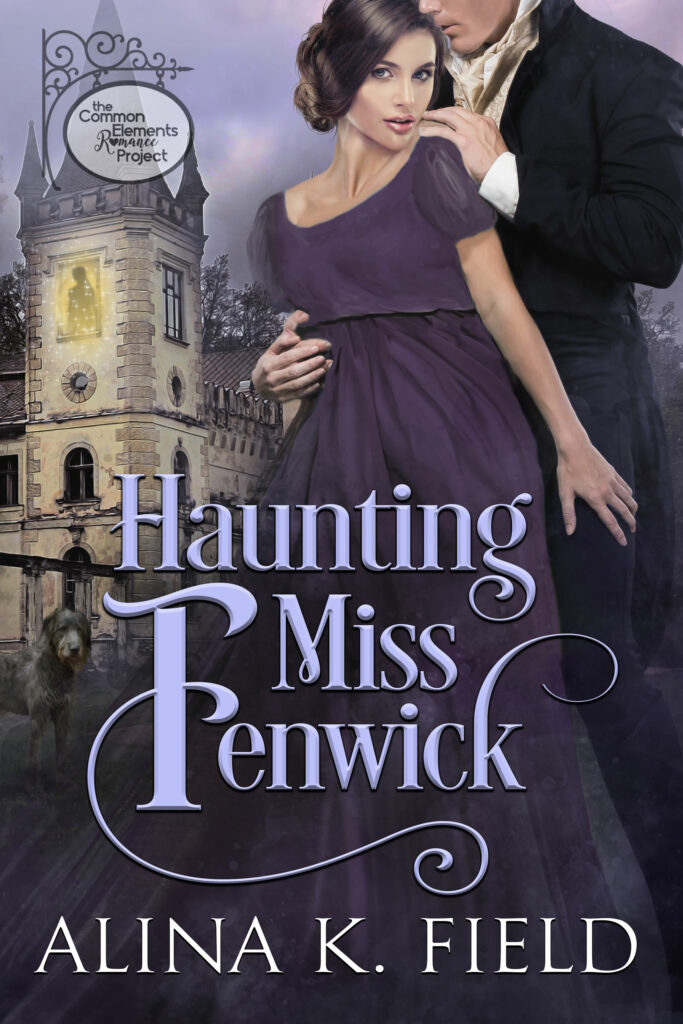
Thrilled to finally have a permanent home, a Squire’s daughter won’t let a supernatural creature scare her away. While hunting the ghost she doesn’t believe in, she stumbles upon a mysterious flesh and blood man who might be the key to all of her problems.
When the new Squire moves into Fenwick Manor, an
ex-army officer secretly searching the sprawling medieval wreck devises a plan.
First, the manor’s legendary ghost will chase servants away. Then, he’ll
convince the new residents to leave.
But the Squire’s spirited daughter soon has him wondering if he might have found a perfect comrade in arms to help battle old enemies and find the proof that will clear his family name.
Award winning author Alina K. Field earned a Bachelor of Arts Degree
in English and German literature, but she prefers the much happier world of
romance. Though her roots are in the Midwestern U.S., after six very, very,
very cold years in Chicago, she moved to Southern California and hasn’t looked
back. She shares a midcentury home with her husband, her spunky, blonde,
rescued terrier, and the blue-eyed cat who conned his way in for dinner one day
and decided the food was too good to leave.
She is the author of several Regency romances, including the 2014 Book Buyer’s Best winner, Rosalyn’s Ring. She is hard at work on her next series of Regency romances, but loves to hear from readers!