
Because history is fun and love is worth working for

Category: Teatime Tattler Page 128 of 154

Vauxhall Vixens: A Sneak Peak at Peter and Alice’s story

Peter de Luca, violinist, had been employed at the Royal Vauxhall Gardens for nearly a week before he caught sight of the lady gardener. She was tall, her dark hair caught up in a white cap, and wore a brown apron over her dark gray skirt. He had seen few females at Vauxhall in the afternoons before the gates opened, and this one stood out from the rest because she seemed to have authority over the other gardeners. He saw her unrolling a sketch and giving instructions to two young men who listened respectfully and showed no signs of resentment at being ruled by a woman. She wasn’t simply a supervisor, however, as he later saw her viciously attack a shrub with a shovel and her own considerable strength.

“A strong one, for a filly,” said a voice behind him.

Peter wheeled around to find himself facing a short, rather stout gray-bearded man with friendly brown eyes and an approving smile.

“Nathaniel Stephens,” he said, extending his hand. “I have the honor of being head gardener here. Miss Crocker there is my assistant.”

Peter shook his hand and nodded. “She is at that,” he agreed. “Miss Crocker. She’s not married, then,” he observed.

Mr. Stephens cocked his head and gave Peter a speculative look. “Calls herself a spinster. Lives with her grandfather. Wouldn’t take no guff from any man, not my Alice.”

Peter raised an eyebrow. “I’m quite sure no man would dare to.” Her name is Alice.

The older man chuckled. “Don’t get me wrong. Alice is a lovely, sweet-tempered young woman. Would make some lucky man an excellent wife,” he added, with a side-long glance at Peter. “But I told her when I hired her that she’d have to be iron-fisted from the start. Demand respect and all that. Men don’t usually like taking orders from a woman, but they come to respect her. Gal’s real talent is design. She could go far if she were a man.” He rubbed his chin. “Might do it even so,” he added.

Peter nodded and was about to respond when he heard the first notes of instruments being tuned. “Peter de Luca,” he said, by way of introduction. “Violinist. Rehearsal time, so I must go. Honored to meet you, Mr. Stephens.”

“Nathaniel.”

The old man had a twinkle in his eye, and Peter suspected he had matchmaking on his mind. Too bad, because Peter could not consider marriage… at least not until he’d cleared his name.

***

Alice found her feet tapping in time to the music of the orchestra rehearsal while she inspected the site for the new illumination, which would honor the new Duke of Wellington after his victory over Bonaparte at the Battle of Paris. If only the designer had included the measurements! It was difficult to decide how to arrange the plantings without some inkling of the space requirements. With luck, the fellow himself would arrive soon, since the spectacle was planned to open the next day.

Miss Catherine Stephens, Vauxhall soprano

Miss Stephens must be singing tonight, she thought as she found herself humming the tune of the popular Northumberland ballad about a brave lass who rowed out in a storm to save her shipwrecked sailor beau.

O! merry row, O! merry row the bonnie, bonnie bark, 

Bring back my love to calm my woe, 

Before the night grows dark. 

She liked the idea of a woman rescuing her man instead of the other way around. It might seem romantic to be rescued by a handsome prince, but one could not always be a damsel in distress, could one?  Alice knew from her mother’s marriage that there was no happiness or romance in a marriage where one partner held all the power. She herself had no intention of placing herself in the power of any man. She would be responsible to no one but herself… and perhaps her employer, as long as she was permitted to work for a living. A pinched expression came over her face. She could work as well as any man, better than some, in fact. Why did so many men feel threatened by that?

Tucking the rolled-up plans under her arm, she made her way down the covered walk toward the Orchestra building to check on the new flowerbeds, unconsciously swinging her head to the music.

A storm arose the waves ran high, the waves ran high, the waves ran high,

And dark and murky was the sky, the wind did loudly roar,

But merry row’d, O! merry row’d the bonnie, bonnie bark,

O! merry row’d the bonnie, bonnie bark

And brought her love on shore.

When the music stopped, she smiled her appreciation to the musicians, most of whom she knew by sight. There was a new violinist, though—one whose dark good looks even she could not ignore—and he was staring right at her!

I must look a mess, she thought, her hand moving involuntarily to her hair. The band struck up another tune and she came to her senses.

Don’t be a nitwit, Alice! You’re a gardener and gardeners get dirt on them. 

Why did she care what a musician thought of her? In any case, it was rude to stare, and staring back could be mistaken for an invitation for dalliance. She’d learned to take care not to show too much friendliness to any of the men, and even then it was tricky.

She took a turn to the left and nearly barreled into her supervisor, who was arranging potted plants in eating-area.

“Whoa! Best watch where you’re a-goin’, Miss Alice. Were you dreamin’ of an admirer? Or perhaps it was that new violinist, Mr. de Luca. Showed some interest in ‘the lady gardener,’ he did.”

He did? 

Alice felt heat creeping across her cheeks. Not for the first time, she lamented her inability to control her blushes. The last thing she wanted was to encourage Mr. Stephens in his matchmaking. A happily-married man himself, he had a tendency to wish the married state on those around him as well.

“A new violinist? I had not noticed,” she lied.

Mr. Stephens chuckled.

A shocking murder; a hasty marriage

Gentle Readers will no doubt recall the tragic Death of the sixth Viscount Fieldhurst last Spring, and the Criminal Investigation which followed. It has recently been brought to our Attention that his lordship’s Grieving Widow has repaired to her childhood Home in Somersetshire. But rumor has it that she did not go alone.

According to our Sources, the former Lady Fieldhurst (last seen at Drury Lane Theatre on the night of the Fire, in the company of an Unidentified Man) has remarried, and a scant ten Months after the shocking Murder of her First Husband. Her new husband (and we would find this very Hard to Believe had the information not come from an Unimpeachable Source) is none other than the Bow Street Runner who brought her first husband’s Killer to Justice.

Her Departure from London is ostensibly for the Purpose of introducing said New Husband to her Parents (one would Love to be a Fly on the Wall during that Conversation), but one suspects it is in Reality an attempt to Escape the Scandal that is sure to follow hard on the Heels of her recent Nuptials.

While the young Man is undoubtedly Handsome (if it was in fact he who accompanied her to the Theatre on that Fateful Night) and she is undoubtedly—and quite Properly—Grateful to him for his Efforts following her husband’s Death, her Fall in the eyes of Society will be Swift and Sure, and should serve as an Example and a Warning to all Young Ladies who might be tempted to Succumb to a Pleasing Countenance and an Engaging Manner.

 For Deader or Worse

After a modest wedding ceremony, Bow Street Runner John Pickett and his bride Julia, the former Lady Fieldhurst, set out for a wedding trip to Somersetshire, where Pickett must face his greatest challenge yet: meeting his in-laws.

Sir Thaddeus and Lady Runyon are shocked at their daughter’s hasty remarriage—and appalled by her choice of a second husband. Pickett, for his part, is surprised to learn that Julia once had an elder sister: Claudia, Lady Buckleigh, disappeared thirteen years earlier, leaving no trace beyond a blood-soaked shawl. When Sir Thaddeus confides that his wife is convinced Claudia’s spirit now haunts her childhood home, Pickett sees a chance to redeem himself in the eyes of Julia’s family. He agrees to investigate and, hopefully, lay the Runyon “ghost,” whoever—or whatever—it is.

Matters take a grisly turn when Sir Thaddeus’s groom is discovered with his throat slit. The timing could hardly be worse, for the whole village is aflutter with the news that Lord Buckleigh has brought home a new bride, just when Major James Pennington, the vicar’s son who was Claudia’s childhood sweetheart, has returned on leave from war in the Peninsula. The major was apparently the last person to see Claudia alive, and Pickett is convinced he knows more about her disappearance than he’s telling. Suddenly it seems the distant past is not so distant, after all. It may not even be past . . .

Amazon US Buy Link


Excerpt

They set out at first light, and although Pickett was in agony after three hours due to the injury he had sustained escaping the fire, he resisted Julia’s efforts to dose him with laudanum, determined to be awake and alert when he made his bow to the squire and his lady. Julia at last prevailed by offering to slide to the end of the seat and let him rest his head on her lap. It made for a tight fit, with his bum wedged against the outer wall of the carriage and his long legs stretched out on the seat opposite, but he rather liked the warmth of her thigh beneath his cheek, and there was something wonderfully soothing about the rhythmic caress of her fingers as she stroked his hair. . .

Thus it was that, when the post chaise turned off the road onto the long drive to Runyon Hall, Julia was obliged to shake her husband by the shoulder in order to rouse him.

“John? Wake up, darling, we’re almost there.”

“What?” Pickett sat up, frantically straightening his cravat and raking his fingers through his untidy curls. “You should have wakened me an hour ago!”

“Nonsense! You needed the rest,” Julia insisted.

And so it was that Pickett descended the post chaise a short time later flushed and disheveled from sleep. Furthermore, as he helped Julia disembark, he noticed on her skirts a small damp spot which he very much feared was his own drool.

“The squire is going to kill me,” he muttered under his breath.

“I beg your pardon?”

He shook his head. “Never mind.”

She sailed up the front stairs with the ease of long familiarity, then raised the iron door knocker and let it fall.

“Good evening, Miss Julia,” said the butler who answered, opening his eyes wider at the sight of the recently widowed daughter of the house arriving with a tall young man in tow.

“Good evening, Parks,” she replied. “I trust Mama and Papa received my letter?”

“Indeed they did.” The butler inclined his head. “Your lady mother ordered dinner to be held back for your arrival.”

“Excellent! Are they in the drawing room, then? We shall go to them at once. You need not announce us.”

Since he could not have announced them in any case without first being informed as to her companion’s designation, Parks merely bowed his acquiescence. Julia took Pickett’s arm and steered him across the hall, stopping in the doorway of a cheerful salon decorated for comfort as well as fashion, with a sofa and two overstuffed wing chairs arranged about an Adam fireplace over which hung a rural landscape executed by the hand of a skillful amateur.

“Mama! Papa!”

At the sound of her voice, the squire (whom Pickett recognized from their brief meeting in London almost a year earlier) cast aside his sporting journal and rose to welcome his adored child, his jovial greeting dying on his lips as he realized she was not alone. In the chair adjacent, a frail little woman laid down her embroidery and regarded her daughter with an expression of bewildered disbelief that exactly mirrored her husband’s.

Julia took a deep breath. “Mama, Papa, I should like you to meet Mr. John Pickett”—her fingers, which had been tucked into the curve of Pickett’s elbow, slid down his forearm to cling tightly to his hand—“my husband.”

A moment of stunned silence greeted this pronouncement. Pickett, finding himself the object of two penetrating and far from admiring gazes, addressed his beloved under his breath.

“You didn’t tell them?”

“I thought it would be better done in person,” Julia murmured.

“But you wrote a letter—”

“I told them I was bringing a surprise,” she offered, half hopefully and half apologetically.

Pickett sighed. “I suppose that’s one way of putting it.”

Lady Runyon, whose cool composure few circumstances had the power to disturb for long, found her tongue at last. “Well, Julia, this is very sudden,” she said in a voice that shook only slightly, as she crossed the room to kiss her daughter’s cheek.

To her new son-in-law she offered her hand, and Pickett, correctly surmising that any attempt to raise it to his lips would be seen as either toad-eating or impertinence, contented himself with pressing her fingers with what he hoped was the correct degree of respectful deference.

“Damme, I know who you are!” exclaimed Sir Thaddeus, who up to that point had been puzzling over where he might have seen this vaguely familiar young man before. “You’re that fellow from Bow Street!”

“Yes, sir,” Pickett said, sketching a bow. He would have expressed his pleasure in meeting Sir Thaddeus under happier circumstances, but his tongue was bridled by the realization that Sir Thaddeus was unlikely to view his daughter’s unequal marriage in such sanguine terms.

Meet Sheri Cobb Smith

Amazon Bestselling Author Sheri Cobb South is the author of more than twenty books. In addition to the award-winning John Pickett mystery series, she has written a number of Regency romances, including the critically acclaimed The Weaver Takes a Wife. Her works have been translated into five languages, released in large print and audio editions, and recorded by the Library of Congress for its Books for the Blind program. She and her husband live in Loveland, Colorado—an excellent town for a writer of romantic novels to call home.


Musings of a Motley Meddler: G— St. V—, Part 2

England 1814

Dear Interested Parties,

Today’s topic: The betrothal of G— St . V—, the future M— of S—

In my last post, I outlined the terms of my latest wager: that I would have G— St. V—t, the future M— of S— betrothed in a fortnight to a gel of my choosing.

Alas, we are halfway to this self-imposed deadline and my quarry (both of them) are proving particularly stubborn despite the fact that they were caught in a most compromising situation, which in normal circumstances would spell a special license and a wedding posthaste.

Both parties claim all innocence. Of course.

Society matrons have called for their immediate marriage. As expected.

As for me? I consider myself somewhat of a progressive mind, yet even I blushed upon (accidentally, of course) overhearing their private, albeit muffled, conversation, which I must admit was quite damning.

And that’s saying quite a lot coming from me. Considering the things I’ve seen…the things I’ve done…

…but I digress.

Here are a few of the key statements overheard (the lady speaks first):

“Can I touch it?”

“Please do.”

“Oh, my. It’s really soft, but at the same time, so hard. Like marble, but warmer.”

“Mmm. Yes. I’ve been told that before.”

“I love the way it feels.”

“Me, too.”

“Do you stroke it often?”

“Every day.”

“Won’t that ruin it?”

Mumbling. Perhaps, a groan.

“Try harder, D—.”

See? Quite incriminatory.

Truthfully, I don’t relish winning in this manner. I want to earn my successes… through my own machinations.

Fortunately, my prey seem bent on allowing their reputations to crumble rather than be forced to marry.

Never fear, dear readers, I have prevailed over narrower odds than this before, and I shall do so once again. Despite their reluctance, I proclaim they will be betrothed in a week. Of their own accord. Without pressure from society and questionably compromising situations.

Now that I have you all anxiously anticipating all the juicy particulars—please be aware, I am chronicling everything, and I vow you shall have the full details of this whirlwind courtship available to you before the end of the year.

Lady Harriett Ross
Bloomfield Place
Bath, England

I’m just an old woman with opinions. On everything.

Harriett Ross is a delightful secondary character who appears in every book of Amy Quinton’s Agents of Change series. She is the Marquess of Dansbury’s beloved aunt and is looking to create her own spin-off series of match-making tales. For now, you can find her in any one of the Agents of Change books, including the wildly popular: What the Marquess Sees.

Read more about this and other stories in the Agents of Change series here.

Miss Atherton’s Misfortune and Sad Entanglements

A letter from Miss Lucretia Atherton to Mr. Henry Atherton, steward of Viscount Saybrook’s Lincolnshire estate. Brighton, May 1821.

My dear nephew:

If the physician be correct in his prognostications, by the time you read this letter I will be dead. Rejoicing, I trust, along with my Maker, if our Lord can find it in his heart to forgive the mistakes of a woman whose sins lie far in the past. I flatter myself that my keeping of your daughter for all these years—more than ten, now, since the passing of my own dear niece, your wife!—will stand me in good stead as I face my day of judgment.

But now I must return poor Harriot to your care, as it has been her misfortune not to secure herself a husband during these years she has lived with me as my companion. Although the primary purpose in removing her from Lincolnshire was to prevent any unfortunate entanglements with the sons of Lord Saybrook, I did advise you that she would have a far better chance of securing herself a suitable husband if she came to me, rather than stayed with your widowed self. But she has not. Why this should be so, I cannot begin to fathom. She has been taught how to run a small household, and how to best keep its accounts; she has a kind, selfless sort of temperament; and, though not a diamond of the first water, she can be pleasing when she makes a proper effort with her toilette. Surely the demands I placed upon her as my companion could not have so occupied her mind as to it leave it no room for wooing.

Misfortune

Brighton, 1883, complements of Antiquemapsandprints.com

I cannot account it my fault. My political work here in Brighton has often brought us into company with gentlemen of the proper social standing, but Harriot would have none of them. Nor did the sons of any of the local gentry seem to catch her eye, nor she theirs. At least we may be thankful her head was not turned by any in the Prince Regent’s dissolute set, who parade about the town in their ridiculous fashions and dandified airs, preening as if they were peacocks wooing a hen. I do not look kindly on our current King for bringing such a dissolute set to my poor Brighton, even if their patronage has contributed to the economy of the town.

I did think at one time Harriot might harbor a tendre for a young officer whose regiment had been stationed in the town. But despite my continual urging, she failed to bring him to the point, and his regiment left town without his having made the expected declaration. Miss Terpent, Brighton’s most determined gossip, dared to put it about that Harriot had allowed Lieutenant Chamberlayne liberties that no lady ought, but for my part, I cannot believe it of my niece. You can be certain I squashed such ill-bred, groundless rumors as soon as they came to my ears, and no word of such things should follow her home.

I understand from Harriot that you have seen little of the new Lord Saybrook at the estate since the passing of his father. I do hope he continues to spend the bulk of his time in London; it would be a pity to send Harriot away for a decade to avoid an inappropriate entanglement with a boy above her station, only to have the grown man persuade her into a dalliance upon her return. I understand from my friends in the city that your new lord is of a low, dissolute character, particularly in his relations with the gentler sex, and have warned your daughter accordingly.

Although I did think from some remarks Harriot let drop that it was not the heir, but his brother, whom she recalled with some fondness—

Be that as it may. I am at peace, knowing I have done all I could for your child.

I will recommend your soul to your wife when we meet in Heaven, and pray it will be many years before you join us there.

I remain, your dutiful Aunt,

Lucretia Atherton

MisfortuneAbout the Book:  A Lady without a Lord

Book #3 in The Penningtons series

A viscount convinced he’s a failure

For years, Theodosius Pennington has tried to forget his myriad shortcomings by indulging in wine, women, and witty bonhomie. But now that he’s inherited the title of Viscount Saybrook, it’s time to stop ignoring his responsibilities. Finding the perfect husband for his headstrong younger sister seems a good first step. Until, that is, his sister’s dowry goes missing . . .

A lady determined to succeed

Harriot Atherton has a secret: it is she, not her steward father, who maintains the Saybrook account books. But Harry’s precarious balancing act begins to totter when the irresponsible new viscount unexpectedly returns to Lincolnshire, the painfully awkward boy of her childhood now a charming yet vulnerable man. Unfortunately, Theo is also claiming financial malfeasance. Can her father’s wandering wits be responsible for the lost funds? Or is she?

As unlikely attraction flairs between dutiful Harry and playful Theo, each learns there is far more to the other than devoted daughter and happy-go-lucky lord. But if Harry succeeds at protecting her father, discovering the missing money, and keeping all her secrets, will she be in danger of failing at something equally important—finding love?

Amazon: http://myBook.to/LwoaL

Barnes & Noble: http://www.anrdoezrs.net/links/8262311/type/dlg/http://www.barnesandnoble.com/w/a-lady-without-a-lord-bliss-bennet/1125511438?ean=2940157235338

Ibooks: https://geo.itunes.apple.com/us/book/a-lady-without-a-a-lord/id1184485124?mt=11&at=1001l5aH

Kobo: http://click.linksynergy.com/fs-bin/click?id=TGFtlVejZLM&subid=&offerid=361251.1&type=10&tmpid=9310&RD_PARM1=https%3A%2F%2Fwww.kobo.com%2Fus%2Fen%2Febook%2Fa-lady-without-a-lord

An excerpt in which Theo offers Harry a long-overdue apology

“I know it’s not much,” he said, gesturing to the flowers. “But rue is supposed to symbolize regret, is it not?”

“Yes. But how could I ever regret receiving my first bouquet from a gentleman?”

“What? No flowers, ever? Why, those fops down in Brighton must be slow tops, indeed.”

“Slower than you, certainly,” she answered, a smile in her voice.

An even worse thought entered his head. Theo clasped his hands in front of his heart in exaggerated entreaty. “Please tell me the boys of Lincolnshire weren’t as dilatory. An entire field full of meadow rue wouldn’t come close to conveying my regrets if your very first kiss came from my bumbling adolescent self.”

“Best start gathering ye rue while ye may, then, sir,” she teased. “And your sin was even more reprehensible than that. For I’d been nursing the most painful case of calf-love for your brother Benedict at the time.”

Theo groaned. “And instead you got me, the careless, foolish brother. How utterly demoralizing, both for you and myself. But only say the word and I’ll dash off a missive this moment, inviting Benedict back to the family manse so you can exert your feminine wiles on the boy.”

Yes, a sensible plan, that, masterminding a match between his brother and the daughter of his steward. Why, then, did the idea of Harry kissing Benedict make him so ill at ease? And not only, he feared, because he worried Ben’s attentions were fixed on someone else entirely.

“Please, do not trouble yourself,” Harry said with a laugh. “As an old Friesian general of my great aunt’s acquaintance used to say, ‘calf-love, half-love, old love, cold love.’”

Theo leaned an arm against a hay bale. “Ah, found a better swain in Brighton than old Ben, did you? One who gave you no flowers, the dunderhead. But perhaps a few kisses, to erase the memory of mine?”

A small, secret smile lit her face. “No need to worry, sir. Yours is not the only kiss I’ve ever received.”

“Ah, you did have a love in Brighton,” Theo said, struggling to make his tone as light as his words. “So why did you leave?”

Harry bent over his drab little bouquet as if she expected to find some hidden scent amongst its wilting blooms. When she raised her head, that private smile was gone, replaced by one wider, but far more brittle. “Not every kiss leads to lasting love, sir. As I’m certain you are well aware, if even a tiny portion of the tales of your London escapades are true.”

The false cheer in her voice, the way she turned the subject away from herself and back on to him—was not it just like her, to insist her own feelings were of no matter? But she had been hurt by her faithless swain, of that he was certain. Damn the perfidious cur to hell and back.

“Of course not,” he said. “Some kisses are simply for pleasure. And some are to dissipate tension, or anger. Some can even offer comfort. Like this.”

Cupping her nape in his hand, he set his lips against hers, pressing all the solace he could into the simple touch.

He had meant it to ease her cares, but the warmth and stillness of her beneath him seemed to calm him, too. Almost as if the tranquility of the lavender about which she’d sung resided somehow within her.

After a long, quiet moment, he raised his head. Stroking a thumb over her cheek, he gazed into her wide, wide eyes.

“Whoever he is, Harry, he is not worth your regrets. Not if he let you go without a fight.”

Then, before impetuosity and rising lust drove him to demand more, he scrambled down the ladder and out into the starless night.

About the Author

Misfortune

Bliss Bennet writes smart, edgy novels for readers who love history as much as they love romance. Her Regency-set series The Penningtons has been praised by the Historical Novel Society’s Indie Reviews as “a series well worth following”; its books have been described by USA Today as “savvy, sensual, and engrossing”; by Heroes and Heartbreakers as “captivating,” and by The Reading Wench as having “everything you want in a great historical romance.” The latest book in the series is A Lady without a Lord.

Gossip makes the march go faster

In the 18th and early 19th centuries, soldiers’ wives were the army support crew, scavenging for food, mending and washing clothes, nursing the wounded, and even working alongside the men.

“Thought you’d be with the wounded, Maggie,” Becky Watson said, trying but failing to keep the glee from her tone. Maggie Palmer had been lauding her extra income and increased status over the other women since she’d won the coveted nursing position, and Becky was not the only one to rejoice in her downfall.

Maggie glared at the girl who rode her donkey twenty yards in front of them. Fifteen years old, newly married, and taking up the duties of the real doctor, her father, who had collapsed with an apoplexy on the day she married Melville.

Lady Melville didn’t notice Maggie. All her attention was on the cart carrying those fit enough to be dragged along with the regiment to their winter quarters, her father among them. For the moment, she was the closest the regiment had to a regimental surgeon. 

“Wash, wash, wash. And every bucket needing to be carried from the river and heated over the fire. I washed this morning, I told her, and I’ll be damned if I wash again. And changing the sheets every day, and all that rubbish. Thinks she’s so much better than us just because she managed to snare a baronet.”

“Captain Brownlie always makes the nurses wash,” Becky pointed out. She’d been appointed nurse herself until little Freddie was born, but Captain Brownlie wouldn’t have women with children in the hospital quarters.

She hoisted the toddler higher onto her hip and kept trudging. The women had left camp as soon as possible after first light, and had been walking for an hour. They’d be another seven on the road. Becky could do with Lady Melville’s donkey, and that was a fact.

Maggie hadn’t finished complaining. “She isn’t her father. She’s not an officer, or even a proper doctor. She has no right to order me around.”

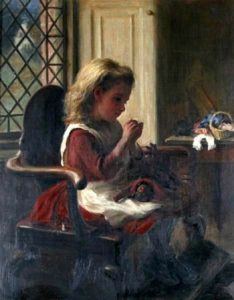
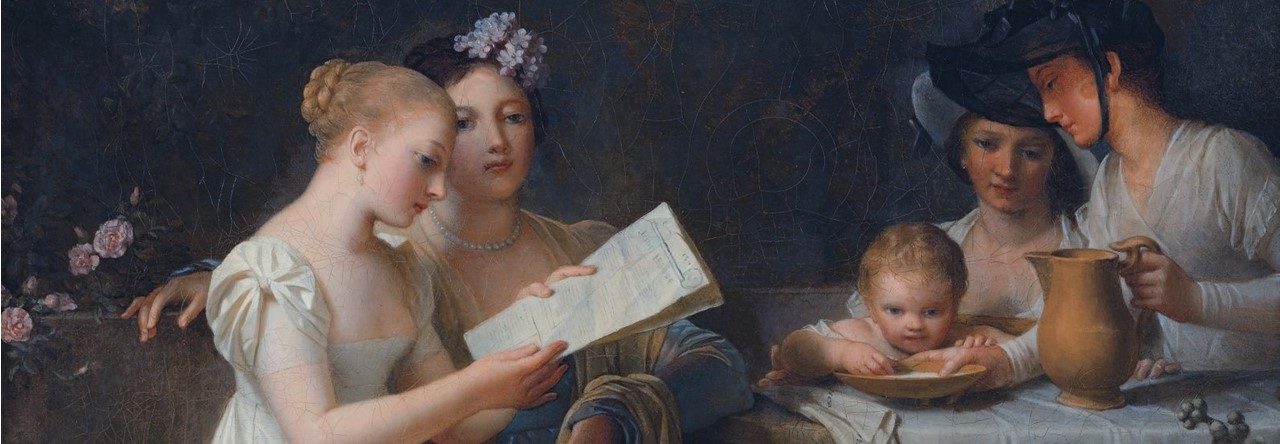
This charming painting purports to record a moment in history, when a child with a French regiment was put on the tomb of a knight to sleep, out of the way of a fight, covered by his father’s jacket.

Maggie was a fool. As long as the Colonel backed Lady Melville’s commands—as he had when Maggie went bleating to him with her complaints—the lady had every right to order the nurses about.

But all the wives knew Maggie was bitter because her former services to Lieutenant Sir Gervase Melville had stopped when he suddenly up and married. And Becky would bet her best iron pot that Maggie did a lot more for him than cooking and cleaning. Mind you, Lieutenant Melville didn’t confine himself to regimental widows like Maggie. He had dipped his toes in a lot of other soldiers’ bedrolls, as well as the local bits of fluff who came out to serve the regiment wherever it camped.

Swiving locals would be frowned on, but tupping the wives of his soldiers was worse. Mind you, it would be the woman who paid if anyone spoke out of turn. She’d be drummed out of the regiment and lucky if she was given the passage home. And the Lieutenant would get a rap on the knuckles.

“I’m going to tell the Lieutenant,” Maggie declared. “He’ll make her take me back.”

Becky stopped to move Freddie to the other hip, then hurried to catch up. “Don’t make trouble for her, Maggie. She has it hard enough. You know what he’s like.”

None of the wives believed the poor girl had suddenly started tripping over tent pegs and bumping into corners. Melville had been horrified when forced to marry the doctor’s daughter, and Melville in a temper was a nasty man.

But Maggie was obdurant. “Serves her right. She made her bed when she seduced him. She’ll just have to lie in it.”

Becky shook her head. No point in arguing. Maggie had her mind made up, but Becky didn’t believe Lady Melville seduced the baronet. Not her. As nice and as ladylike as the Colonel’s wife, who Becky had served as maid back when she first married Watson, while the regiment was still in England.

In any case, anyone with eyes would know it hadn’t been Melville that the doctor’s daughter wanted.

Becky sighed. She was a happily married woman, and a mother. But even she could see the appeal of Captain Alexander Redepenning. It was over now, of course. Lady Melville had made her choice and was stuck with it.

And how it happened, Becky couldn’t fathom.

“Yes. That’ll do. Gervase will help me.” Maggie slid her eyes sideways to see the effect of her use of the baronet’s personal name.

Suddenly sick of the other woman’s nastiness, Becky decided to take a stand. “Watson says the Colonel’s wife has come over to join him in winter quarters. Used to be her maid, I did, and she still has a fondness for me.”

“Not as fond as the Lieutenant is of me,” Maggie smirked.

“Yes, well, that’s the point, isn’t it. The Colonel will want her to check that the camp followers are,” Becky quoted the oft-repeated demand of the regimental regulations: “sober, industrious, and of good character. Don’t worry about it, Maggie Palmer. If they find out what you’ve done with the Lieutenant, you’d likely get your passage home. If the Colonel is in a good mood.”

Maggie frowned. “Are you threatening me?”

Becky shrugged. “Take it how you will. But leave Lady Melville alone.”


Their marriage is a fiction. Their enemies are all too real.

Ella survived an abusive and philandering husband, in-laws who hate her, and public scorn. But she’s not sure she will survive love. It is too late to guard her heart from the man forced to pretend he has married such a disreputable widow, but at least she will not burden him with feelings he can never return.

Alex understands his supposed wife never wishes to remarry. And if she had chosen to wed, it would not have been to him. He should have wooed her when he was whole, when he could have had her love, not her pity. But it is too late now. She looks at him and sees a broken man. Perhaps she will learn to bear him.

In their masquerade of a marriage, Ella and Alex soon discover they are more well-matched than they expected. But then the couple’s blossoming trust is ripped apart by a malicious enemy. Two lost souls must together face the demons of their past to save their lives and give their love a future.

Jude Knight’s book pageSmashwords # iBooks # Barnes and NobleAmazon US

Page 128 of 154

Powered by WordPress & Theme by Anders Norén