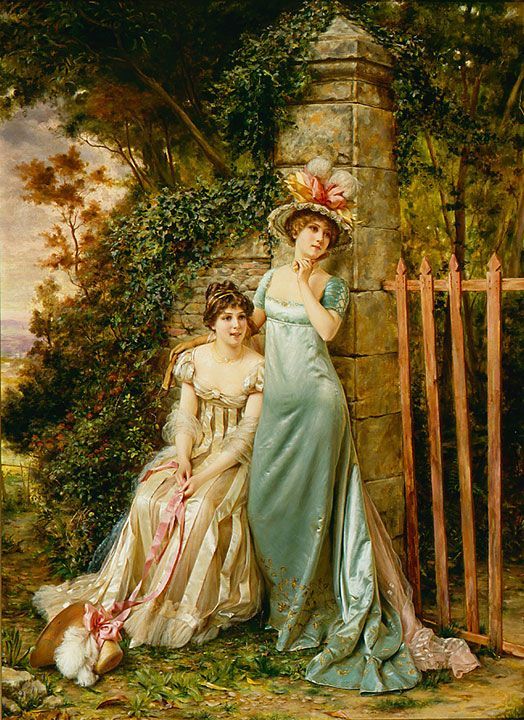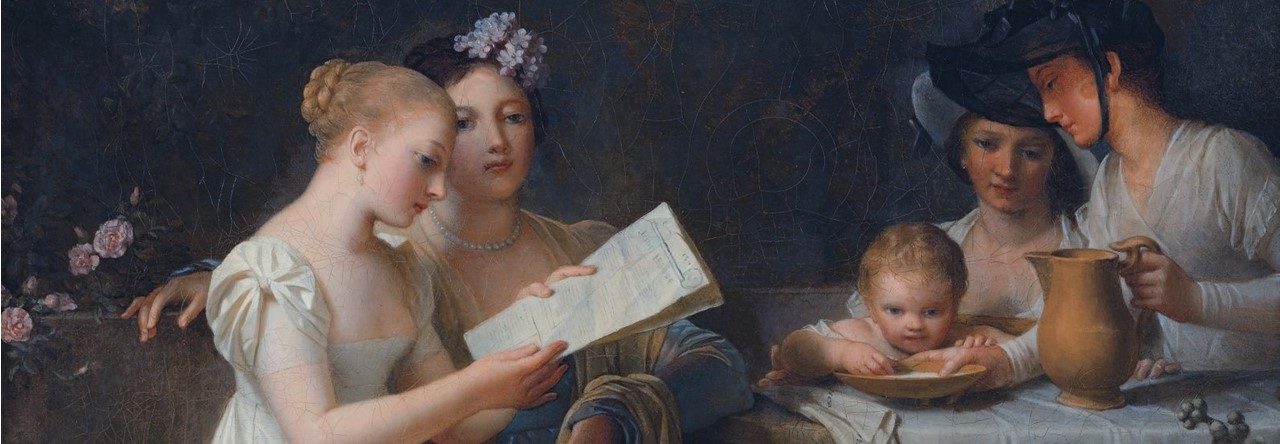
My Fishingham twins spying on their sister’s meetings with the Beast Next Door.
“Why did you stop me telling Charis about the Earl of Wayford?” Matilda demanded, as soon as Charis was out of earshot. “She clearly has no idea…”
Eugenie smirked. “Exactly. She has no idea. Just think what a delightful surprise it will be for her when the Earl actually turns up to claim his bride!”
Matilda frowned, puzzled. She could work absolute magic with a needle, but she sometimes had to have plots explained to her. It was not that she was stupid, it was just that she was straightforward and honest, so Eugenie had to be devious enough for them both. Eugenie didn’t mind; that was, after all, what a twin was for.
Eugenie didn’t exactly mind, either, that Charis, who was two years older than the twins, walked around with her head in one of her books, and ignored the family’s dire straits and the measures needed to save them. That was just Charis. She had always been that way, preferring her own company to playing with the twins, and regarding fashion, gossip, and the twins’ other interests with a kind of bewildered disdain.
She was extremely cross that Mother had accepted a proposal on her behalf.
“Are you not delighted that Charis is the one to find a rich husband to save the family?” Eugenie asked Matilda. “You and I will be much freer to choose. Someone comfortably placed, of course, but how lovely that Mama will be able to depend on Charis!”
Matilda nodded. “Of course I am pleased. But Eugenie, shouldn’t we tell Charis…”
“Definitely not. After what she has put us through this season? Besides, if she had told mother she was meeting someone when she wandered off next door, she might have learned the truth much earlier. Nothing good comes of lying to one’s mother!”
Matilda burst out laughing. “Eugenie Fishingham, you are a complete card. You and I have been lying to Mother ever since we followed Charis weeks ago, and saw whom she was meeting. Not to mention…”
“Let’s not mention,” Eugenie said, hastily. She would be far more prone to falsehoods if she did not fear that Matilda would blurt them out at the first opportunity. She reminded herself that really was lucky to have such an honest twin.
“I suppose we can always tell Charis tomorrow,” Matilda decided. “Shall we go up to our room, dearest? I, for one, do not wish to return to the parlour to hear Mother berating Charis for refusing this wonderful opportunity.
It is with great reluctance and heaviness of
heart that I write to you today, but decency demands I must. Were that it not
so! A most intriguing stranger arrived at the Pump Room not a fortnight past —
you’ll note I hesitate to call him “gentleman”! The Chevalier d’Aubusson — if
indeed he holds the honor — has charmed all and sundry with a practiced grace
and the face of an Adonis, but I rather suspect –nay, I am certain! — he
means to abscond with one of our impressionable young ladies. For their part,
the young ladies are only too happy to comply!
His attention has fallen upon the rather
tragic figure of Lady Emilia Lloyd-Marshal, known to some by the affectionate
appellation “Lady Taffy” because of her unfortunate Welsh roots. As you well
know, Lady Emilia was presented late, and is now on her sixth — sixth! —
season with not a suitable swain in sight. What does she expect, carrying on
the way she does? She shocked the assembly into silence with an impromptu harp
recital whilst we were attempting to take the waters in peace. She discarded
her gloves, then emptied her glass into a ficus — a ficus, I ask you! At the
ball this Thursday last, I espied her sneaking gin from a flask concealed on
her person, then she stole a dance with the chevalier from my daughter, and deported herself like a veritable harlot. If that
isn’t enough to scandalize you, my dear Mr. Clemens, you may need to find your
seat for what I am about to impart.
Lady Emilia Lloyd-Marshal is to appear in a
play with none other than the infamous Countess of Somerton — in a theater!
Truly, some Good Samaritan ought to save that
girl from her own worst impulses. I suppose it cannot be helped. Though I have
not seen her parents in your scandal sheet of late, I can assure you their behaviour
is as reprehensible as ever. It is an open secret Lord Brecon lives in sin with
a fishwife in some Welsh backwater, while Lady Brecon frequents the bawdy
houses of Soho with her retinue of misguided lords, chief among them the
hapless Lord Dorchester, who seems quite devoted, poor lamb. In such a
household, I daresay Lady Emilia hadn’t the slightest chance of reaching
maturity unscathed. But I digress–!
Mr. Clemens, I only wish to caution the
unmarried ladies of the ton against this mysterious chevalier. He must be a
pretender, for what gentleman would ever seriously court Lady Taffy? Fortune
cannot make up for shamelessness or ill manners, and I’m afraid Lady Emilia has
an abundance of both. I shudder to think what machinations the “chevalier” has
in store for her, but whatever fate awaits her, I am assured she brought it on
herself.
Regretfully,
Lady C—-
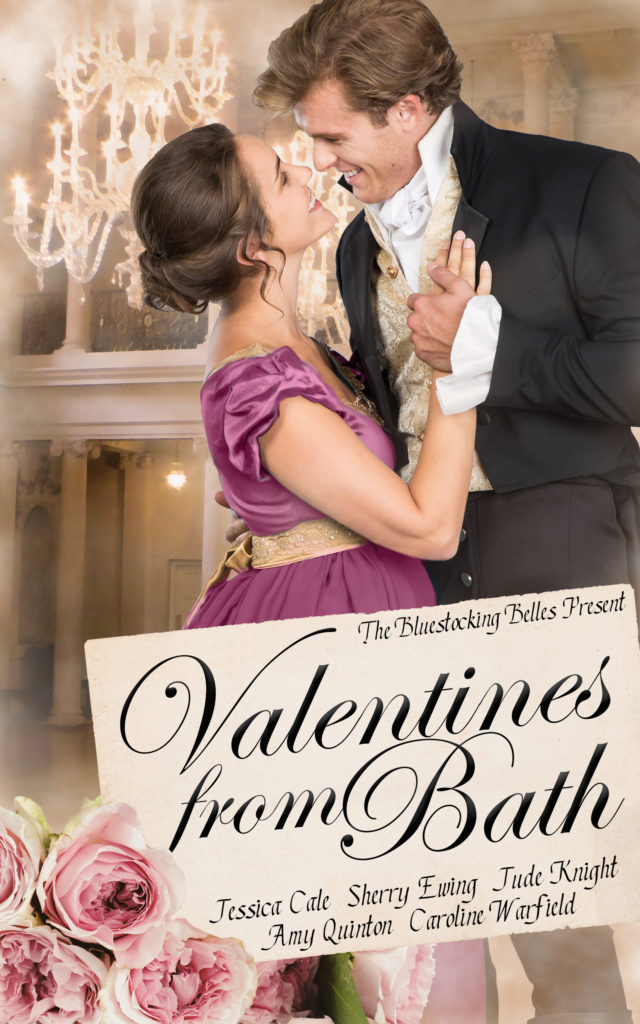
Beauty
and the Bounder by Jessica Cale
He’s a
liar and a fortune-hunter . . . and exactly what she needs.
The moment Lady Emilia sets eyes on the Chevalier d’Aubusson, she knows their fates are tied together. For good or ill, she cannot say. A mysterious aristocrat with a tragic past, the chevalier makes waves with his considerable charm.
Seb
Virtue is not as he seems. A once-famous actor with a limited options, his
future depends on him catching a rich bride. He thought it would be easy, but
he didn’t count on Emilia.
There
are cracks in Seb’s story, and Emilia never could resist a mystery. Whether
he’s a gentleman or a bounder, he might just be the man for her.
Seb had as much right to be here as
anyone. Birth be damned, he was just as good as them if not better. Hadn’t he
fought and nearly died for his country? So, he didn’t have a fortune or an
ancient name that meant anything outside of Southwark, but he knew how to treat
a woman. If Emilia took a chance on him, she’d find out just how good he was at
that.
As the couples split into pairs, Seb took Emilia in his
arms. She looked startled as his hand found its natural place at the base of
her back. At a loss, her free hand skimmed his chest and settled behind his
neck. Holding their joined hands tighter, he led her around the room. As he
spun her in clockwise circles in an anticlockwise direction, the unavoidable
dizziness gave one the sense of flying.
Emilia followed him easily, but he had the sense he’d
shocked her. They were moving too quickly to properly converse, and he
preferred it that way. He relaxed into the familiar steps and focused on her
face. Her eyes were bright, her cheeks flushed, and her lips parted in
surprise. She was a little breathless, but not nearly breathless enough. As he
twirled her, a sprig of lavender fell from her hair and was crushed underfoot,
adding to the perfume of beeswax and warm bodies in the air. She gasped as he
caught her and held her to his chest.
Her gaze fell to his lips. “I’m quite scandalized.”
He regarded her with interest. Not yet, she wasn’t.
Jessica Cale is an
author, editor, and historian based in North Carolina. Originally from
Minnesota, she lived in Wales for several years where she earned her B.A. in
History and MFA in Creative Writing while climbing castles for history
magazines. She kidnapped (“married”) her very own British prince (close enough)
and is enjoying her happily ever after with him in a place where no one
understands his accent. She is the editor of Dirty, Sexy History, and you can
visit her at dirtysexyhistory.com.
Website: http://www.dirtysexyhistory.com
Facebook: http://www.facebook.com/dirtysexyhistory
Twitter: http://www.twitter.com/JessicaCale
Instagram: http://www.instagram.com/caleisafourletterword
He found the Forster twins in the face of
Rob Jones, the junior footman. “We get the card room. We always do. It’s
ourn,’” Hiram Forster shouted at the boy. The card room always had good hunting
for stray coins and half-empty wine glasses. Valuables were meant to be turned
in, but they all knew Fowler would pocket any coin they handed over.
“Then get you here early,” Harold snarled,
coming up behind him. Hiram looked as if he might complain, but the miscreant
looked up at Harold’s size and backed down. “Get up into the gallery, you two.
Clean the floor. There’ll be wine stains, make no mistake. Mind you scrub it
good.”
Hiram stuck out a defiant chin, but his
brother Grady pulled his arm. “Told you to come sooner,” the brother muttered.
“Let’s see what we can find in the gallery.”
Harold shook his head. If it was up to him,
he’d fire the pair of them. As they walked away, something caught his eye.
“What’s that sticking under your shirt, Forster,” he demanded stepping smartly
to grab Hiram by the arm and spin him around. He reached under the shirt and
pulled a silky white garment out, a pair of lady’s lace drawers.
“That’s mine!” Hiram shouted.
“Wear them often?” Harold sneered.
Hiram turned beet red. “Found it, din’t I?
Keeping it for m’ sister.”
“Where would you ‘find’ something like
that?”
“That big pot at the end of the portico
where it meets the alley. Nice dark spot is that at night.” Hiram shrugged.
“Some widow no better than she should be.”
Harold looked at the object he held between
thumb and forefinger. It cost someone a pretty penny, but he doubted any lady
of quality would admit to losing it. He tossed it at Hiram. “Go ahead. Keep it.
Give it to your sister.”
“Yah. Yer sister,” Grady laughed. They
scurried off and Harold shook his head. He peered up at the clock on the
Octagon. Half-past ten, and still no sign of Fowler.
“Do I need to turn this in?” Rob asked. He
held up one black leather glove. Harold nodded at him. “Sorry to say it after
those two, but yes. You know where it goes. A gentleman might ask for that.”
Rob glanced at the departing Forsters and nodded his understanding.
Maudy approached him when he went back
about his work. “Here’s the flannel square, Mr. Randal. Bit damp yet.” She
beamed at him, and his heart warmed.
“Put it on the subscription desk, Maudy.
We’ll see what Fowler wants to do.” If the fool turns up to work.
He had moved the second row of chairs and
was staring on the back one when Maudy returned. “It will go faster if I move
them and you mop,” she suggested. He should send her into the tea room, he
knew, but what harm in the pleasure of her company? They set to work, and it
went quickly, until he found himself mopping the very back row by the wall
while Maudy moved the last of the chairs. He looked over to see her bent over,
gifting him with the sight of her rounded little behind, and rattling his brain
so that he didn’t hear what she said.
“Mr. Randal,” she repeated. “Did you hear
me? I found something.” She pushed herself off the dirty floor, and wiped
one hand on her skirt, the other holding something. He leaned in and saw it was
a book. “Miss Middleton’s Guide To Etiquette,” he read, “Some lady’s no doubt.”
“It’s well thumbed, for sure,” she
murmured. “Do you think they’d let me keep it? I won’t want it if I have to ask
Fowler.”
Harold didn’t blame her but, as it turned
out, she didn’t have to. The Master of Ceremonies, Old King himself, appeared
on the scene just as they got the chairs back in their proper places. And it
just noon—odd that.
“Good man—Randal, is it? The men told me
you sorted the work out.” He must not have spoken to the weasels in the
musicians gallery.
“Aye, Sir. They’re good workers.”
“Have you seen any sign of Fowler?” King
asked.
“No, Sir.”
“Had complaints from no less than an earl
last night. Went to fetch him and he’d scampered. Took the money from the safe
with him.” King looked like he’d sucked a lemon. “We can’t have it out, mind
you. I’m trusting you to keep it to yourself.”
“No problem, Sir. We don’t want our
Assembly Rooms besmirched,” Harold said.
King nodded. “Can you manage the thing? At
least for a while until I can sort it out?”
“Yes, Sir. I know I can.” Harold stood a
bit taller. Over King’s shoulder he saw Maudy smiling at him. If a promotion
was on offer he could afford—well, best left unsaid for now.
“It was a fine ball, though, wasn’t it?”
King said. “Valentine’s Day Ball. We’ll have to do it again next year, don’t
you think?”
“Yes, Sir. A night for lovers that was.” Maudy’s smile spread into a cheeky grin. Next year might be even better.
For Part 1 of After the Ball is over, see last Wednesday’s post.
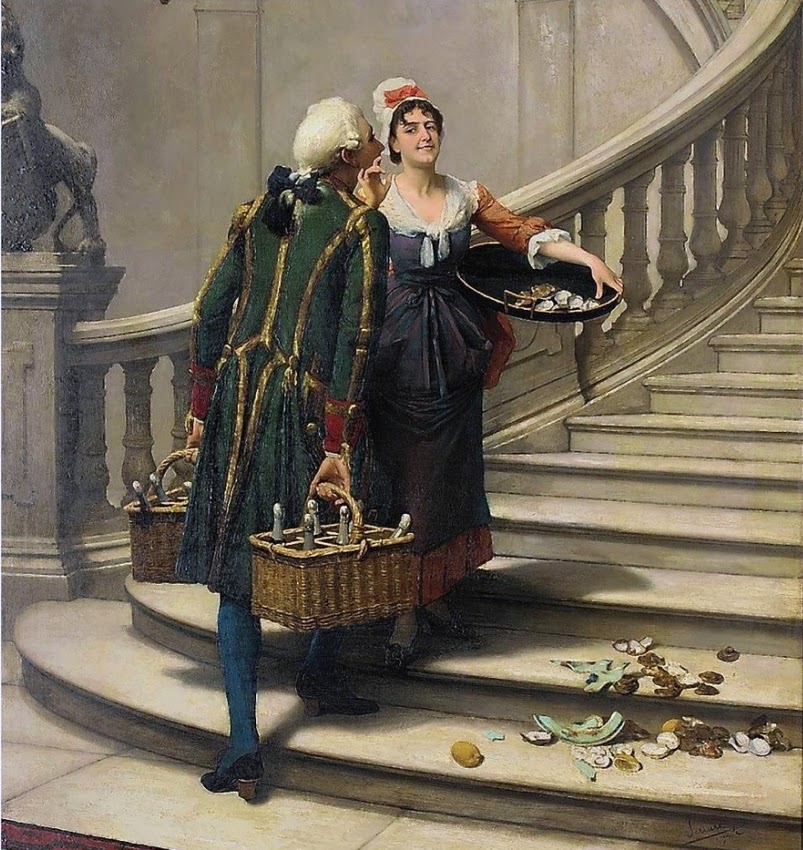
When the toffs dance the night away, they
spend the morning in bed. The folks who run about to take their coats, clean
their spills, and carry trays laden with delicacies—not to mention deliver
their billets doux and right
scandalous invitations—have no rest at all.
Harold Randal woke at dawn, stuffed his
rumpled shirt into his trousers—no need to look sharp during cleanup—and gulped
down coffee from a tavern on his way to work. He didn’t worry about being late;
that snake Fowler wouldn’t waltz in before ten. Harold prided himself on being
better than that. He would have to get the lazy Forster twins moving on his own
or they would be at it all day.
He found the key in its spot under a brick
by the tradesmen’s door and let himself in. The caterer’s kitchen looked well
enough. They always take their glassware and leave their bill. He wandered down
the servants’ passageway, under the stairs to the musicians gallery, and into
the Octagon. Sun streamed through the east windows, and he wished it didn’t.
They had a long day ahead.
A soft sound from the ballroom startled
him. He thought he was alone. He peeked around the door to see Maudy, the shy
little maid of all work, scrubbing away at a doorknob with an odd little scrap
of flannel. Pretty little thing was Maudy, but how did she get in?
“Good morning, Mr. Randal,” she said
twinkling up at him and not pausing in her work. She peered closely at the
brass handle and rubbed it harder. Harold stood transfixed by the sight. Pretty
and industrious. She glanced up and blushed. “I ’spect you’re wondering how I
got in so early.”
“The thought did come to me.”
“I never went home,” she told him. “I fell
asleep under the counter in the cloak room. Thought I best get to work.” She
stared down at her dress. “Sorry I’m so wrinkled up.”
Harold laughed at that and pointed to his
own clothing. “No need to look fine for cleaning,” he assured her. “Have you
had something to eat?”
“I found a half-eaten cake on a plate on
the counter when I crawled out. I hope no one minds I ate it and all.”
“What were you doing under the counter,
Maudy?” he asked.
She stared at her feet.
“Maudy…”
“Hiding from Fowler,” she whispered,
glancing furtively around. “It doesn’t do to get cornered by that one, and he
was in a taking last part o’ the night. Frightens me, he does.”
“Dirty bounder,” Harold muttered. He groped
for something else to say. “What’s that you’re using to clean with? Looks finer
than our usual.”
She held up a piece of flannel, cut in a
neat square with embroidery clear around the hem. “I found it on the floor of
the cloak room. It’s perfect for shining brass. I can clean it if you think
someone will come looking for it.”
Harold’s brows came together. The edge
looked fancied up, but who would care about a scrap of flannel left on the
floor. “Keep doing what you’re doing. We can clean it if they ask, like you
say.”
He fetched a mop and began cleaning the
floor to the ballroom, moving chairs back as he went. In a half hour, he had a
pile of dust, used tokens, and crumpled valentines fetched up in the middle of
the floor. At least four of the gents had their sentiments rejected, near as
Harold could see.
By that time most of the crew had wandered in. Most needed no direction. They set about dusting, scrubbing and polishing as needed. He reached the rows of chairs where the dowagers and wallflowers generally sat and began moving chairs so he could mop. He hadn’t gone more than a row deep when he heard a scuffle in the Octagon room.
“Mama, why must we,” Emma twitched at her crinoline with a scowl in an attempt to keep it clear of the mud and manure in the middle of the main thoroughfare, “wear the height of London fashion in this God-forsak—”
“Emma!” Mrs.Wyndham-Smyth hissed. “Ladies do not use that
sort of language.” She flicked glances over both shoulders, her face paling.
Her daughter continued like she hadn’t heard her. “I thought we were moving to the wilderness when we came all the way to New Zealand and we’re still stuck in this filthy town. At least if we went to the provinces we could have some fun and not dress like trumped-up—”
“That really is enough, young lady.”
from http://www.aucklandcity.govt.nz/dbtw-wpd/heritageimages/index.htm
Emma took a deep breath to steady herself before she went
on. “Tūī says we wear too much clothing. I agree. It’s steaming hot in these
woolen dresses. We should dress like—”
“Heathens!” her mother declared. “You pay no mind to what
the servants say. They are servants and we are their masters.”
She stared at her mother. “Tūī is my friend. She works for us, even though New Zealand is their land. The Māori’s land. I’m not sure why you treat them with the disdain you and so many others do.”
“It’s just the way it is.” Her mother tried to look
indignant, but she seemed to be losing ground and stole more looks around her. As
if her friends might be nearby.
“Anyway, I want to go live in the provinces. Coromandel Town seems a nice place.”
Driving Creek, Coromandel
“The mines?” Mrs. Wyndham-Smyth’s eyes goggled and she
turned a shade whiter. “Wherever did you hear that claptrap?” Her knuckles
whitened on her shopping basket and she walked faster toward the market.
“From that nice Prussian newspaperman, ummm…”
“You mustn’t say ummm, my—”
Emma went on. “That Mr. von Tempsky whom Papa invited to supper last month.”
Her mother’s lips tightened. “He’s not a newspaperman any
more. He’s leading our colonial troops into the bush… against the Māori. To ensure the successful invasion of the Waikato.”
von Tempsky
“But…” Emma froze, then finally slapped her mouth shut a full half minute later. “That can’t be true.”
“True it is,” the woman said, turning back toward her. “And don’t let your father hear you say that. He’s the one who secured the commission for ‘The Prussian’ to help our army.”
“But we can’t…” Emma whispered. “It’s their land. They
have all the land south of the—”
“Not any more.” Her mother gritted her teeth. “Seems the land
in the Waikato has already been offered to the Australians and mercenaries who
are coming to help fight.”
“Clear the way, prisoner coming through!” shouted a burly man. It was the jailor, bundling along a tall, dark man who would’ve been as handsome as Mr. von Tempsky if only he wasn’t so dirty and wearing manacles.
“Do you know who that is?” Emma whispered to her mother.
“It must be that Spaniard—Xavier Argolli or something, I think they said. The constable just caught him. He’s been running free after murdering his ship’s captain on the voyage to New Zealand.” She sniffed. “Imagine that.”
The prisoner looked up then and his eyes met Emma’s. He shook his head and just had time to whisper something before his captor dragged him past.
Fort Britomart, Auckland
“Find von Tempsky,” had been his words.
Emma stared after the prisoner. He must’ve heard her mention the Prussian’s name. “Excuse me, Mama, I’m not feeling well,” she said as she spun on her heel and raced for home, already planning what to pack in her saddlebags. She’d find him.
Excerpt from A Sea of Green Unfolding:
December 1863, Auckland
Crowned by a spired white
church, a high, rocky headland jutted out of the coastline to their port side.
The captain of the whaler steered wide of the breakwater extending from the
point and headed his ship into the next big bay.
“Auckland,” the captain said,
nodding his head at the sprawling city behind the ships filling the inlet and
docked at the wharves.
Upon the headland ranged
several cannon and many one- and two-storied stone buildings. A Union Jack,
flying from a flagpole, presided over the site.
“Complete with fort?” Xavier
said.
“Fort Britomart, on the point
of the same name.” Thompson nodded at the cluster of buildings. “Built on an
old pā site.”
“Big ditches around the
outsides and all,” Xavier said, staring up at them as they passed.
“They’d be the original Māori
trenches,” the captain said, never taking his eyes from the rocks to their port
side. “We’ll dock at Queen’s Wharf,” he added.
The city of Auckland spread out
before them, rising up the gradual slope beyond the bay. The fort was sizable,
but the church dominated the skyline behind Point Britomart. Warehouses and
stores lined the road running along the water’s edge and houses covered the
hills in the background.
“That’s a bit grand for this
little place,” Xavier said, pointing to the church.
“Eh? Oh, that’s St. Paul’s
Anglican. It was the first one here. It’s been there for twenty years, already.
And up there,” he jutted his chin up the hill a little further, “is St.
Patrick’s. Take your pick. They’re both grand.”
“I think I’ll find Aleksandra
before I start looking around at churches,” Xavier said, with a grin.
The sounds and smells of port
hit him when they edged up to the wharf and threw out their hawsers to the
waiting men. As soon as the boat was moored, Xavier grasped the hand of the
captain and thanked him profusely, then climbed down the rope ladder to the
dock.
“Von Tempsky shouldn’t be too
hard to find,” the captain called down after him. “Just ask at Fort Britomart.
They’ll know where to find him.”
“Thanks again,” Xavier said,
waving, as he headed for the point.
The rough scoria of the road
surface grated on the soles of his boots as he passed the church. With its tall
spire and elegant lines, it was truly beautiful. Certainly a finer building
than he’d expected to find here. Perhaps it wouldn’t be such a backwater, after
all.
His legs were proving a bit
unsteady from his time at sea, so he stretched them out as he walked, nodding
to passers-by, many of whom turned their faces away as he neared them. He
grinned, despite himself. He must smell like a fiend after being on ship for
three months, and the last of that on a whaler. Once he set the wheels in
motion to find von Tempsky and Aleksandra, he’d get a room and a bath. He could
almost feel the warm water of a scented bath enveloping him.
“Hold there,” the guard at the
entrance to the fort challenged.
He held up his hands and stood
still, coming out of his daydream.
“Hello,” Xavier said. “De
veras, of course.”
“State your name and business,”
he barked.
“Xavier Argüello, looking for
Captain Gustavus von Tempsky. I understand he may be near Drury?”
Several men looked up at his
comment, brows narrowed.
“Right this way,” the guard
said, giving him a sideways glance, his hand on his sword hilt.
The other men melted away, then
the guard stood aside for him to precede him into a stone building.
The door slammed behind him and
metal scraped upon metal.
Xavier turned, but the guard
was nowhere to be seen.
He surveyed the waiting room. A
five by five room, with only a wooden bench against one wall and a high, barred
window.
Some welcome.
If they were trying to discourage
visitors, they were doing a good job. He knocked on the door. A shiver ran up
his spine when no one replied. He tried to lift the latch, but it wouldn’t
budge. Even when he shook it. “Hey, you’ve locked me in! Guard!”
Only silence, then retreating
footsteps on the boardwalk outside the door.
It finally clicked.
This was a gaol cell. But why?
Had von Tempsky disgraced himself?
Xavier sat down to wait
patiently, but eventually he rose to prowl from one wall to another. He pulled
the bench before the grilled window, but it didn’t give him enough height to
see out, so he put it back and continued to walk the walls.
There must be some mistake.
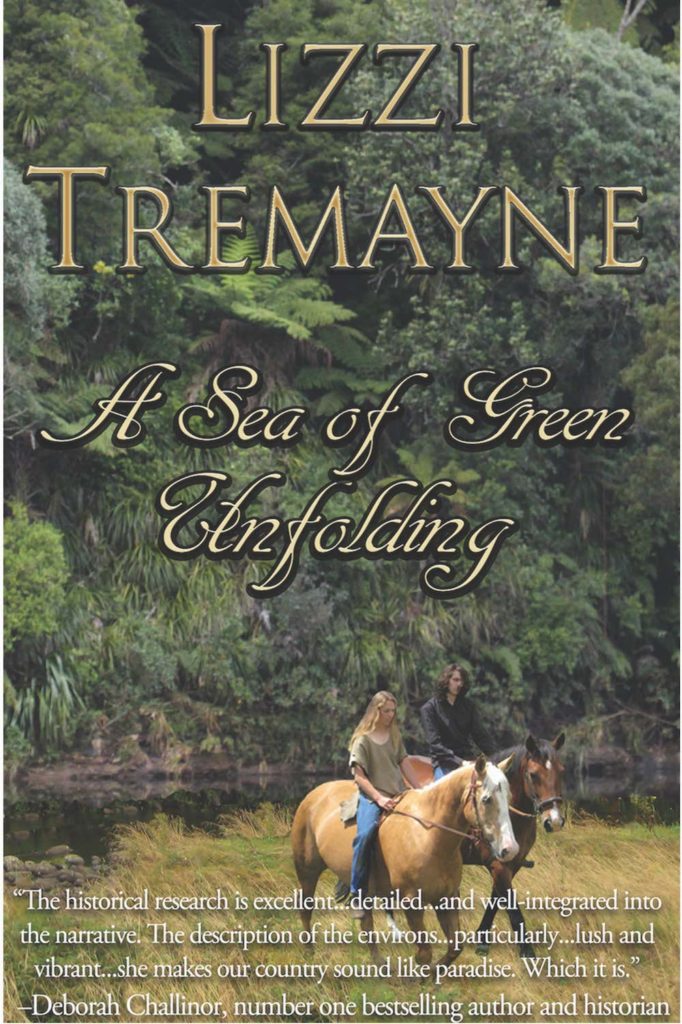
A Sea of Green Unfolding
When you’ve already lost everything, the only place left to go is up…
Tragedy strikes in Aleksandra and
Xavier’s newly-found paradise on their Californio Rancho de las Pulgas and
newspaperman Gustavus von Tempsky invites them on a journey to a new life in
New Zealand—where everyone lives together in peace.
Unfortunately, change is in the
wind.
When they reach Aotearoa, they
disembark into a turbulent wilderness—where the wars between the European
settlers and the local Māori have only just begun—and von Tempsky is leading
the colonial troops into the bush.
Lizzi
grew up riding wild in the Santa Cruz Mountain redwoods, became an equine
veterinarian at UC Davis School of Veterinary Medicine and practiced in the
Gold and Pony Express Country of California before emigrating to New Zealand.
Busy
raising two boys, farming, and running her own equine veterinary practice, she
never thought she’d sit down long enough to write more than an article. A
serious injury, however, changed all that, and planted her in one place long
enough to jump-start her new career as an author!
With Lizzi’s
debut historical romance, A Long Trail Rolling, she
was: Finalist 2013 RWNZ Great Beginnings; Winner 2014 RWNZ Pacific Hearts Award
for the best unpublished full manuscript; Winner 2015 RWNZ Koru Award for Best
First Novel and third in the 2015 RWNZ Koru Long Novel section; and Finalist,
2015 Best Indie Book Award. She’s working on her eighth story!
When
she’s not writing, she’s swinging a rapier or shooting a bow in medieval garb,
riding or driving a carriage, playing in the garden on her hobby farm, singing,
cooking, practicing as an equine veterinarian or teaching high school science.
She is multiply published and awarded in special interest magazines and
veterinary periodicals.
Lizzi loves
the friendships she’s developed with the rest of the Belles. She adores how
they’re so progressive, organized, and fun. Best of all, they are all willing
to put themselves out there, together, to achieve
more, create more, than would be possible going it alone.
Lizzi
loves to connect with her readers. How would you like to connect?