 CONTEST CLOSED: SEE THE COMMENTS FOR WINNERS
I hope you enjoyed your stay in Regency England via Nicole Zoltalk’s Blog. You are now in 17th Century England!
Thanks for stopping by and welcome to London in 1645: a time of intense political and religious upheaval.
Civil War

King Charles I by Anthony van Dyck
In 1645, England was in the midst of a civil war between King Charles I with his Royalist supporters (or Cavaliers) and Parliamentarians (or Roundheads) who wanted a parliamentarian government rather than a royal monarchy.
The English Civil War lasted from 1642 to 1651, and the end saw the trial and execution of Charles I (Beheaded in 1649), the exile of Charles II (in 1651), and the replacement of the English Monarchy with the Commonwealth of England (in 1649-53) followed by The Protectorate under Oliver Cromwell (in 1653-1658) followed by Richard Cromwell (in 1658-59).
The English Monarchy was restored in 1660 when King Charles II returned from exile and retook the English throne. This date also marks the beginning of the Restoration period of England.
The period of time between the beheading of Charles I (in 1649) and the Restoration and return of Charles II (in 1660) is known as an Interregnum.
King Charles I portrait by Anthony van Dyck
Religious Upheaval, Puritanism, and an Attack on Christmas!
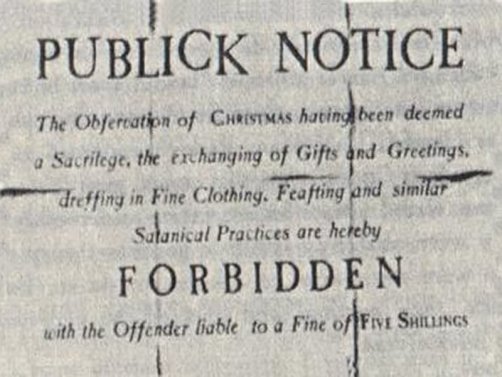 By the mid-17th century, Puritans—whose initial goal was to purify the Church of England and abolish any connection with Catholicism due to the idea that the entire organized religion of Catholicism was corrupt—had considerable influence in America and most of Europe. Puritans had power in government and thus the ability to influence laws. In the 1640s, the parliamentary party (working within the elected parliament) began working to suppress saints’ and holy days, including Christmas! This attack on Christmas came about for several reasons: they disliked the extravagance and disorder associated with the celebrations surrounding Christmas, and they saw Christmas as an unwelcome reminder of Catholic traditions (Christ’s mass). Further, they argued there was no biblical justification for celebrating Jesus’s birth.
By 1644, parliament went so far as to stress that December 25th should be a regular day of fasting and humiliation, as it happened to coincide with their weekly holy day. Further, people were directed to consider it a specific time of penance for past carnal delights associated with the holiday.
In January 1645, Parliament fully abolished and made illegal any observation of holy days, apart from Sundays. By 1659, Christmas was even abolished in parts of America, specifically the New England area, which had a strong concentration of Puritans. In fact, though the ban on Christmas in America was repealed in 1681, it wasn’t until the mid-19th century that people widely began celebrating Christmas again in Boston!
A Year Without a Christmas from Never Too Late takes place during this time, when Christmas celebrations were prohibited, and is a theme of the story.
17th Century Fashion
We’ve all seen the extravagant neck ruffs associated with the Elizabethan era. By the 17th century, ruffs began to disappear to be replaced with broad lace or linen collars. Sleeves, which had previously been tight and fitted, became loose and flowing—many had slashed sleeves which revealed the shirt or chemise beneath.
Women’s clothing still consisted of bodices, petticoats, and gowns with wide lace collars and matching kerchiefs. Waistlines raised and lowered throughout the century, favoring a longer, loose silhouette. Men wore shirts, doublets, and hose, and for the first time, shoes began to have heels.
The influence of Puritanism can be felt in fashions of the time, with many apart from the extremely wealthy wearing more somber colors and significantly less lace, which was considered extravagant and wasteful. However, the higher the rank, the more lace was worn as success in Puritan eyes mean that a person was particularly blessed and therefore more Godly.
Women wore the bulk of their hair loose, with the top section pulled back into a bun, and often had bangs or fringe. Married women quit wearing lace caps so characteristic of the previous era. For men, long curls were fashionable. Cocked hats, pinned on one side with a mass of ostrich plumes was characteristic of the 1630s. The ascendance of the wig did not come about until the 1660s.
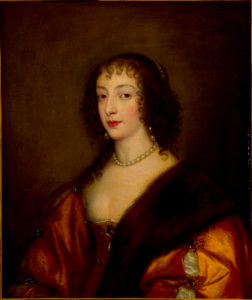
Henrietta Maria of France, Queen of Charles I by Anthony van Dyck

Hester Tradescant, second wife of John Tradescant the younger, attributed to Thomas De Critz, 1645.

Philip IV in Fraga by Diego Velazquez
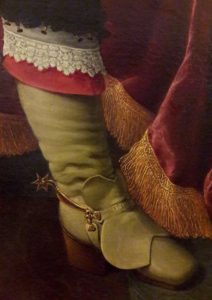
Fashionable heeled boot with butterflies to prevent chafing from spurs.
Giveaway
Comment on all eight blogs in our tour and be entered to win a $25 gift voucher from Amazon and a print copy of Never Too Late!
You can get to all eight blogs via the time machine page on our Bluestocking Belle’s website once all tour stops are published.
Farewell from 1645
Thank you for stopping by. We hope you found your stay informative. Your next stop, takes you back to the beginning of the tour on Jude Knight’s blog, where you’ll visit New Zealand in 1886. Or you can return to the time machine page on our Bluestocking Belle’s website and pick a year.
I wish you safe travels. Good luck. Try not to land in the midst of the Battle of the Somme!
Buy Links
Amazon US | Barnes & Noble | iBooks | Kobo | Smashwords
Amazon AU | Amazon BR | Amazon CA | Amazon DE | Amazon ES | Amazon FR | Amazon IN | Amazon IT | Amazon JP | Amazon MX | Amazon NL | Amazon UK
 On Tuesday, the newly wed Lady Theodora Stonemere and I had the occasion to take tea. It was quite the visit as I have learned so many tidbits about some of my favorite former patrons.
 His brother’s untimely death leaves him with an Earldom and a fiancée. Too bad he wants neither of them…
 Inside a Parisian tavern on July 13, 1789
 The Season is off to an excellent, if early, start. Lady S., daughter-in-law of the Duke of W. must be delighted with the attendance at her soirée, though perhaps less than pleased with the behaviour of some.
 But the affairs of the great are far from the only business conducted at such an event, and last night was no exception.
 One would expect a maiden in her second season to show more sense than to respond to a note from a man, and certainly the girl’s protectors to display more awareness of their charge’s whereabouts. Was the title ‘Earl’ a lure that caused her and her chaperone to cast discretion and rational thought to the wind?
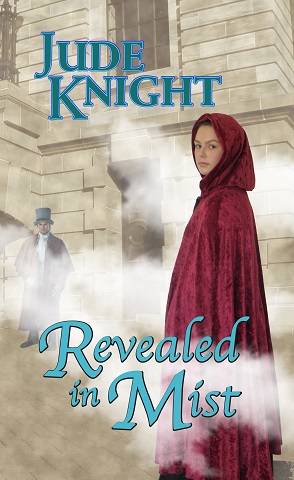 Prue’s job is to uncover secrets, but she hides a few of her own. When she is framed for murder and cast into Newgate, her one-time lover comes to her rescue. Will revealing what she knows help in their hunt for blackmailers, traitors, and murderers? Or threaten all she holds dear?
 The newest correspondent for The Teatime Tattler is masked, but the mask cannot disguise the youth of her voice or the slenderness of her form. Still, who better to interview a viscount about his life and his love, than a lady? The predictable, thrifty, chivalrous hero from Barbara Devlin’s book My Lady, The Spy takes the seat beside her in the park, as arranged.
 The Descendants
 Bestselling, Amazon All-Star author Barbara Devlin was born a storyteller, but it was a week long vacation to Bethany Beach, DE that forever changed her life. The little house her parents rented had a collection of books by Kathleen Woodiwiss, which exposed Barbara to the world of romance, and Shanna remains a personal favorite.