I write as a concerned member of the public. This recent rash of BRIDES who refuse to do their duty to their FAMILY must be stopped.
Sir, I protest the latest offering from the Bluestocking Belles, this CABAL of females who publish FICTIONAL ACCOUNTS that encourage women to think for themselves.
As if any female has the BRAIN, sir, to know better than her FAMILY about how to choose a husband to protect and care for her.
In their latest book, the Bluestocking Belles offer stories of brides who RUN from excellent matches. The first has a maiden who is upset to find that a young man is marrying her for her dowry and her pedigree. This, young woman, if the WAY of the WORLD. It is not an excuse to flee your responsibilities.
In the second, likewise, the young woman rejects the excellent match her FATHER made for her on the specious grounds that the chosen man has firm ideas about controlling her behaviour. Clearly a case of spare the ROD and spoil the CHILD.
The third story has a commoner who refuses to marry at the behest of her AUNT, even though the COUSIN the aunt choses is a man with a TITLE, and therefore better than such a female might hope to expect.
In the fourth, a girl whose birth is questionable runs from an earl offering, or so she thinks, a liaison that is NOT respectable. What else does such a female expect?
Two more short stories complete the set, on the same scandalous theme.
I wish, sir, to express the most serious of objections to this collection.
Imagine our surprise, dear reader, at what we saw today on the corner of Milsem and Bond Streets. A certain runaway bride, six months gone from London.
You may remember the scandal we wrote about six months ago; a nobody of a chit, Miss F., who trapped Lord B., the handsome and mysterious earl, into marriage. She was discovered in his bed. Drugged and placed there by her wicked uncle, the earl said. Said we, pull the other one, my lord.
Whoever came up with the ruse, they were wed within days, and a week later the new Lady B. disappeared, run away with a sailor.
Lord B. retired from Society immediately after. Does he know she has returned? And what will he do when he finds out?
‘A Gentleman Honors His Word’ is a bonus short story in the new box set by the Bluestocking Belles, coming out on 15 November. In Holiday Escapes, four runaway brides who first saw their stories told in the Bluestocking Belles’ first box set, long out of publication, are brought together again.
Holidays, relatives, pressure to marry—sometimes it is all too much. Is it any wonder a woman may need to escape? The heroines in this collection of stories aren’t afraid to take matters into their own hands when they’ve had enough.
Holiday Escapes
The Ultimate Escape, by Susana Ellis On the eve of her wedding, Julia needs to take a moment to consider what she is doing, and where better than 100 years in the past? Unfortunately, Oliver finds a way to chase her through time.
Under the Mistletoe, by Sherry Ewing Margaret Templeton will settle for Captain Morledge’s hand in marriage, until she sees the man she once loved at her second-best bridegroom’s Christmas party.
Gingerbread Bride, by Jude Knight Travelling with her father’s fleet has not prepared Mary Pritchard for London. When she strikes out on her own, she finds adventure, trouble, and her girlhood hero, riding once more to her rescue.
A Dangerous Nativity, by Caroline Warfield With Christmas coming, can the Earl of Chadbourn repair his widowed sister’s damaged estate, and far more damaged family? Dare he hope for love in the bargain?
These stories are republished here at 20% of the cost of collecting them all from each individual author
But wait, there’s more
Two bonus short stories round out the collection.
The Fugitive Fiancée
What can a penniless orphan do, when faced with a malodorous baron and an authoritarian baroness? She can run, that’s what.
A Gentleman Honors His Word
Dickon marries Letty to save her, but she flees him a week after the wedding, and runs off with a sailor. Now he has until their ship reaches London to give her a good reason to come home.
Yes, dear reader, the rumour about London’s newest and most exotic viscount is true. We have it from one who heard it from the Duke of W.’s own lips.
Viscount E. has been ordered choose a bride and marry as soon as possible.
One sees the Duke’s point. The man is heir (after his father) to his grandfather’s title, and he is (not to put too fine a point on it) a foreigner. An English bride as mother of the Duke’s greatgrandchildren, including the one day future duke, would make his existence much more palatable to the high sticklers of Society.
Not that the young viscount is shunned. Far from it. He is handsome (though swarthy) speaks English without an accent, is personable, and is almost certainly extremely rich, if the money now being spent on the much neglected W. estates has anything to say to the matter.
Good looks and fine manners will get him invited to dinner tables and dance floors. Money and the prospect of one of England’s finest titles may assist with the rest. For the moment, the most cautious matchmaking mothers are reserving judgement, waiting to see whether Society’s acceptance will warm beyond reluctant.
But those who have hopes of a duchess in the family may be too late. Our source tells us that Viscount E. has been instructed to marry one of his cousins. Which shall it be? The one known as the Saint of Mayfair? Or Society’s darling, the W. Diamond?
Or, has the prospective groom ideas of his own? His attentions to the sisters of the Earl of H. have not gone unnoticed. Will Lady F. be the viscount’s bride?
Your devoted reporter watches with interest.
***
Excerpt from To Wed a Proper Lady
James had stayed back from the hunt organised for the men in the hopes of spending time with Sophia, and had found out about the charity expedition too late to offer his services. “I am sorry that I missed it,” he said sincerely.
He noted one glaring omission in her descriptions of her preparations for Christmas. “Just a decoration,” she had told him, mendaciously, when he asked about the kissing boughs.
And now pretending to be ignorant of these English Christmas customs was about to pay off. One day, when she was safely his wife, he might admit to Sophia that he and the whole citadel had hung on his father’s tales of an English Christmas, that his mother and her maids had decorated high and low, and his father had led the troops out to find a fitting Yule log to carry home in triumph on Christmas Eve. A harder job in his dry mountains than in this green land.
But this was not the time for that story. Not when Sophia was relaxed and about to pass under a kissing bough that retained its full complement of mistletoe berries.
James suppressed a grin. “Look,” he said, at the opportune time, pointing up. “My Kaka—my father—told me about these.”
She stopped, as he had intended, and with a single stride, he had reached her, wrapped her in his arms, and captured the lips that had been haunting his dreams this past eight months.
And she kissed him back. For a moment… for one long glorious moment, while time stood still and the world ceased to exist, Sophia Belvoir kissed him back.
***
The Children of the Mountain King series
In 1812, high Society is rocked by the return of the Earl of Sutton, heir to the dying Duke of Winshire. James Winderfield, Earl of Sutton, Winshire’s third and only surviving son, has long been thought dead, but his reappearance is not nearly such a shock as those he brings with him, the children of his deceased Persian-born wife and fierce armed retainers.
This series begins with a prequel novella (Paradise Regained) telling the love story of James senior and Mahzad, then leaps two decades to a series of six novels as the Winderfield offspring and their cousins search for acceptance and love. It is free to download from most ebook retailers.
The first novel, To Wed a Proper Lady, tells the story of James junior, the Viscount Elfingham. It was published in April this year and is available from those same retailers.
The novella Melting Matilda (this year’s Bluestocking Belles’ story published in Fire and Frost) is also set in the world of The Children of the Mountain King, and happens after To Wed a Proper Lady and novel 2 (coming soon), To Mend the Broken Hearted.
My dear, I have just heard the most scandalous thing, but you cannot tell a soul. Do you remember me speaking of Lady Selby? A poor little dab of a woman. Wouldn’t say boo to a goose. Of course, I befriended the countess. It was an act of charity, for she was not at all up to snuff.
How she captured herself an earl is beyond me, especially a rogue like Selby.
Not that he was faithful to her, for of course he wasn’t. She told me herself that one of his mistresses had the audacity to visit her in her own home. Can you imagine! Of course, the woman claimed that Selby had tricked her with a false marriage ceremony.
“Nonsense, dear,” I told her. “You mark my words; it’ll be a scheme to inveigle money out of you.”
Well, dear, it turns out that I may have been wrong, for I met the unfortunate female just as she was about to leave the manor with her two daughters in a cart bound for who knows where.
She seems to believe that Selby played the same trick on her, and if that is true, then she is not the countess at all, but just another fallen woman!
It is such a pity, for I am known to have been a friend of the countess, insofar as she had friends. To discover that I have been so taken in! I am deeply upset, as you must imagine. I tell you, next time I see Selby, I shall be very inclined to tell him precisely what I think of him, whatever his rank in Society.
The female who thought she was Lady Selby has left the neighbourhood, thank goodness. It would have been unpleasant to give her the cut direct, for it appears to have been not her fault at all, poor creature.
I won’t add to her burdens by spreading her story about, but I just had to tell you, my dear friend. And do show my letter to your sister, for I know she will be interested.
But apart from that, don’t tell a soul.
Lord Selby’s shocking behaviour is a subplot in the historical mystery novel Revealed in Mist, by Jude Knight. The former Lady Selby and Chastity Virtue, the other false wife mentioned, will one day also have their stories told. So many stories, so little time.
“She has been rather busy,” Barney Somerville commented. As a vicar, he felt it incumbent on him to be fair, anxious though he was to know how his story turned out. “She has retired, left her old house, spent months house-hunting, moved into her new house, and is now renovating.”
Lady Ruth Winderfield was prowling impatiently along the spaces between the lines in her manuscript. “That’s easy for you to say, Reverend. You and Theo are first on her list. She has to have you done by early next month.” She bit back what she was going to say next, but the Marquis of Aldridge guessed her complaint.
“You and Val were about to enjoy your first kiss, were you not? And now it has been months. But take heart. She must finish your story before it is my turn.” His smirk turned wry at the edges. “I’ve waited years,” he murmured, almost too low to be heard. For the moment his heart was in the hazel eyes that lingered on the lady he loved. Saint Charlotte, they called her. She had rejected him several times, and how his author was going to resolve this was beyond him.
Otto had been sitting hunched over a tankard of ale, but he looked up at Aldridge’s complaint. “At least you are sure your story will be written one day,” he pointed out. “She doesn’t think she’ll have time for mine. And I read the original at school. It did not turn out well.”
Barney clapped the big dark-skinned man on one rugged shoulder. “She specialises in happy endings, my friend,” he pointed out.
Theo looked up from the game of cards she was playing with Otto’s wife, Desiree. “Why don’t we write a letter?” she suggested. “A summary of our concerns. A manifesto, if you will. We could send it through the Teatime Tattler. I know she reads that.”
Aldridge twirled his empty glass between his fingers. “Dear Jude, your characters are revolting?” he suggested.
“Set aside time to write us now, or we leave.” Otto’s blunt suggestion fell into a brief silence, which Val broke, speaking as Theo’s pen flew across the page at his dictation.
“Dear author, please remember your characters. We are yearning to get out of your head and onto our pages.”
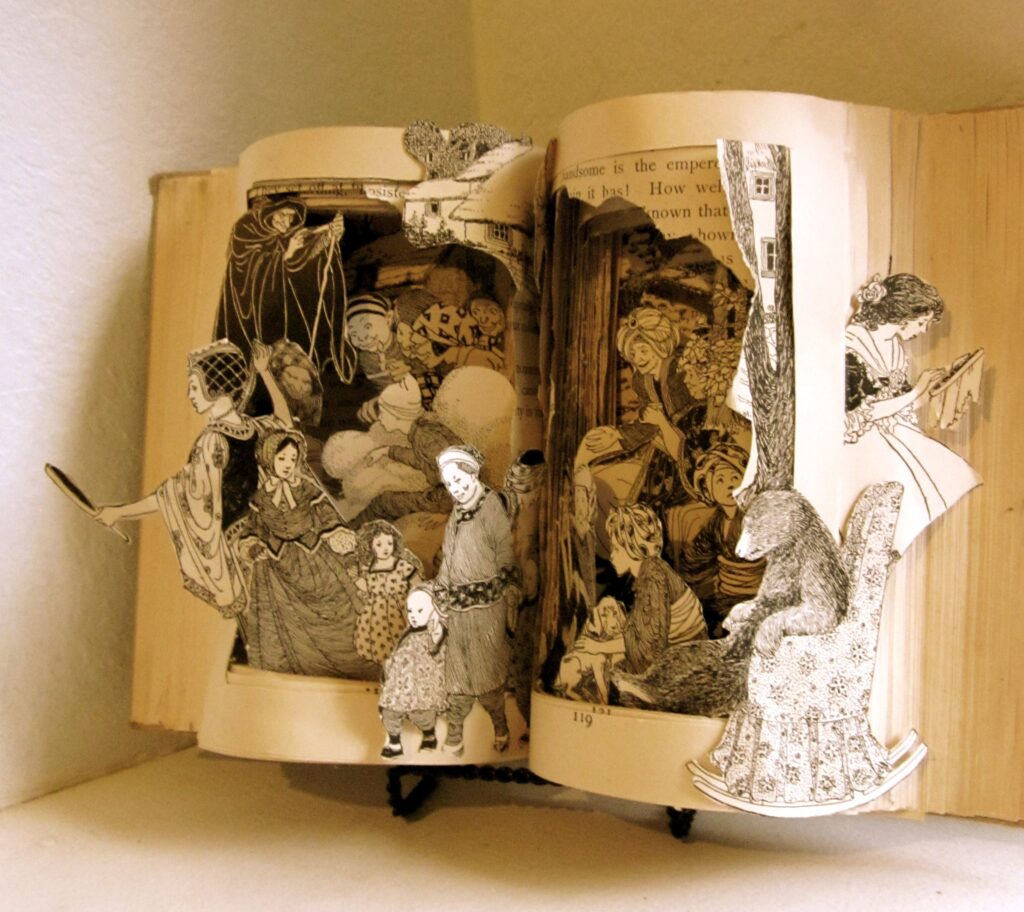
(Book sculpture by Susan Hoerth)
Dear characters and readers. I have missed you all. I’m trying to carve out some time to write each day, and hope to catch up soon. Love you all.