Because history is fun and love is worth working for

Author: Bluestocking Belles Page 28 of 37

Local Thief Spots Apparition

Your humble correspondent, journalist for The Teatime Tattler, begs leave to draw notice to Mr. Algernon Cuffy, sometime resident of St. James’s Square, as he describes an alarming encounter with a strange apparition on the night of London’s latest fog.
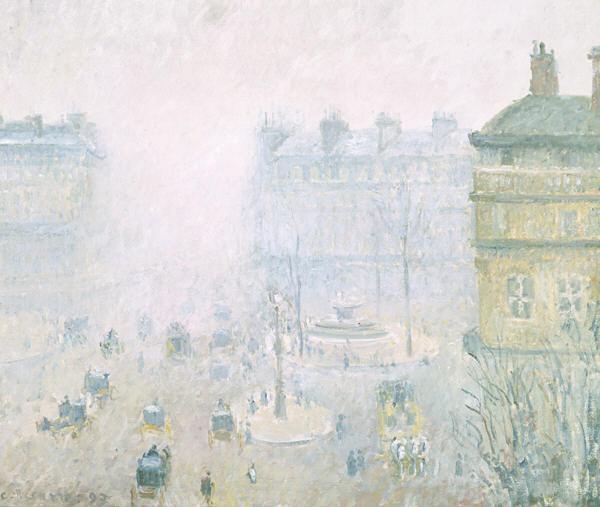
apparition
Pissarro, Place du Theatre, 1897

“I’m a thief. Write that down, plain and simple. Poverty might have driven some other poor blighters to a life on the hop but I have, you might say, a natural bent.”

Though a bit of a Renaissance man in all the arts of financial misappropriation, Mr. Cuffy likes housebreaking the most.

“Pickpocketing is for children and women—pathetic types who can look sorrowful like Mother Mary or an orphaned lamb. But I got this here,” he said, tracing a finger down a four inch scar running to his left ear, part of which was missing. “Don’t look harmless enough for work at close quarters, now, do I? Anyone with any brains would know to steer clear of me.”

Your humble correspondent backed away as he continued.

“An’ then there’s highway robbery. You’ve got travel and horse fairs and boxing mills and lonely moors—all well and good,” he said, detailing his interests. “But you’d be surprised how few coves are worth getting hung for.”

Your humble correspondent could not but agree.

“The night in question—” your correspondent began, hopeful that Mr. Cuffy would return to ghosts and spirits.

“There’s an art to housebreaking,” Mr. Cuffy continued, warming to his subject. “Liking the name of a street, following a likely looking coach home to its roost… Best to stay clear of the poshest squares. That night, conditions were perfect,” he said, tugging his cap on.

Your humble correspondent dared a question and he obliged with an answer.

“Dark. Dark as coal. An’ fog like soup. I was on the damp roof tiles of Lord Fox’s establishment—”

Readers will imagine an elegant white house in the Georgian style.

“—full to the gills with lacquered snuff boxes and jeweled tie pins, and like most bachelor’s quarters, lax about the housekeeping. I was preparing to ease myself into the empty bedroom of the recently dismissed second footman. That’s when I saw her.”

“What?” your correspondent exclaimed. 

“Pretty young thing. Loose hair, white dress. I dashed near dropped forty feet to the pavement when she rose up out of mist. I could see clear as day that she wasn’t a ghost.”

“She must have been a ghost,” I insisted. “People do not fly.”
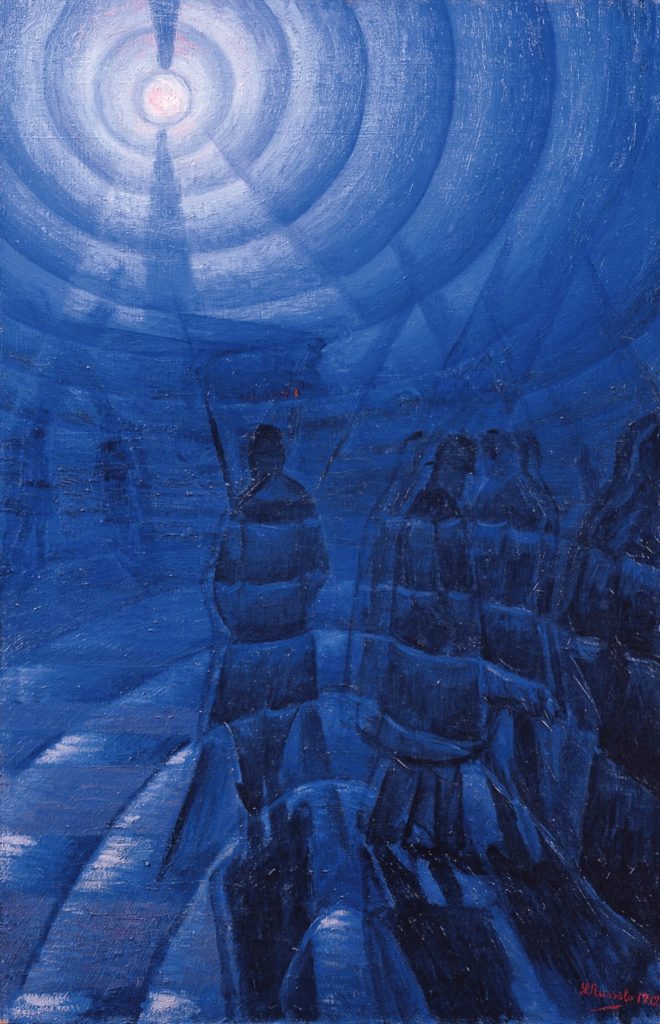
Apparition
Russolo, The Solidity of Fog. 1912

“She wasn’t flying,” Mr. Cuffy said, his look quite insulting to the junior correspondent of London’s seventh most popular daily newspaper. “Just sort of floated for a while. Took a good look towards Westminster on the river and another over towards St. Paul’s.”

“And then?” I asked, scribbling hastily.

“Then there was a shout from below and she disappeared into the fog again.”

“Where you drunk?” I asked.

Mr. Cuffy gave no proper answer but resorted to his fists. Thus concluded our interview.

About the Book: Her Caprice

A MOST PRIVATE BATTLE

Since Beatrice Thornton was 13 years old she’s been living with a secret that could ruin her family forever. Her parents are the only ones who know, and now, seven years later, they are forced to put on a sham for Beatrice’s late first Season. The plan, make Beatrice as mousy and ill-clothed as possible so no suitor would consider her. Then they can all escape back to their country home in Dorset to keep the terrible secret safe. But the unthinkable happens… Beatrice meets a man who gives her hope of a normal life, and Beatrice dares to love with horrible consequences.

Captain Henry Gracechurch has resigned his commission after living through the horrors and waste of war. Recently returned from Spain, he is cajoled by his formidable godmother to make an appearance at one of her famous balls. When he sees a young woman abandoned on the dance floor, honour commands him to save the day. Nothing could have prepared him for meeting the person who is a balm to his soul and gives wings to his heart. But winning Beatrice Thornton will take every ounce of courage he has, and this is a war he will win, no matter the cost.

Buy Links:

Amazon: https://www.amazon.com/gp/product/B07N9B81QR

Barnes and Noble: https://www.barnesandnoble.com/w/books/1130437723?ean=2940155962496

Smashwords: https://www.smashwords.com/books/view/920856

Kobo: https://www.kobo.com/us/en/ebook/her-caprice

Her Caprice, Excerpt:

Beatrice was left alone to take in the whole scene. It was familiar to her, in a way. She had seen illustrations of balloons before, studied them closely from books and newspapers. The flying machine could do what she did, and yet there were reasons for it, purposes, a whole science, explanations of the mechanics.

“It’s magical,” a deep voice intoned at her side. She looked up to find Henry standing next to her as if he had always been there. Beatrice felt the solid ground she stood on almost melt away.

Quarry stone, the involuntary thought flitted through her mind, and she blinked, feeling herself grow heavy and pressed more firmly into the grass. That was strange. It was not as though she had been about to float away at the mere sight of him in the middle of a bustling London crowd. What a silly thing to think. She shook her head and met his eyes.

There was the usual delight she felt each time she saw him that sent her insides spinning, but it was tempered by the knowledge that he had not called. It was the merest chance that brought him here.

“It’s not magic,” she retorted, swallowing deeply. Six days since she’d last seen him. He had no right to look like he hadn’t been wasting away. Drat. “It’s hydrogen. The gas is produced when sulphuric acid is poured over scrap iron. How did you happen across me in this crowd?” she asked, thankful for the cool morning air, which would be a plausible reason for her pink cheeks.

“Magic,” he asserted, offering her an arm, which she took. He did not lead her anywhere but stood, gazing up at the activity on the rise. “Have you been busy these past days?”

Busy? She felt the shame of returning home each afternoon, her eyes hungry for some sign that he had come. “This and that,” she answered, hoping with all her heart that her tone conveyed a calendar too full for waiting and longing.

He looked down at her. “You’ve not been at home,” he stated.

It wasn’t a question. The damp ground at the bottom of the hill began to seep through her slippers, but she would not move for anything. “No. My mother had a sudden enthusiasm to see everything in Town. I am not sure the carriage horses can take much more. You?”

“I passed your door, hoping that—”

“You called?” The surprise of it made her yelp.

“I said I would.”

Beatrice looked up at him. “You left no sign,” she stated while feeling great relief. Forgetting to leave a card—it was endearing, though it had cost her the enjoyment of racing through the maze at Hampton Court, of savouring the ice at Gunter’s.

His head cocked to the side and his brows came down. “But I—” And then his lips shut into a firm line.

Beatrice waited for him to finish and then, finally, when it was clear he would say no more, the wheels in her mind began to turn. She looked up the hill again to where the balloonist had given Penny a small parcel, some silk fabric full of hydrogen. Her sister let it go and, as it drifted up and up, it moved in easy state, tossed lightly by sudden currents of wind. The crowd let out a great cheer, and in that clamour, Beatrice whispered, “You did leave a card, didn’t you?”

“Yes.”

Penny waved to her as she dashed down the hill and away toward the carriage.

Beatrice lowered her brows. She might have missed the card in her meticulous search of the entry hall, when she had turned each paper over and over, upending the tray and running her fingers along the back of the table, and then closely questioned the townhouse staff. It would not be so amazing if she lost— “Just the one?”

“One each time I visited.”

“Each? What do you mean? How many times was it?” she asked, her words tripping over themselves.

His look was keen. “Seven,” he answered and then his mouth lifted. “I’m almost out of cards.”

She answered quickly. “But it’s been six days.”

“Exactly six? Has it?” he asked, his eyes narrowing like a cat on the trail of a limping mouse. “How clever you are to know the precise number. I came twice on Wednesday.”

Beatrice put a hand to her pelisse, fastening and unfastening the button. Seven cards. Seven messages scrawled on the back. Seven times he had come. Seven times. She couldn’t let the number go. A girl might have her head turned by a thing like that.

Henry didn’t say another word, and merely waited for her to work it out—though the way his eyes studied her face wasn’t helping her concentration at all. It set her blood to warming and her mind to wondering if the world really would come crashing to an end if she leaned up on her tiptoes and kissed him on those firm lips.

About the Author

Keira Dominguez graduated from BYU with a B.A. in Humanities and lives in Portland, Oregon with her husband and five children. When she is not busy avoiding volunteerism at her kids’ schools like it is the literal plague, she writes sweet romance novels.

https://www.keiradominguez.com/

Foreign Children in Our Park

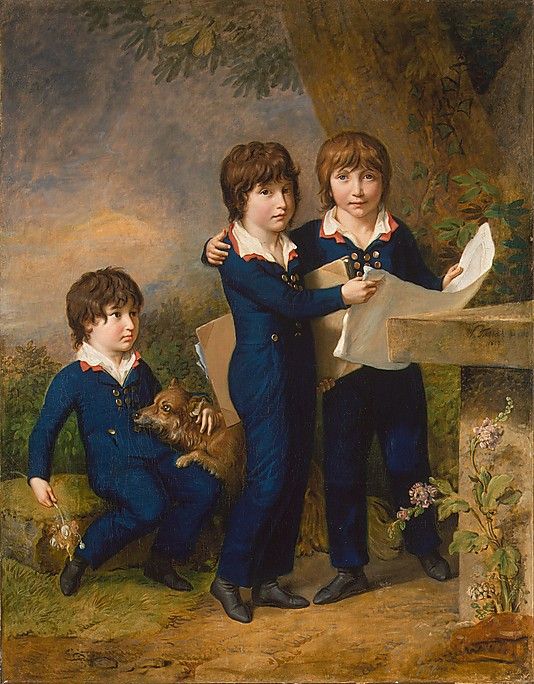
Many of Society’s finest will recognise the Redepenning boys, the three fine young sons of one of the Nation’s Heroes. Captain Richard Redepenning, second son of that well-beloved patriarch known to us all as Lord Henry, is deservedly renowned his courage and dashing.

His lovely wife, daughter of another Naval hero, was seen yesterday in Hyde Park with her three sons, accompanied by her sister-in-law, Mrs Julius Redepenning.

The fourth son of Lord Henry also serves his country as Captain in His Majesty’s Royal Navy. We regret to remind our readers that this gentleman’s reputation is not as sterling as that of his close male relatives.

You may recall his close brush with a court martial less than ten years ago, his hasty marriage in scandalous circumstances seven years ago, and his immediate departure to flee his brand new bride to the other side of the world, to return to his mistress and children.

This is old news, you may say, but this newspaper regrets to say that the man’s effrontery has no equal. We have it on good authority that the dusky complexioned boy and two little girls playing with Captain Richard Redepenning’s children were, in fact, the son and daughters of the very mistress for whom Captain Julius Redepenning left his unfortunate bride.

What pressure was brought to bear on Mrs Julius to force her to not only acknowledge these offspring of a kept woman — and a coloured kept woman, at that — but to take them into her care? This newspaper shudders to think!

The story took on an even more dire aspect when we learned that the boy who was being treated every bit as if he were the equal of Captain Richard’s sons has no Redepenning blood at all! Indeed, he is a child of a previous lover, whom Captain Julius permitted, undoubtedly motivated by lust, to remain with the seductress who drew him from his marriage vows.

We register our protest, as all right-thinking people must, at the probable contamination of three such fine young men as the Redepenning boys by the casual offspring of a harlot. May the Redepenning family come to their senses before too much harm is done.

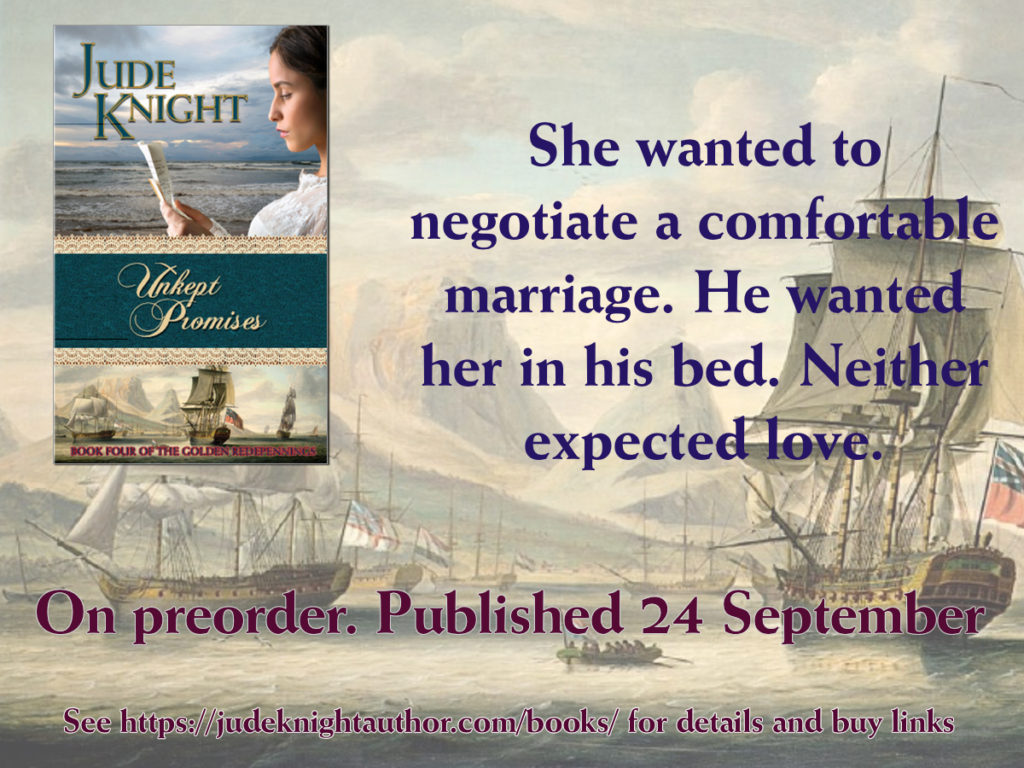
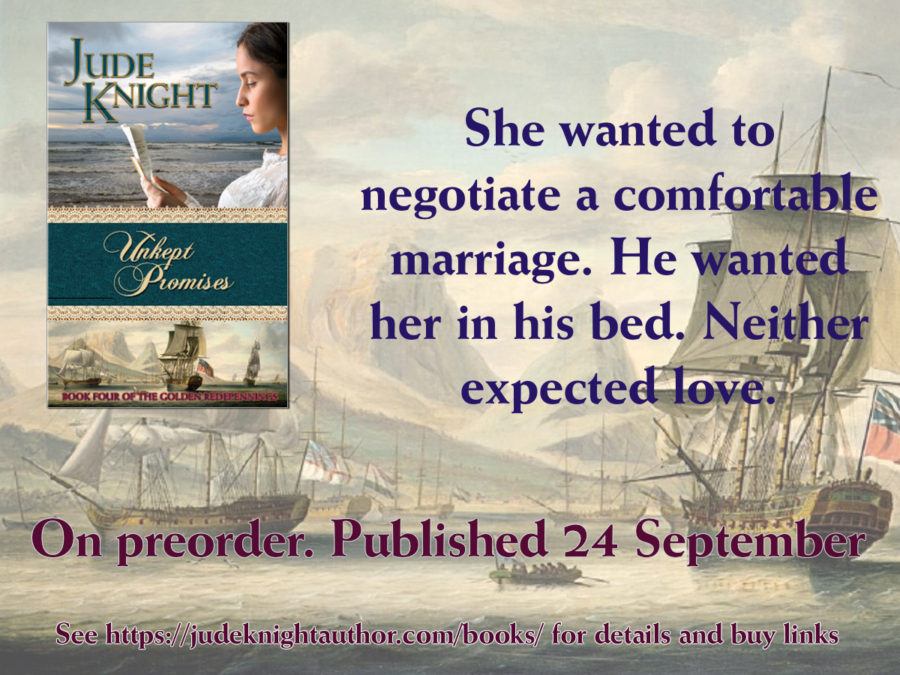
Naval captain Jules Redepenning has spent his adult life away from England, and at war. He rarely thinks of the bride he married for her own protection, and if he does, he remembers the child he left after their wedding seven years ago. He doesn’t expect to find her in his Cape Town home, a woman grown and a lovely one, too.

Mia Redepenning sails to Cape Town to nurse her husband’s dying mistress and adopt his children. She hopes to negotiate a comfortable married life with the man while she’s there. Falling in love is not on her to-do list.

Before they can do more than glimpse a possible future together, their duties force them apart. At home in England, Mia must fight for the safety of Jules’s children. Imprisoned in France, Jules must battle for his self-respect and his life. Only by vanquishing their foes can they start to make their dreams come true.

Buy links

Amazon: https://www.amazon.com/gp/product/B07TXXK53N/

Bookbub: https://www.bookbub.com/books/unkept-promises-by-jude-knight

Goodreads: https://www.goodreads.com/book/show/47161695-unkept-promises

Barnes and Noble Nook: https://www.barnesandnoble.com/w/unkept-promises-jude-knight/1132401931?ean=2940163272938

Kobo: https://www.kobo.com/nz/en/ebook/unkept-promises

Smashwords: https://www.smashwords.com/books/view/947394

Apple Books: https://books.apple.com/us/book/unkept-promises/id1471938393

About Jude Knight

War and Petty Grievances

This letter appeared in my upper desk door this week by means I can’t explain. One continues to be astounded at how much jealousy, gossip, and spite is by nature the same in every era.

S. Clemens

Amiens, France, March 4, 1918

Darling Céline,

Oh why do I write this? By the time it arrives I may already be in Marseilles! You will have heard the news that the Russians have made peace with the Huns, the traitorous animals. Now the German war machine will pour its entire might into northern France while the worthless Yanks drag their feet rather than deploy their troops. Amiens will be destroyed—leveled even as Arras has been or the villages along the Somme.

Dear Edgar insists I come to you and Aunt Adele and remove myself from the path of the Hun army. Lucille, our maid of all work, is packing as I write this.

Gossip
Sabine

I was astonished that you would ask after Rosemarie when you well know I no longer speak to the hussy. Believe me, my brother’s widow has not improved her behavior in the past year, for all she now parades on the arm of a Canadian soldier—as if that would erase the taint of collaboration with a German. Rauol himself told me what she did before he died. Just wait. She will get what she deserves when the war is over.

The boy looks better fed this year, but of course decent women wonder what the trollop does to manage that miracle. The stupid English, now that she sews in one of their workshops, treat her as the would any decent woman. It is almost more than I can bear.

Rosemarie

I will never understand why God blessed her with a son while cursing me with none. Abbé Desjardin, that wrong-headed priest, takes her side. Well, let him protect her when the German war machine rolls into Amiens. She can suffer as she deserves. and she certainly isn’t coming with me. I just wish I could take her son south with me. Life is not fair.

Your loving cousin,

Sabine

About the Book

When it is finally over will their love be enough?

After two years at the mercy of the Canadian Expeditionary force and the German war machine, Harry ran out of metaphors for death, synonyms for brown, and images of darkness. When he encounters color among the floating islands of Amiens and life in the form a widow and her little son, hope ensnares him. Through three more long years of war and its aftermath, the hope she brings keeps Harry alive.

Rosemarie Legrand’s husband left her a tiny son, no money, and a savaged reputation when he died. She struggles to simply feed the boy and has little to offer a lonely soldier, but Harry’s devotion lifts her up. The war demands all her strength and resilience, will the hope of peace and the promise of Harry’s love keep her going?

Available for Pre-order now. You can find it here: https://www.carolinewarfield.com/bookshelf/christmas-hope/

Gossip

Doings Near Hadrian’s Wall

A report from the Vindolanda excavations.

Dear Mr. Clemens,

I trust that you remember me from your visit to Hadrian’s Wall last summer. You expressed much interest in the diggings, and despite the severe cold you caught (t’was but a summer squall) invited me to share updates on the excavations. I do so with great delight, we have uncovered many items that in combination, allow us to paint a vivid picture of a time lost to us for two thousand years.

Vindolanda discoveries

The site of Vindolanda is a treasure of ancient artefacts. The site conditions can at times be grim – there is no winter season, and the Summer season is brief and intense. The colder months are devoted to cleaning and recording our finds.

The fort itself was manned from around 85AD to 370AD, thus spanning much of the early days of Roman occupation. The fort was manned by a troop from Gaul. The site so far consists of a bathhouse, many layers of wooden structures, the stone buildings of the fort and a larger town to the west, where many native Britons would have lived, and the families of the garrisoned soldiers.

The site is fascinating. It is buried deep in rank muds, but that is its glory. The mud is low in oxygen, which is the enemy of preservation of objects. So many things have emerged from this mud that it staggers the imagination. There would be few sites indeed that allow us to get a glimpse into the day to day lives of people two thousand years past.

The town itself would have been a hive of activity, perhaps typical for the towns along the Wall, close to the forts – where the money and markets were. We have uncovered spinning whorls in great quantity, a business important for textile manufacture. The town – or vicus – as it is known in latin, also had an animal butchery, with excellent drainage. We know that the soldiers consumed vast quantities of bacon, sheep and used goat hides for their tents. There is also a bathhouse, which would have been heated, and used by locals and soldiers.

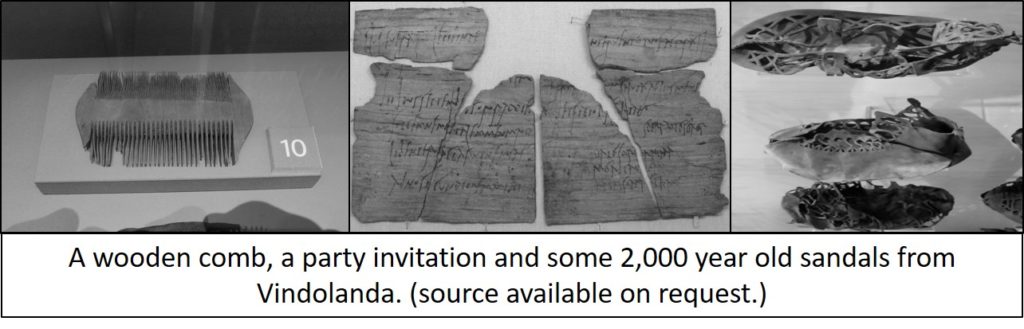
But the finds are what has made Vindolanda famous. Hundreds of leather sandals have been uncovered, and of all sizes – from children shoes, to the dainty lattice patterned ladies sandals, and rugged soldiers foot wear. Other leather goods include goathide tents, the neat lines of stiches joining the hides still intact.

Wooden objects such as combs, and many pieces of horse harness, game pieces, weaponry, arrowheads, and textile fragments are also well preserved. You will pardon the personal nature of the following, but we also found the first known wooden toilet seat, its design similar to the ones in use today.

The most fascinating of all has been the Vindolanda tablets. Written on thin sheets of oak, and a similar size to a modern postcard, many tablets have been uncovered, and to our joy, the writing (in a blackish mix of ink gall) is still readable. While many are like a modern shopping list one might give a servant, some are letters home from soldiers complaining about the weather, and one is a party invitation from a young lady.

Vindolanda

I will finish up, Mr Clemens, in the hopes that you will find this of sufficient interest to publish in your newspaper. We trust that should you visit England again, you will pay us a visit, and perhaps participate in the diggings yourself.

I have taken the liberty of enclosing some photographs of the finds.

About the Druid’s Portal Series

The Druid’s Portal series is a genre blend of action, adventure, romance, time travel and magical historical fantasy. Set in Roman Britain in the Hadrian’s Wall and Northumberland region.

On the First Journey, travel back in time with modern day archaeologist Janet and meet Roman soldier Trajan. Described as the book the writers of Indiana Jones wanted to write, and a runner up in the Raven awards for dark fantasy.

The Second Journey is now out on Amazon. Join Ethan, son of Janet and Trajan as he follows his heart into danger and an alternate history that will lead him from Hadrian’s Wall to the dark past of Stonehenge.

Available on Amazon https://amazon.com/author/cindytomamichel

Vindolanda

 Druid’s Portal: The Second Journey

A love that can never be.
Ethan—latest guardian of the Arwen pendant—finds his heritage of time travel a burden he can scarcely endure. Rowena—last of the line of Daman—is a soldier in the Celtic army, forced to perform deeds that haunt her. Both tormented by visions of the other, separated by barriers of time.
A time that should not exist.
Rowena flees the catastrophic end of her time but is trapped by an ancient family pact with an evil goddess. Desperate to save her, Ethan crosses over into her timeline, where his parents never met, and Daman—their greatest enemy—rules.

The past is ruled by a man who knows the future.
Thirty days to stop a goddess taking over her body. Thirty days to save his timeline. Together they will fight their way through an altered history to the dark past of Stonehenge.

Time is running out – for everyone.

Vindolanda

An excerpt from Druid’s Portal: The Second Journey

Then a sound… soft laughter… and he gazed at the woman with hair the colour of moonlight and eyes as dark as the night. Coloured mist wrapped around her, tight woven as destiny. Dark threads of death and red banners of danger – all centred around and surrounding the woman.

His love.

She filled a hole in his heart he had always known was there, but had never known the shape of it was her. The sense of completeness hit him like a blow.

“I will find you… ” he shouted as she faded. “I will protect you, always… ”

But she was gone, leaving nothing but a ghostly fragrance of flowers, and he was alone once more.

Read a preview: https://tinyurl.com/DruidsPortal2

or buy on Amazon: http://getbook.at/DruidsPortal2

About the Author

Cindy Tomamichel is a multi-genre writer. Escape the everyday with time travel action adventure novels, scifi and fantasy stories or tranquil scenes for relaxation.

Find a world where the heroines don’t wait to be rescued, and the heroes earn that title the hard way.

Contact Cindy on

Website: http://www.cindytomamichel.com/

Facebook: https://www.facebook.com/CindyTomamichelAuthor/

Twitter: https://twitter.com/CindyTomamichel

Amazon Author page: https://amazon.com/author/cindytomamichel

Who is the Intrepid Female Smuggler?

The little Sussex village of Boltwood is in a sorry state indeed—or so I learned during a visit to my mother’s dear friend, Mrs. Ponsonby of Chichester.

I stopped by for tea and found Mrs. Ponsonby already entertaining Lady Ariadne Luttrow, one of the ton’s worst gossips. She never hesitates to tear a character to shreds. Poor Mrs. Ponsonby dislikes backbiting, but she cannot afford to offend the daughter of an earl, so she puts up with Lady Ariadne’s occasional visits.

I, on the other hand, was delighted. As a regular contributor to the Teatime Tattler, I am not in the least averse to listening to gossip, especially the scurrilous sort. After giving Mrs. Ponsonby a sympathetic glance, I prepared to enjoy myself.

“My dears,” Lady Ariadne said, “we are overrun with smugglers.” Her hands fluttered here and there as she spoke. “They have become so bold that one can scarcely sleep at night. Trains of pack ponies pass without hindrance through one’s property. These dreadful criminals even store some of the smuggled brandy in one’s own outbuildings!” She helped herself to one of Mrs. Ponsonby’s delicious drop cakes. I took one in a hurry, for the plate was almost empty.

“Surely,” I said, “your husband can put a stop to that.” Sir William Luttrow is dead set against smuggling—officially, at least, for like everyone on the coast, he gets his brandy from the free traders.

Lady Ariadne took a sip of tea. One restless hand hovered over the last cake on the plate. “Yes, but we are often in London, and meanwhile the servants do their best to aid and abet the smugglers. I suspect that my head groom, a violent sort of man, is actually a member of the gang.” She snatched the cake and devoured it.

“How terrifying!” Mrs. Ponsonby cried.

“The stuff of nightmares,” Lady Ariadne said, but I didn’t believe that for an instant. The smugglers are no threat to her. She was enjoying herself, leading up to something even more shocking.  

She glanced about, as if she feared being overheard, and lowered her voice. “As if that weren’t bad enough, there are rumors that the gang is now led by…a woman!”

“Surely not,” Mrs. Ponsonby bleated, but I rather liked the notion. Women so seldom get to run any sort of enterprise.

“It is a disaster in the making,” Lady Ariadne said with a pout. “This creature, whoever she is, will bring the whole smuggling gang to ruin.”

It was one thing to tell frightening tales to an elderly lady, and another entirely to wax indignant at the possible failure of the local gang. How strange. Why would Lady Ariadne care?

“Surely the arrest of the gang is ‘a consummation devoutly to be wished?’” I asked.

The quotation sailed right over Lady Ariadne’s head, but Mrs. Ponsonby, who adores Shakespeare, said, “Not for the wives and children of the smugglers. It is foolhardy of the men to put their faith in a mere woman.”

What nonsense. “A clever woman is just as capable as a man of running a successful enterprise—legal or illegal,” I said.

Mrs. Ponsonby shook her head. “My dear child, you will never find a husband if you insist on such opinions. We are the weaker sex. Men are naturally superior in every way.”

On this, Mrs. Ponsonby and I will never agree. I shouldn’t have allowed myself to digress, for Lady Ariadne’s conflicting sentiments about the smugglers had aroused my curiosity. However, that talkative lady had already moved to another subject.

“Dear Lord Boltwood, who would have dealt firmly with the smugglers, is not expected to live out the week,” she said.

“Poor Lady Boltwood,” Mrs. Ponsonby said. “She is a close friend of mine.”

“Of mine as well,” Lady Ariadne said soulfully. “She suffers doubly, for while her husband is on his deathbed, her only son, Richard, cavorts in London. If you had heard the tales about him, you would faint on the spot! He’s a dreadful rake and a bitter disappointment to his unfortunate mother.”

With that, we turned to rather more scurrilous gossip. Lady Ariadne moved from drop cakes to macaroons and did her best to shock us, and Mrs. Ponsonby sighed with relief when she finally left.

Well, now. I have met Richard Boltwood. He is a devilishly witty man, and a great favorite with the ladies—and perhaps with females of another sort. But no mother could be disappointed in such a handsome, charming son.

Why, I wondered, does he absent himself from his father’s deathbed? Might there be an estrangement of which society is unaware?

And who is the intrepid female smuggler?

It is clearly my duty to find out.

After escaping the guillotine, Noelle de Vallon takes refuge with her aunt in England. Determined to make her own way, she joins the local smugglers, but when their plans are uncovered, Richard, Lord Boltwood steps out of the shadows to save her. Too bad he’s the last man on earth she ever wanted to see again.

Years ago, Richard Boltwood’s plan to marry Noelle was foiled when his ruthless father shipped him to the Continent to work in espionage. But with the old man at death’s door, Richard returns to England with one final mission: to catch a spy. And Noelle is the prime suspect.

Noelle needs Richard’s help, but how can she ever trust the man who abandoned her? And how can Richard catch the real culprit while protecting the woman who stole his heart and won’t forgive him for breaking hers?

Released today, 24th July. Buy now on Amazon!

Excerpt:

“Open it, my love,” Richard said. “If you don’t like it, the jeweler will allow us to exchange it for something else.”

Slowly, almost reluctantly, Noelle opened the little box. Nestled inside was a delicate necklace of diamonds and sapphires. “It’s beautiful.” She closed the box and returned it to his hand.

“Take it, sweetheart. It will suit you admirably and as befits my wife.”

She sighed. “As I have told you over and over, I will not marry you.”

He tried to drum up his usual lighthearted retort, but fortunately she forestalled him. “I will accept your gift under one condition,” she said.

He managed a smile. “A condition. How delightful! Do tell me.”

Noelle, his darling, the love of his life, said, “Will you take me as your mistress instead?”

About Barbara Monajem

Barbara Monajem wrote her first story at eight years old about apple tree gnomes. She published a middle-grade fantasy when her children were young, then moved on to paranormal mysteries and Regency romances with intrepid heroines and long-suffering heroes (or vice versa). Regency mysteries are next on the agenda.

Barbara loves to cook, especially soups. She used to have two items on her bucket list: to make asparagus pudding (because it was too weird to resist) and to succeed at knitting socks. She managed the first (it was dreadful) but doubts she’ll ever accomplish the second. This is not a bid for immortality but merely the dismal truth. She lives near Atlanta, Georgia with an ever-shifting population of relatives, friends, and feline strays.

Page 28 of 37

Powered by WordPress & Theme by Anders Norén