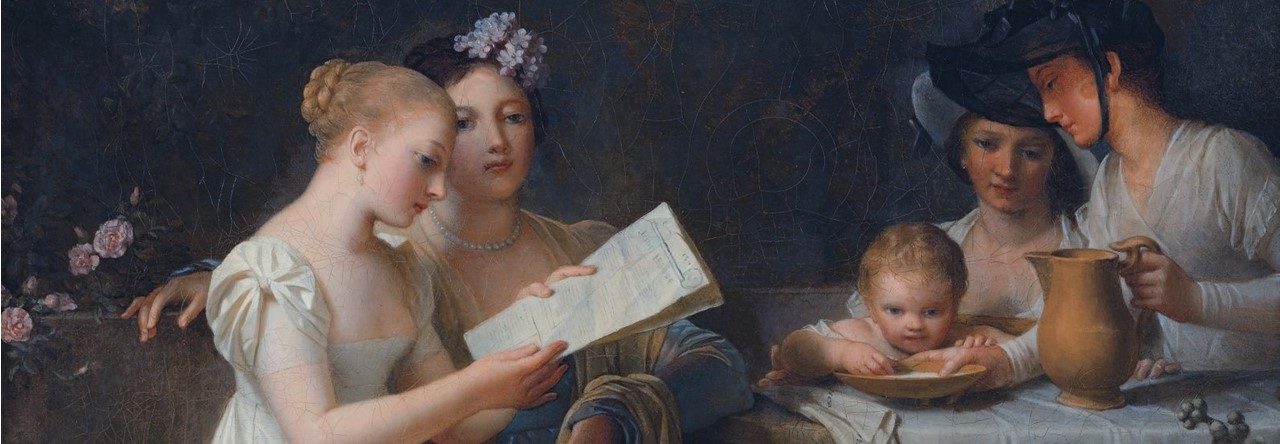
1818, London
Despite the dubious legality of the noble and quintessentially English pursuit of pugilism, matches, or set-tos still happen with utmost regularity under our very noses. Why, there is word amongst the Fancy that the notable and invincible London championess, Miss Bess Abbott has a set-to for the ages scheduled at two months hence. One may recall her sponsor, the late Lord D—, who paraded her about last year. This female pugilist is also connected since childhood to the social climber with a Midas touch, Mr. A—, who has lately found matrimonial attachment with a respectable family, no doubt to the chagrin of Lord L—, whose daughter made such a sacrifice as to tie herself to the former prizefighter.
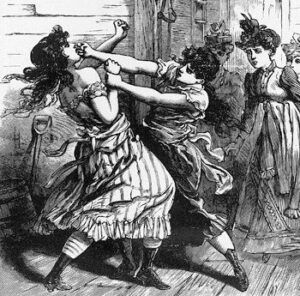
Should we exalt the athletic prowess of Miss Abbott, and call her one of our own, for her record is as yet unblemished? She may not possess the refinements of a lady, for she is not one. But her opponent in this set-to is heralded as the championess of Ireland. No one has found record of the Irish bruiser’s matches, but is that a surprise? No, I urge the dear readers to throw their support behind our own! We must give Miss Abbott her due in the ring, for such a woman has very little outside of it. I fear for her prospects should she retire from her sport.
An excerpt from the advertisements shows the strength of character:
I, Bess Abbott, am not known for my fine features. And knowing such a mug as mine with intimacy, I pledge to remake Miss Kelly in my own image. If you have seen my nose, then you know it’s uneven features, which would be beguiling replacement seated amidst Miss Kelly’s delicate visage. Place your blunt on my fists, dear Fancy, and I promise to return your investment in a hail of blows unseen in any match yet in London.
Excerpt
The empty apple boxes clattered as the men shifted their weight and stood, their boots heavy as they hit the ground.
The lamplighters were still some way off. Bess sighed and turned, hoping the men would see her better as the meager gaslight spilled down the thoroughfare. This usually put off any would-be brawlers. “I said, go home, lads.” Bess planted her feet and put down the bottle.
“Cor, not a beaut by any measure,” one of them said as he stalked closer.
“What’s with yer nose, pretty?” The men chuckled.
Bess took the insults without blinking. These jabs didn’t hurt, but she steadied her breathing, readying for the moment to come.
“Jeezus, Harry, look at her ears!” another said.
Bess had tried to take pride in the uneven scarring of her cauliflower ears. Male pugilists were proud of this physical sign of their profession, but somehow, Bess didn’t care for it, despite her status as a fighter being apparent in so many other ways.
“Eh,” said the one who was probably Harry. “Put a sack over ’er head.”
“You should be grateful some blokes want to have a bit o’ fun with you,” one insisted.
“Such a compliment,” another said, daring to pluck at her sleeve.
It was the sleeve that pushed her over the edge. She kicked the man closest to her and went after the one who had touched her. A quick right cross followed by a left uppercut and right kidney shot put him on the ground.
She pivoted to survey the other three. The man she’d kicked had stumbled but was on his feet. “Go home, lads,” she said, her hands still ready. She wasn’t above running, but with a group like this, it would be easy for them to overcome her if her back was turned.
They didn’t speak for a moment, still unable to understand how their chum had ended up on the ground.
“Let’s go, Mickey,” urged the one who had been kicked.
The silhouettes faded into the darkness of the streets. Bess sighed and scooped up the bottle, inspecting it for damage. Suddenly, Bess heard clapping from behind her. She spun towards the noise, her heart ticking faster just as it had begun to slow down.
“Well done,” a low voice boomed.
Searching the dark shadows of the storefronts, Bess felt the voice almost in her bones. “Show yourself,” she said.
A large man with dark skin stepped out of the shadows and into the light. He was at least two hands taller than Bess, and twice as wide. In his hand, he carried a blacksmith’s hammer.
“I’d prefer if you put down the weapon,” Bess said. Again her nerves prickled, but this time in a way she could not identify. The man was powerfully built, but likely slow on his feet. If nothing else, she could slide in a few hits and then run. The hammer swing would be slow enough to dodge, but a mistake would be fatal.
He chuckled, another low noise that sounded more like the shifting starts of an iron locomotive. She felt it in her ribs, and it made an ache bloom almost as if she had been knocked by a belly-go-firster.
He put up one of his massive paws as a show of peace. “I’d not raise a weapon to the great Bess Abbott,” he said, lowering the hammer to rest on the ground.
“You have me at a disadvantage,” she said, still not abandoning her defensive stance but no longer thinking about running. The ache in her chest eased, and she was distracted by the roping power in his bare forearms, the low light etching him in silver and gold.
The man shook his head. He had no hair, and the dark skin of his bare pate gleamed. “I don’t believe you could have a disadvantage. You’re too quick.”
She watched him a minute more, waiting for something else to happen: an insult, a shout, or even for him to slide back into the shadows. Instead he smiled at her, which made her suspicious.
“You’re my favorite fighter,” he said, leaning back against the building. His accent was strange. The lilting sounds of the West Indies came through, tempered by what sounded Northern, maybe a Manchester accent. The odd mix was pleasing to hear.
It sounded so wrong to hear, it almost struck her as a joke. She shook her head and walked over to where he stood. The hammer leaned against the wall next to him, the handle coming near to her waist. It was no ordinary tool. Suddenly, she forgot how to breathe, being this close to a man that wasn’t trying to train with her. “Then I thank you,” she said, gasping for no reason. “You a smug?”
“My foundry is up there,” he said, gesturing with his chin back toward Edgeware Road.
Bess frowned. “Isn’t that Barnsworth’s?”
“Took it over when he died. It’s been mine for a little over a year now,” the blacksmith said, shifting his weight to better look at her.
“I didn’t hear.” So many people from her childhood were passing that she could barely keep track of the old neighborhood anymore. The foundry was a landmark in everyone’s mind, a place of perpetual fire, the sound of metal on metal at all hours.
He lifted his massive shoulder and let it fall. The motion only showed how much power was poised inside of him. If he’d an inclination, there’d be plenty of money to be found in the ring.
She felt him weighing her, taking in all these odd pieces. It was only a matter of time before he ran away, having identified her for what she was. Unnatural. Strange. She braced for the impact of his judgment.
“I’ve always wanted to tell you that I like your ears,” he said. “I thought if I met you someday, on the street, I would tell you that.”
Heat flushed Bess’s face. Without thinking, her hand went to cover the telltale scarring. “It makes me ugly.” She pulled her cap down lower, covering the dirty-dishwater color of her unwomanly short hair.
He lifted his dark eyebrows, the whites of his eyes near glowing. “It makes you powerful,” he said, picking up the heavy blacksmith’s hammer with ease.
“I never got your name,” Bess said, reaching out with her hand before she thought better of it.
“Come by the shop and I’ll tell you,” he said before he slung the hammer over his shoulder and sauntered away.
Bess stared at his receding figure before remembering the empty bottle in her hand. The glass was warm from where she clutched it. Talking to the blacksmith had been so distracting she had almost forgotten if she was coming or going.
Turning to finally head down to Tuck’s, Bess kept looking back at him, this blacksmith who liked her ears.
About the Book
 Can London’s lady champion fight for love?
As London’s undefeated women’s boxer, Bess Abbott has the scars-both inside and out-to prove it. But when one of her boxing students, Violet, needs protection, Bess Abbott’s rock hard heart cracks open. And when a handsome blacksmith comes along, giving her compliments and treating her, well, like a woman, Bess doesn’t know what to do. She’s on the ropes in the face of love.
Os Worley was a child when he became an accidental stow-away. He grew up not knowing the family or the island that inflected his accent. His only memory of his mother is a head bent, hands working a stitch, a voice humming a melody. Now that he has his own foundry, and his own apprentice, he’s come to London to find the woman attached to this memory. His heart is already tempered and quenched, focused on his goal-but a lady boxer threatens to recast his love in her own image.
As Os and Bess face off, will they toe the line or retreat to their corners?
Buy Links:
A Lady’s Revenge https://books2read.com/u/38EojZ
The Boxer and the Blacksmith https://books2read.com/u/3JXDEJ
 About the Author
Edie Cay writes Feminist Regency Romance. Her debut, A LADY’S REVENGE won the Golden Leaf Best First Book in 2020. The next in her series, THE BOXER AND THE BLACKSMITH won the Hearts Through History Legends Award as an unpublished manuscript in 2019. She obtained dual BAs in Creative Writing and in Music, and her MFA in Creative Writing from University of Alaska Anchorage. She is a member of RWA, The Beau Monde, the Historical Novel Society, and a founding member of Paper Lantern Writers. Follow her on social media for pictures of the latest baking project with her toddler @authorEdieCay.
Links:
Facebook: www.facebook.com/authorEdieCay
Instagram: www.instagram.com/authorEdieCay
Website: www.scarabskinbooks.com , www.paperlanternwriters.com
Newsletter sign up: http://eepurl.com/gOrfZP

 We shudder to think of the reasons. Were they both lured away by some nefarious person? Were are they colluding together to escape the frolic? Miss Esme to escape her wedding and Lady Willa to confuse us or deter us from finding Miss Harvey? Did they—oh, my dear reader—run away with gentlemen? Men whom we do not know? Or worse, have they been kidnapped?
 We understand less about motives for the disappearance of Lady Willa Sheffield, the daughter of the Earl and Countess De Courcy. We grieve for that lady who has already endured much grief personally. Her two previous fiancés died tragically young and unexpectedly. And now we wonder if there has there been another gentleman who has interested her? Is there another love affair brewing? The vicar of the church where Miss Harvey was to be wed and a new friend of Lady Willa tells us that no love affair led her to disappear. But what then occurred? What do we not know?
 LADY WILLA’S DIVINELY WICKED VICAR, Book 4,
  Cerise DeLand loves to write about dashing heroes and the sassy women they adore. Whether she’s penning historical romances or contemporaries, she’s praised for her poetic elegance and accuracy of detail.
 The Respectable English Company is scant. Imagine my delight when the HMS Boreas came into port bearing the Earl of Chadbourn and the Marquess of Glenaire. I was even pleased to have the company of the marquess’s brother-in-law, Mr. Mallet. At least, I would be pleased if we didn’t have to endure the presence of That Woman.
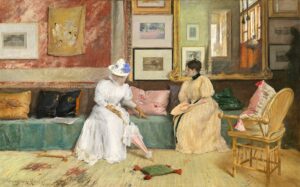 The earl and Mr. Mallet appeared well enough, but Marquess of Glenaire wore a Lieutenant’s tunic, a bit too small, and trousers which could only be described as ragged. When I could not refrain from my natural horror, the marquess subjected me to one of his famous icy stare. Dressed like that!
 Never have I seen such scurrying. Bath water went up. Tea went up. Platters of food ascended the stairs. Clothes were procured. I know this because I Iingered on a comfortable divan near the entrance. Eventually the entire party descended, clothed, thank the Almighty, in respectable, if rather unfashionable, Western dress.
 About the Book
 The Mistress of Rosings Park: A Pride and Prejudice Vagary
 Regina Jeffers, an award-winning author of historical cozy mysteries, Austenesque sequels and retellings, as well as Regency era romances, has worn many hats over her lifetime: daughter, student, military brat, wife, mother, grandmother, teacher, tax preparer, journalist, choreographer, Broadway dancer, theatre director, history buff, grant writer, media literacy consultant, and author. Living outside of Charlotte, NC, Jeffers writes novels that take the ordinary and adds a bit of mayhem, while mastering tension in her own life with a bit of gardening and the exuberance of her “grand joys.”