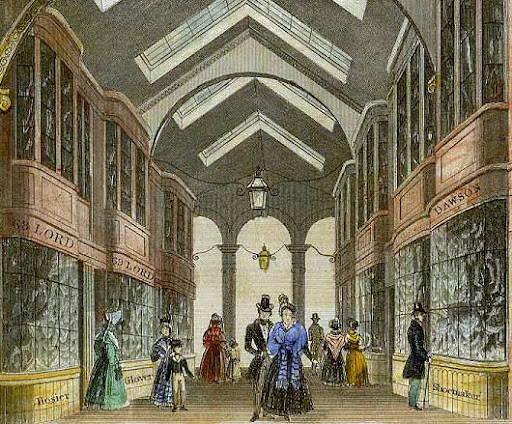
The whole of fashionable London is talking tonight about what happened at Burlington Arcade yesterday afternoon. Whispers that a particularly juicy piece of gossip would be revealed that afternoon had been circulating since the evening before, though no-one admitted to knowing what was to transpire.
Certainly, no one expected the drama to involve eight of the ten sons of the M. of T., who is well known for controlling every breath that his sons take, and every bite they eat. To see even one of the brothers out in public was surprise enough. But what happened next was almost beyond belief.
The arcade was full when the first act of the drama started, in the person of one of the brother, Lord C., whose wife was understood to be long dead. Some said suicide. Some said (but not where he could hear) murdered by her Papa-in-law. But there she was, on Lord C.’s arm, holding the hand of a little boy who looked so much like Lord C. that he had to be the man’s son.
Then three more of Lord C.’s brothers, all with ladies on their arms, arrived and Lord C. called “Well met, brothers and sisters.” And when the newcomers stopped to join Lord C.’s group, word quickly spread that what we saw was three newly-wed couples, and to brides that Lord T. had certainly never approved.
Then came Act two, with three more brothers, each escorting a lady. Two of them were known to be betrothed, and not to the ladies on their arms. The crowd held its collective breath as the ladies to whom they were betrothed stepped out of the glovers, only to be introduced by Lord B. and Lord E. to the ladies in question–their new wives.
Both brothers repudiated the betrothal as being forced, and Lord E. made a gracious apology to Miss F-S.
The third mother spied the Earl of K., the eldest brother, and demanded to know if he, too, was married, but replied that he was being forced into marriage by threats against his youngest brother, who was now on his way overseas. Since the threat was removed, he repudiated the betrothal.
The final act involved a speech from Lord K., who stood on a box to explain the situation to anyone who had not been close enough to hear.
The sons of the M. of T. have broken free of the parent’s tyrranous yoke, though it seems that seven of the ten have instead willing donned the yoke of matrimony in its stead.
What will Lord T. do? He is unlikely to acquiesce quietly to such a rebellion, but they are adult men, and this is a country under the rule of law. What can he do? This is, indeed, the question, gentle reader, and we shall watch with interest to find out!

The Night Dancers
Certain that the Marquess of Teign is behind her cousin’s disappearance, investigator Melody Blackmore enters his mansion disguised as a man. Tasked with discovering how Teign’s sons are leaving their tower prison or having food and other items brought in, she soon realizes that the sons are also the marquess’s victims. As her interest in the eldest of the brothers grows, she joins them all in a campaign to bring Teign down.
Allan Sheppard, the Earl of Kemble, is the eldest of Teign’s ten sons. He is weighed down by his frequent failures to protect his brothers from Teign’s beatings and abuse, but determined to keep them as safe as he can until his youngest brother is no longer under Teign’s guardianship.
All they must to do is fool the most recent investigator sent to find out their secrets. But Mel Black is not like the others, and Allan finds that an alliance with her gives the brothers the chance to not only survive, but to thrive.
However, Teign will stop at nothing to punish his sons for escaping him. Only Allan’s and Melody’s growing commitment to one another keeps them steadfast as they uncover evidence of evil beyond imagining.
Buy on Amazon or read in KU.
An excerpt from The Night Dancers
The third mother had been looking around, and had caught sight of Kemble. “Lord Kemble,” she trumpeted, and surged toward him, drawing her daughter in her wake. “Lord Kemble, I suppose you are going to tell me that you, too, have married.”
She looked Mel up and down with eyes that spat contempt. Had she the power, Mel felt, she would have burnt Mel to ashes where she stood.
“Mrs. Blackmore has not yet done me the honor of accepting a proposal from me, Lady Spurfold. That, however, is not the reason I am refusing to wed your daughter. I was being forced into marriage by threats to my youngest brother. He is now on his way overseas, and will no longer be under our father’s malignant guardianship by the time he returns to England.”
He inclined in a shallow bow. “Be grateful. Coercion is grounds for annulment, which would have been far more embarrassing for your daughter than having me repudiate the agreement you made with Teign.”
“Come along, Felicia,” said Lady Farringford-Smyth. “We shall see about this. Lord Baldwin, we and our husbands shall be calling on Lord Teign.”
The six of them, mothers and daughters, hurried off along the arcade, brushing off questions and comments from the bystanders.
“A flock of silly geese,” said Kemble, with no sympathy at all. “They thought Teign would be their golden egg, but they should not have treated us as if we were of no account. Time for Act Three of our little drama.”
The rest of the brothers and their wives approached. A beadle hurried up with a wooden box that Kemble had organized earlier. He stepped out from the bookshop doorway, and climbed up on the box.
The brothers gathered around him, their wives on their arms. The audience stilled, waiting to find out what was about to happen.
“Ladies and gentlemen,” Kemble said loudly. “The Sheppard brothers are no longer subject to Teign’s tyranny, and he will no longer be deciding our social calendar, nor threatening our younger brothers to gain our compliance. Should you care to send invitations to any of us—my brothers, myself, our ladies—my sisters-in-law Lady Baldwin and Lady Donald have agreed to receive our mail. Thank you all for your attention.”
He stepped down, and offered his arm to Mel. “Finis,” he said.
It was not, in fact, quite the end. Continuing Kemble’s play analogy, Mel supposed she could compare the walk to a series of encores, as people claimed an acquaintance with one of the brothers, or one of their wives, and presumed on it to ask questions or offer an invitation to call.
They kept walking however, claiming another pressing engagement, which was true enough, for they all wanted to be somewhere else by the time Teign learned what had happened here this afternoon.
The people that Clara had hired—bodyguards from a firm called Moriarty Protection—closed around them as they left the arcade, and saw them to their carriages. The agency had assigned a team to each couple. One team followed Mel and Kemble when Winifred’s carriage dropped them at the mouth of the alley that contained the gate to the tunnel.
“We shall be safe from here,” Mel told them. “But I should like to reassign you, with Lord Kemble’s permission, to guard my daughter, sister, and nephew.”
“We could put another team on them, Mrs. Blackmore,” said the senior of the two bodyguards.
“I need a team on my daughter and brother-in-law,” said Kemble. “If Teign finds them, he will use them against me. But I agree that Mrs. Blackmore’s family are also at risk. Talk to your employer and arranged for both addresses to be covered. As for Mrs. Blackmore and me, we are heading for our beds. We won’t need guards until at least noon tomorrow, and can meet them here. I’ll cover any extra costs.”
The bodyguard peered at him with narrowed eyes and then nodded. “If I can have those addresses then, my lord, ma’am.”
Mel felt in her reticule for a notebook and pencil. “I shall write a note for my sister, and put the address on it,” she said.
“A good idea,” Kemble approved. “If you would be so good as to spare me a sheet of your paper, I shall do likewise.”
It took only a couple of minutes. Soon, the bodyguards had gone and Mel and Kemble were locked inside the gate and on their way down the tunnel and up the stairs.

Leave a Reply