It has come to this writers attention that a young lady from our very own town is getting married to the grandson of the Duke of Dunsbury. Savannah is in an uproar. It has been well known that Miss Tara Wellesley was a Union Sympathizer during the War Between the States. Some speculate that she was a Union Spy but no evidence was found to prove said scandalous behavior. Sebastian Stafford, the man she is engaged to wed, is said to have been part of a secret society called the Rakes and the Crown. No evidence has been found to ascertain the validity of this either, since records don’t exist on the group, itself. Readers, you can’t get this anywhere else!
Harry Fenn, View of Savannah from the River
Strange events have been happening at night here in Savannah. Sounds of musket shots, canon fire, and sword clashing could be heard from near the river. Some have noticed British flags flying from the redoubts, men dressed in Colonial garb, and some even in the bright red coats of the English Army. This humble writer, would love to know more about these somewhat bizarre events and would like to see them for himself. Maybe even write a future article about it.
In other news, the Wellesley twins are back from their adventures in the North. There is gossip saying that one of them has a secret child housed at the Whispering Oaks plantation. Oh la la, readers! The other twin is said to have fallen for an English girl whom no one has heard of before. How scandalous! The women of Savannah will surely mourn the presence of such handsome gentlemen.
Readers, this author will have more gossip for you in my next article. Until then, check out “A Sea Between Them” by Jessica A Clements and follow this link to find out more: https://www.amazon.com/dp/B082S2KVJH.
About the Book
Tara Wellesley, a Southern belle, knew her world was going to change. The only one in her family with the second sight, she could see what would happen to those around her. What she didn’t see, however, was the English Rake that befriended her twin cousins—dragging them into a deadly battle with a rival spy ring. Sebastian Stafford, the grandson of the Duke of Dunsbury, came to the United States to resurrect the Rakes of the Crown, a spy syndicate that once supplied information for the English Crown. Now, far from England, Sebastian takes solace in Tara’s love and renames his group The Rakes of Liberty. The Rakes have one mission—to keep the Union together no matter the price. That means engaging in their own battle with the Order. But, fate has other plans. When the Order launches an attack against Sebastian’s family, he races back to England to save what is left of them. With a sea between Tara and Sebastian, will the Order get the upper hand or will love be enough to conquer an old foe?
When last I wrote, I related the servants’ natter I overheard regarding the Marquess of Castlereigh and his Irish mistress, and the Duchess of Wiltshire’s new ward, her recently departed fourth cousin’s daughter, Lady Maris.
Lately the servants’ gossip has not been much more interesting then the boring gossip overheard at every ladies’ tea in London. But I have gathered a few more details on both accounts. One of our number, who shall not be named, was overheard in one of the more notorious gaming hells rambling on about the aforementioned Marquess of Castlereigh. It seems this habitually drunken earl had the occasion to meet the previously mentioned Irish mistress while in Ireland. According to my source, who is a servant in the household of one of the others in attendance that night at the gaming hell, the earl claimed the Irish woman, though common, to be a raven-tressed sorceress, whose beauty bewitched and beguiled the marquess so thoroughly that he humiliated a perpetually drunken earl’s daughter at a harvest ball by choosing to waltz with the beauty instead. That is all this maid could relay, as it seems her employer was much in his cups himself that evening. For my part, I must admit to being entirely beside myself with curiosity and hope beyond hope Lord Castlereagh brings a dash of scandal to this Season. As for young Lady Maris, she was seen recently being escorted to the seamstress’ shop by her dutiful cousin Lord Wellesley. Being that Lord Wellesley’s relation to Lady Maris is quite distant, and it being said he is overly protective of her, I had thought perhaps the two might make the Season interesting. Sadly, Lady Maris showed up on the arm of that scoundrel Archibald, the current Duke of Wiltshire, Friday evening past, dashing my plans to have news far more entertaining for you. It seems the marriage between Lord Wellesley and Lady Twila is still to be expected before this year closes Let us all pray Lady Maris finds a more worthy suitor than the duke. Yrs. Truly,Lady Doe
About the Book
THE LOCKET, Aidan, Marquess of Wellesley, and Maris’s story, which was to be released early summer 2020, has been pushed back too late summer/early fall 2020.
The author’s previous book, THE BRIAR AND THE ROSE, is available as an ebook.
THE BRIAR…One moment Raven is alone in the world and working as a maid in the gardens of a grand estate in Ireland; the next she finds herself handed the life of a lady by the dark and handsome Marquess of Castlereagh. Devan insists his intentions are honorable, and that he only wishes to help reunite her with her family. But Raven finds herself in a constant struggle to deny the smoldering attraction between them, and in her secret heart, wishes he wanted more.
THE ROSE…Devan, Marquess of Castlereagh, is tormented by his past and determined to live out his days in quiet solitude at his Ireland estate. That is until Raven enters his life. With the face of an angel, the body of Aphrodite, and the tongue of a drunken Irishman, he’s never met any woman so infuriating… so seductive… so… his match.
THE LEGEND…From historical Ireland and its mystical legends to the elegant ballrooms of Regency London, together Devan and Raven discover the truth of the past and a love so strong it cannot be denied.
Laura Mills-Alcott spent the first two months of 2020 with pneumonia and two flus, thanks to her beautiful grandchildren. In March, after Ohio locked down, she went through four quarantines back to back, having been exposed to three active Covid-19 cases and one employee whose wife had come down with the virus. With her husband using her computer so he could work remotely, and not being able to use it herself for fear she may have contracted the virus, she opted to stay at the house they moved from and take on a full remodel in the hopes of eventually renting or selling it.
Just for entertainment, because things get boring living in a house all by one’s self without books, a computer, or Wi-Fi, Laura put the house on Zillow for sale or rent, not expecting much interest as the pictures showed it torn apart and in the throes of a major remodel. As fate would have it, in early April, a couple 1500 miles away landed on the ad, toured the house via Facebook video call, and believed her when she bragged about all she planned to single-handedly do to the house. They signed a rent-to-own contract the same day. Then Laura found herself in the unenviable position of having to make good on her bragging. The couple moves in May 31st and she is still living on the job site, determined to get the house finished on time.
Laura recently learned she has the coronavirus antibodies and actually had the virus in January when she thought she had pneumonia, which explains why she was so sick for so long, and why since March she has not caught the virus even though she was exposed to it numerous times. Laura looks forward to using her computer soon and having WiFi, and getting back to writing on something other than her smart phone.
It should come as no surprise that her second book, THE LOCKET, Aidan, Marquess of Wellesley, and Maris’s story, which was to be released early summer 2020, has been pushed back too late summer/early fall 2020.
To the Esteemed Editor, The Teatime Tattler, London
Sir, it is with a heavy heart that I take up my pen to document the sad fall of a former ornament of our Society.
Your readers will remember Lady S. B., sister to the Earl of Hy., a lady past her first years, and with two scandals already in her past. She has been betrothed twice, and married not at all. On both occasions, the lady has emerged with her reputation intact, but after recent events, one must wonder if we have been over generous to a serpent in our midst.
Be that as it may, Lady S. has continued to enjoy the approval of Society, and has persisted in trading on that approval in pursuit of funding for one of her many causes.
Those enjoying the hospitality of the Duchess of Hfd have recently been treated to the less than edifying spectacle of the half-breed viscount pursuing the Earl of Hy.’s sisters. Or was the pursuit the other way? We thought he preferred the younger, but he was seen kissing the elder. Under the mistletoe, to be sure, but such a kiss, sir!
It takes so little to ruin a lady. One kiss, and a woman past her first years, who might be supposed to have more sense, has eloped with two rakes. Not one, sir, but two. Neither of them the man she kissed.
It is to be hoped her brother will cast her off completely for the sake of her sister, Lady F., though saving that chit’s reputation is probably already a lost cause.
Be that as it may, we can be sure that the worthy leaders of Society can loosen their grips on their pocketbooks.
Editor’s note: Our readers will be pleased to know that the lady who is the subject of this letter was safely conveyed to London, with her maid in attendance. Her wedding followed shortly after. The Teatime Tattler wishes to convey congratulations to the happy couple, now the Earl and Countess of S.
To Wed a Proper Lady
Everyone knows James needs a bride with impeccable blood lines. James needs Sophia’s love, more.
James, eldest son of the Earl of Sutton, must marry to please his grandfather, the Duke of Winshire, and to win social acceptance for himself and his father’s other foreign-born children. But only Lady Sophia Belvoir makes his heart sing, and to win her, he must invite himself to spend Christmas at the home of his father’s greatest enemy: the man who is fighting in Parliament to have his father’s marriage declared invalid and the Winderfield children made bastards.
Sophia keeps secret her tendre for James, Lord Elfingham. After all, the whole of Society knows he is pursuing the younger Belvoir sister, not the older one left on the shelf after two failed betrothals. Even when he asks for her hand in marriage, she still can’t quite believe that he loves her.
In the following excerpt, Sophia decides to follow James to London.
The duchess excused herself and left, to return after a few moments. “A messenger has come to fetch my son Jonathan. If you will excuse me, my friends, I will go and help him prepare for his trip. Please. Continue the celebrations. I will join you again as soon as I can.”
Sophia followed her into the hall in time to hear Aldridge say, “If you must go, use my yacht. It stands off Margate, but we can be there in two days, and she is faster than anything you’ll pick up in London. You will not have to wait for the Thames tide, either.”
“What you propose is not safe, my darling boy. The Grand Army is in your way. You could be shot as a spy,” the duchess said. “Why, this friend of yours cannot even give you assurance that the grand duchess will not behead you on sight. It is possible that…”
“Mama, all things are possible.” Gren was lit from within, bouncing on the balls of his feet as if his joy were too big to contain. “All things but one. I have tried living without the woman I love, Mama, and that, that is impossible. Anything else, I can do. Wait and see.”
“I have sent a message to the stables,” Aldridge said, “and another to my valet telling him to pack for us both. Mama, we shall rest overnight in London then leave at first light for Margate. If you have any messages, write them now.”
“Take me.” Sophia did not know she was going to speak until the words were from her mouth.
“Lady Sophia?” Lord Aldridge was frowning.
“You are right,” Sophia told Gren. “Only one thing is impossible, and that is living without the man I love. I should have said yes. I will say yes. Take me to London, Gren, and to James.”
Gren looked at his brother and then back at Sophia. “We shall be travelling fast,” he warned.
“All the better.”
“What will Hythe say?” the duchess asked.
“I hope he shall wish me well, but I am going, Aunt Eleanor. If Lord Aldridge will not take me, then I shall catch a mail coach.” The decision made, she would not let anything stand in her way.
Lord Aldridge spread his hands in surrender. “Say your farewells, then, Lady Sophia. We leave in thirty minutes.” He turned to his brother. “I’ll write to Baumann. You’ll need money, Gren. He’ll know who can supply it overnight at short notice at this time of year.”
Hythe was not happy. “Sophia, you cannot mean to go chasing after Elfingham. Why, he might already be wed to Lady Charlotte.”
“He is waiting for me, Hythe. He needs me at his side, and that is where I want to be.”
“I can take you to London after the New Year’s Eve ball,” he suggested. “In just a few days.”
“Aldridge and Gren can take me now, today. In a few days, the duke may be dead, and James will be in mourning.”
“The duke might be dead now, Sophia. This is a mad start, running off with two of England’s worst rakes. What of your reputation?” He frowned. “At least take your maid.”
“Theodosia gets sick in a fast coach. Besides, Felicity will need her.”
“Felicity. What of Felicity? You cannot just race off and abandon her.”
Cedrica spoke up. “Do not be silly, Lord Hythe. Her Grace will chaperone Felicity, you will protect her, her maid will take care of her, and I will make sure she behaves. Sophia, Her Grace will have a maid she can send with you to give you countenance. Let me speak to the housekeeper while you set Theodosia packing a bag for you.”
After one astonished look, Hythe subsided, and almost before she knew it, Sophia was on her way out the door. Felicity hugged her and wept a little on her shoulder. The duchess gave her an absent peck on the cheek, most of her attention on her own sons, but then had a sudden thought.
“Wait!” she said. “Saunders, fetch me paper, ink, and a quill. You will find some in the Gold Drawing Room on the library table.”
While the duchess wrote a letter in neat copperplate using her finest paper, others of the party, Cedrica among them, gave their best wishes for a safe journey, “and a happy arrival,” Cedrica whispered.
Then the duchess handed her the sealed and folded letter. “The Archbishop of Canterbury is an old friend of mine, dear Sophia. This letter will get your James in to see him. You will need a license, my dear.” She kissed Sophia again then went to kiss Gren and weep a little onto his shoulder.
At the last moment, Hythe caught Sophia up into a fierce hug. “Tell him from me that he is to treat you well, or he will have me to deal with. And you can always come home, Sophia.”
She hugged him back and allowed Aldridge to hand her up into the carriage.
Welcome, devoted readers of the Teatime Tattler. My name is Tess Cochran, investigative reporter for the Weekly Informer, and I am here to bring you the truth. What truth, you ask? The truth behind the spiritualist craze sweeping our good nation. Now, this reporter can make no claim regarding the existence or non-existence of ghosts or spirits. But what I aim to reveal are the secrets behind the so-called mediums and other spiritualist practitioners who have made it their goal in life to defraud good people such as yourselves with false spirits.
Only yesterday, I attended a seance performed by the well-regarded medium Madame Xyla. Like others of her ilk, she exudes a mystical charm and an air of competence that lure her audience to believe her pronouncements. Aided by a room shrouded in darkness, magicians’ tricks of moving tables, mysterious noises, and sleight-of-hand create a compelling illusion of ghostly visitations.
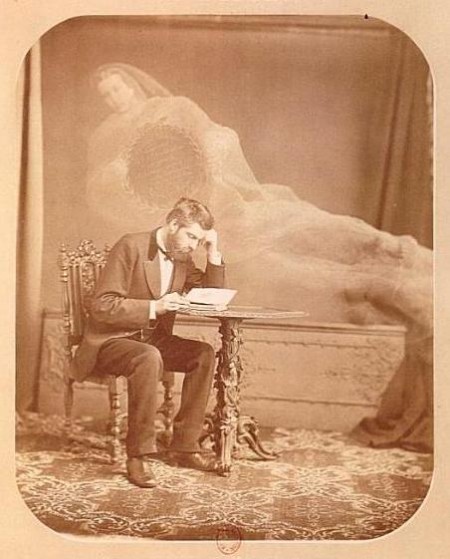
To add to the allure of the seance, this event also hosted a spirit photographer peddling his wares. Still all the rage in America, in recent years these trick photographs have gained popularity and created a host of devoted believers on our side of the Atlantic. No mere portrait, these. For a price, Mr. Jack Weaver will pose you before the camera, using his knowledge of the art of photography to create a faint “spirit” standing or hovering beside you—a visitation, he says, by a dearly departed friend or relative.
But how does this trickster accomplish such a feat? One has heard, I am certain, of the double-exposure: a technique where two images are imprinted on the same photograph. During my own sitting, I saw no evidence to suggest that Mr. Weaver used such a method, but there are other, less obvious techniques, and I intend to learn them all. Rest assured, I will be keeping a close eye on Mr. Weaver as I delve into his mysterious art.
Thanks to the generosity of a friend, I have acquired an invitation to the greatest spiritualist gathering of our time: a contest held at the remote (and reportedly haunted) castle home of the Earl of Bardrick. This two-week gathering of the most popular spiritualists of the day will give me a once-in-a-lifetime opportunity to bring to light the truth of these con artists. And you, dear readers, are the first to know of it.
Wish me luck, my friends. With my notebook and pen in hand, and a determination to save the good people of England from those who would swindle them, I prepare to depart. Be sure to watch for the Weekly Informer, where soon I will lay the truth bare for the world to see. Until then, I bid you farewell.
-T. Cochran, journalist and champion of truth
About the book:
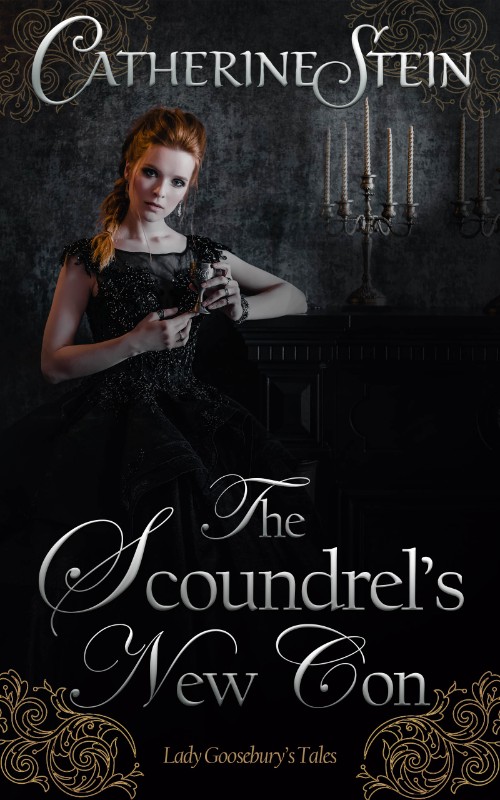
Follow Tess’s adventures as she seeks the truth and tangles with roguish spirit photographer Jack Weaver in The Scoundrel’s New Con, a fairy-tale inspired Victorian romance set in the Lady Goosebury’s Tales shared world.
He’s pulling the con of a lifetime. Unless she exposes the naked truth.
Conman Jack Weaver has his eyes on the prize. The arrogant Earl of Bardrick has offered five thousand pounds to anyone who can prove his castle is haunted. With money like that, Jack can ensure he’ll never end up on the streets or in prison again. And his spirit photography skills are just the trick needed to convince all of the earl’s houseguests to believe in something unseen.
Investigative journalist Tess Cochran believes in one thing: the truth. She’s not going to let phony ghosts and trick photographs swindle anyone, even a snobbish aristocrat like Bardrick. And she’s certainly not going to let herself be swayed by Jack Weaver’s charming smile and mischievous antics.
When Jack and Tess stumble upon one of the castle’s many secrets, they realize something nefarious lurks behind the earl’s competition. To solve the mystery, these rivals forge a reluctant partnership. As they strip down the facts, Jack and Tess begin to find that the deepest truths may be concealed in their hearts.
Award-winning author Catherine Stein believes that everyone deserves love and that Happily Ever After has the power to help, to heal, and to comfort. She writes sassy, sexy romance set during the Victorian and Edwardian eras. Her books are full of action, adventure, magic, and fantastic technologies.
Catherine lives in Michigan with her husband and three rambunctious girls. She loves steampunk and Oxford commas, and can often be found dressed in Renaissance Festival clothing, drinking copious amounts of tea.
I write with a warning for all who may consider a journey to the West Indies. The British Government wishes us to believe that Pirates no longer rule the waters of the Carribbean. That the so called ‘golden age of piracy’ ended with the captures and deaths of Edward Teach–commonly known as Blackbeard and Bartholomew Roberts. However, this is far from the case.
Image Courtesy of Wikipedia
I know from my own experience that Piracy is alive and thriving in the Carribean and the coastal waters of the former Colonies. Our government calls it ‘privateering,’ and claims that such persons as Mr. LaFitte of New Orleans and the infamous Irish Red–supposedly of Jamaica have letters of marque placing them under the protection of legitimate governments and preventing our Navy from summarily executing them when captured.
This is a deception most foul and it must stop. I recently embarked on the merchant ship Tally Ho, returning to England from a visit to my sister who lives in St. Martin. We were three days out of port when sails were sighted on the horizon. Soon enough, it became obvious that the approaching ship was The Dragon’s Rest, flag ship, if you will, in the flotilla led by the pirate–I refuse to dignify this rapscallion with the title privateer, Irish Red.
The Tally Ho was out gunned and its Captain, poor man, unable to outrun or out manuever The Dragon’s Rest. We were boarded and subjected to a most humiliating search. All valuables were seized and our lives threatened, lest we refuse to give over all money, jewels and important papers. Thought what a pirate wants with bonds, certificates and government documents is beyond me.
As a last humiliation we were all assembled on the main deck and forced to kneel, heads bowed for that scum of the oceans Irish Red to inspect each of us personally. I thank heaven he chose to pass me by, though the woman next to me had her chin lifted and was forced to look the heathen in the face.
We were told that because of our cooperation our lives would be spared and the Tally Ho would not be confiscated. The pirate crew returned to their ship and departed. Thankfully no passenger was seriously hurt, although several of our valiant crew suffered wounds in attempting to prevent the pirates from boarding.
Frankly I was astonished that we escaped so easily. However, I was even more astonished to learn from the woman who was forced to face Captain Irish Red that the man is no man at all. It is an insult to the British Navy that it has allowed this renegade female to rule the Carribean for so many years. I call upon our government to do its utmost to capture this woman, and I most emphatically warn all my fellow citizens not to sail in Carribbean waters without well armed naval escort. Heed this warning or you will certainly lose your fortunes and may well lose your lives.
Sincerely yours,
She who shall never again leave England.
A word about this post. This week I will begin my next story, which centers around the character known as the pirate Irish Red. The article above lays some of the preliminary ground work for Irish Red’s book. You can expect to see more about her and her adventures in the next few months. Thank you all for reading and sharing.
About Rue Allyn: Award winning author, Rue Allyn, learned story telling at her grandfather’s knee. (Well it was really more like on his knee—I was two.) She’s been weaving her own tales ever since. She has worked as an instructor, mother, sailor, clerk, sales associate, and painter, along with a variety of other types of employment. She has lived and traveled in places all over the globe from Keflavik Iceland (I did not care much for the long nights of winter.) and Fairbanks Alaska to Panama City and the streets of London England to a large number of places in between. Now that her two sons have left the nest, Rue and her husband of more than four decades (Try living with the same person for more than forty years—that’s a true adventure.) have retired and moved south.
When not writing, enjoying the nearby beach or working jigsaw puzzles, Rue travels the world and surfs the internet in search of background material and inspiration for her next heart melting romance. She loves to hear from readers, and you may contact her at <a href=”mailto:contact@RueAllyn.com” title=”Contact Rue Allyn” target=”_blank”>contact@RueAllyn.com</a>. She can’t wait to hear from you.