To
the editor of the Conwy Chronicle, Abergele, Wales
When does
London plan to act? Kinmel Camp is a tinderbox. We know those troops
have been through hell, and now they’re locked up in that sad excuse for a
facility as bad as any billet they had in France with nothing to do but scratch
for food and scrap with each other. We heard they’re overcrowded, underfed, and
falling sick. The Spanish flu is still spreading, and it’ll infect the county,
too.
A person could have some sympathy, but if things go haywire they’ll spill out into the county. Those Canadians already rioted once and men died. They kept it in the camp that time, but what about next time? What if they spill out into Bodelwyddan or some other town next time?
We all know about the strikes in the port holding up
shipping, but the government must act. Those men did their duty; they need to
go home; they need to get out of our county. Does the government expect us to
just sit and wait for another explosion?
That isn’t all. The longer they are here, the more we have women
hanging around claiming to be war brides. They all want passage to North
America. I know what I’m talking about. My aunt has an inn in Bodelwyddan, and she’s
heard it all. Last week a woman from France turned up. Claimed to be the wife
of a Canadian officer. A French woman! The army tossed her right out of the
camp, just like the rest of them. Next day she was begging my aunt for a job or
a place to stay. Barely speaks English but she wants a job.
Close the camp, I say. The
county government should demand it. The war is over now we want them to leave
us in peace.
About the Book
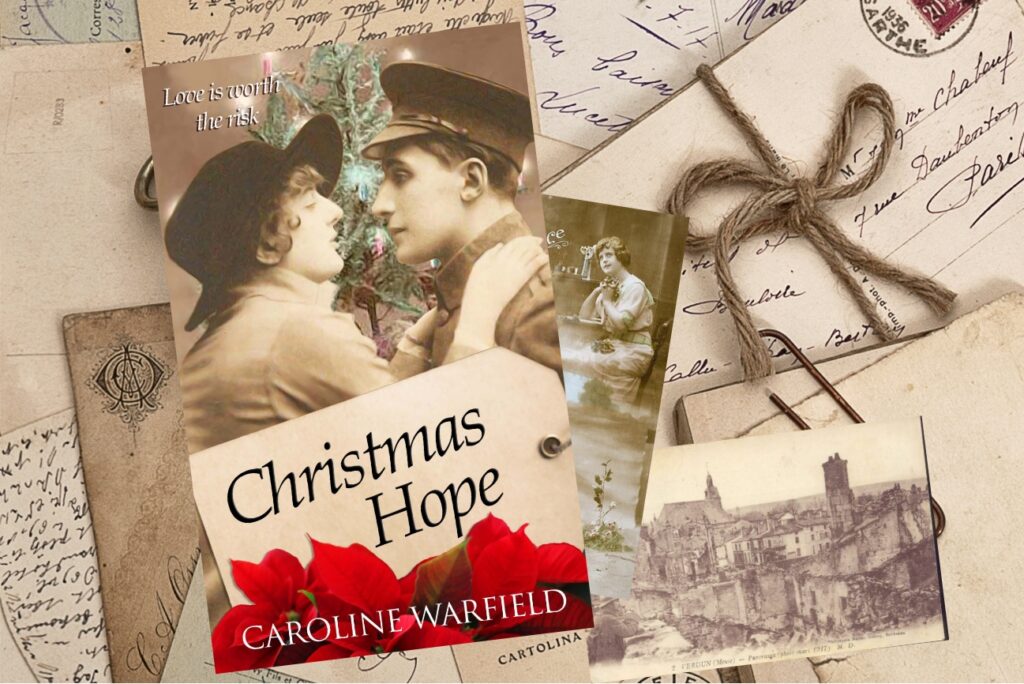
Some wars must be fought, some loves must live on hope alone, and some stories must be told. Christmas Hope a wartime romance in four parts, each one ending on Christmas 1916-1919, is one of them.
After two years at war Harry ran out of metaphors for death,
synonyms for brown, and images of darkness. When he encountered the floating
islands of Amiens and life in the form a widow and her little son, hope ensnared
him.
With the war over, and no word from Harry, Rosemarie Legrand searched for him all the way to the Kinmel Camp, only to be thrown out by authorities. She can’t linger; no one will hire her. Now that the Great War is over, will their love be enough?
Award winning author of historical romance usually set in the Regency and Victorian eras, Caroline Warfield reckons she is on at least her third act, happily working in an office surrounded by windows where she lets her characters lead her to adventures in England and the far-flung corners of the world. She nudges them to explore the riskiest territory of all, the human heart, because love is worth the risk.
Your humble correspondent, journalist for The Teatime Tattler, begs leave to draw notice to Mr. Algernon Cuffy, sometime resident of St. James’s Square, as he describes an alarming encounter with a strange apparition on the night of London’s latest fog.
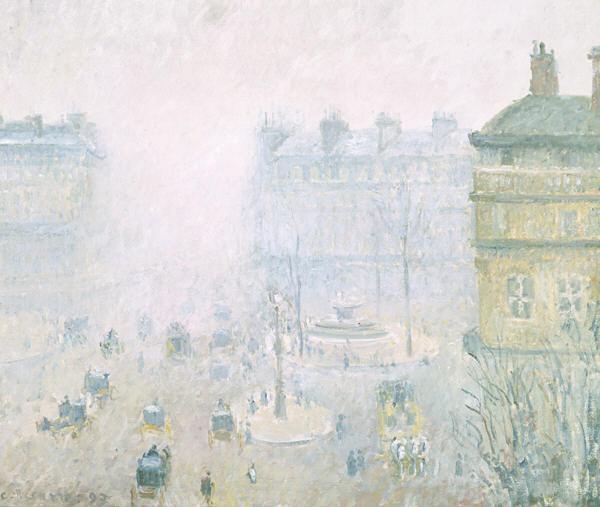
Pissarro, Place du Theatre, 1897
“I’m a thief. Write that
down, plain and simple. Poverty might have driven some other poor blighters to
a life on the hop but I have, you might say, a natural bent.”
Though a bit of a
Renaissance man in all the arts of financial misappropriation, Mr. Cuffy likes
housebreaking the most.
“Pickpocketing is for
children and women—pathetic types who can look sorrowful like Mother Mary or an
orphaned lamb. But I got this here,” he said, tracing a finger down a four inch
scar running to his left ear, part of which was missing. “Don’t look harmless
enough for work at close quarters, now, do I? Anyone with any brains would know
to steer clear of me.”
Your humble
correspondent backed away as he continued.
“An’ then there’s
highway robbery. You’ve got travel and horse fairs and boxing mills and lonely
moors—all well and good,” he said, detailing his interests. “But you’d be
surprised how few coves are worth getting hung for.”
Your humble
correspondent could not but agree.
“The night in question—”
your correspondent began, hopeful that Mr. Cuffy would return to ghosts and
spirits.
“There’s an art to
housebreaking,” Mr. Cuffy continued, warming to his subject. “Liking the name
of a street, following a likely looking coach home to its roost… Best to stay
clear of the poshest squares. That night, conditions were perfect,” he said,
tugging his cap on.
Your humble
correspondent dared a question and he obliged with an answer.
“Dark. Dark as coal. An’
fog like soup. I was on the damp roof tiles of Lord Fox’s establishment—”
Readers will imagine an
elegant white house in the Georgian style.
“—full to the gills with
lacquered snuff boxes and jeweled tie pins, and like most bachelor’s quarters,
lax about the housekeeping. I was preparing to ease myself into the empty
bedroom of the recently dismissed second footman. That’s when I saw her.”
“What?” your
correspondent exclaimed.
“Pretty young thing.
Loose hair, white dress. I dashed near dropped forty feet to the pavement when
she rose up out of mist. I could see clear as day that she wasn’t a ghost.”
“She must have been a
ghost,” I insisted. “People do not fly.”
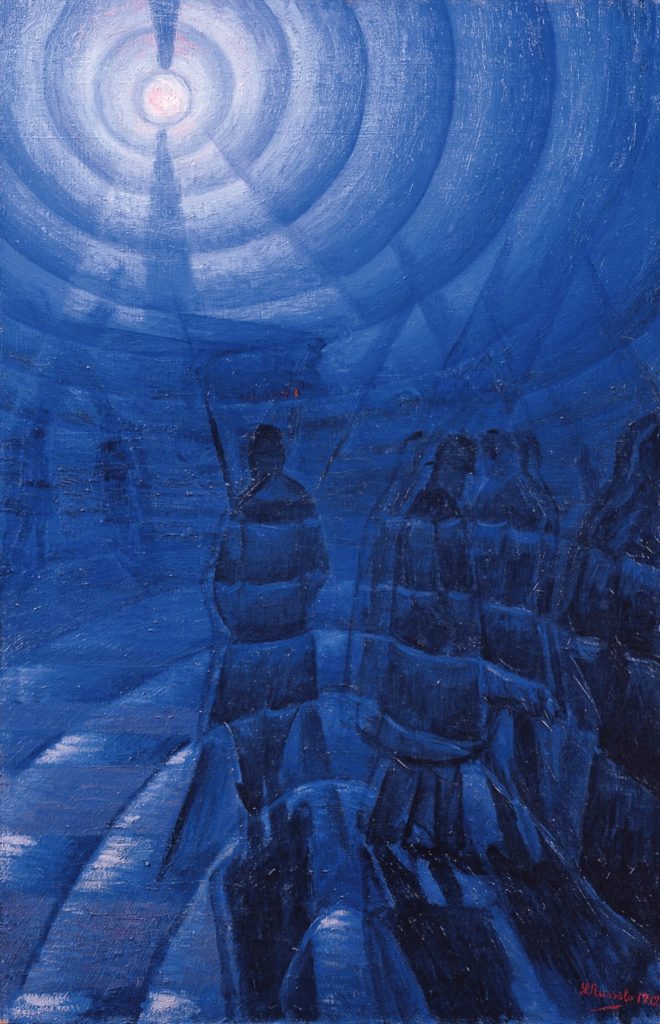
Russolo, The Solidity of Fog. 1912
“She wasn’t flying,” Mr.
Cuffy said, his look quite insulting to the junior correspondent of London’s
seventh most popular daily newspaper. “Just sort of floated for a while. Took a
good look towards Westminster on the river and another over towards St.
Paul’s.”
“And then?” I asked,
scribbling hastily.
“Then there was a shout
from below and she disappeared into the fog again.”
“Where you drunk?” I
asked.
Mr. Cuffy gave no proper answer but resorted to his fists. Thus concluded our interview.
About the Book: Her Caprice
A MOST PRIVATE BATTLE
Since Beatrice Thornton was 13 years old she’s been living with a secret that could ruin her family forever. Her parents are the only ones who know, and now, seven years later, they are forced to put on a sham for Beatrice’s late first Season. The plan, make Beatrice as mousy and ill-clothed as possible so no suitor would consider her. Then they can all escape back to their country home in Dorset to keep the terrible secret safe. But the unthinkable happens… Beatrice meets a man who gives her hope of a normal life, and Beatrice dares to love with horrible consequences.
Captain Henry Gracechurch has resigned his commission after living through the horrors and waste of war. Recently returned from Spain, he is cajoled by his formidable godmother to make an appearance at one of her famous balls. When he sees a young woman abandoned on the dance floor, honour commands him to save the day. Nothing could have prepared him for meeting the person who is a balm to his soul and gives wings to his heart. But winning Beatrice Thornton will take every ounce of courage he has, and this is a war he will win, no matter the cost.
Beatrice was left alone to take in the whole scene. It was familiar to her, in a way. She had seen illustrations of balloons before, studied them closely from books and newspapers. The flying machine could do what she did, and yet there were reasons for it, purposes, a whole science, explanations of the mechanics.
“It’s magical,” a deep voice intoned at her side. She looked up to find Henry standing next to her as if he had always been there. Beatrice felt the solid ground she stood on almost melt away.
Quarry stone, the involuntary thought flitted through her mind, and she blinked, feeling herself grow heavy and pressed more firmly into the grass. That was strange. It was not as though she had been about to float away at the mere sight of him in the middle of a bustling London crowd. What a silly thing to think. She shook her head and met his eyes.
There was the usual delight she felt each time she saw him that sent her insides spinning, but it was tempered by the knowledge that he had not called. It was the merest chance that brought him here.
“It’s not magic,” she retorted, swallowing deeply. Six days since she’d last seen him. He had no right to look like he hadn’t been wasting away. Drat. “It’s hydrogen. The gas is produced when sulphuric acid is poured over scrap iron. How did you happen across me in this crowd?” she asked, thankful for the cool morning air, which would be a plausible reason for her pink cheeks.
“Magic,” he asserted, offering her an arm, which she took. He did not lead her anywhere but stood, gazing up at the activity on the rise. “Have you been busy these past days?”
Busy? She felt the shame of returning home each afternoon, her eyes hungry for some sign that he had come. “This and that,” she answered, hoping with all her heart that her tone conveyed a calendar too full for waiting and longing.
He looked down at her. “You’ve not been at home,” he stated.
It wasn’t a question. The damp ground at the bottom of the hill began to seep through her slippers, but she would not move for anything. “No. My mother had a sudden enthusiasm to see everything in Town. I am not sure the carriage horses can take much more. You?”
“I passed your door, hoping that—”
“You called?” The surprise of it made her yelp.
“I said I would.”
Beatrice looked up at him. “You left no sign,” she stated while feeling great relief. Forgetting to leave a card—it was endearing, though it had cost her the enjoyment of racing through the maze at Hampton Court, of savouring the ice at Gunter’s.
His head cocked to the side and his brows came down. “But I—” And then his lips shut into a firm line.
Beatrice waited for him to finish and then, finally, when it was clear he would say no more, the wheels in her mind began to turn. She looked up the hill again to where the balloonist had given Penny a small parcel, some silk fabric full of hydrogen. Her sister let it go and, as it drifted up and up, it moved in easy state, tossed lightly by sudden currents of wind. The crowd let out a great cheer, and in that clamour, Beatrice whispered, “You did leave a card, didn’t you?”
“Yes.”
Penny waved to her as she dashed down the hill and away toward the carriage.
Beatrice lowered her brows. She might have missed the card in her meticulous search of the entry hall, when she had turned each paper over and over, upending the tray and running her fingers along the back of the table, and then closely questioned the townhouse staff. It would not be so amazing if she lost— “Just the one?”
“One each time I visited.”
“Each? What do you mean? How many times was it?” she asked, her words tripping over themselves.
His look was keen. “Seven,” he answered and then his mouth lifted. “I’m almost out of cards.”
She answered quickly. “But it’s been six days.”
“Exactly six? Has it?” he asked, his eyes narrowing like a cat on the trail of a limping mouse. “How clever you are to know the precise number. I came twice on Wednesday.”
Beatrice put a hand to her pelisse, fastening and unfastening the button. Seven cards. Seven messages scrawled on the back. Seven times he had come. Seven times. She couldn’t let the number go. A girl might have her head turned by a thing like that.
Henry didn’t say another word, and merely waited for her to work it out—though the way his eyes studied her face wasn’t helping her concentration at all. It set her blood to warming and her mind to wondering if the world really would come crashing to an end if she leaned up on her tiptoes and kissed him on those firm lips.
About the Author
Keira Dominguez graduated from BYU with a B.A. in Humanities and lives in Portland, Oregon with her husband and five children. When she is not busy avoiding volunteerism at her kids’ schools like it is the literal plague, she writes sweet romance novels.
I write to you today to share my
outrage at occurrences in Dudley Crescent. I simply cannot abide the recent
changes and must have your advice.
Two years ago, a murder occurred at
Number 10. The horrid matter was quickly resolved when the culprit was
identified and put away from fine society.
But the greater scandal was that the widowed lady of the house had
intimate relations with her butler! Then last year, a noted member of society
hired a young woman as ward to his child…and later, did marry the woman! She
was far below his station, though, I do understand, an heiress of considerable
worth. I must tell you the man is one of our finest gentlemen with a spotless
reputation and high military honors. Yet, I worry.
Another event occurring last week causes
me to question my presence here!
I understand that one noble gentleman
has paid attentions to one of his servants! This time, said woman is not a
governess. No, indeed, she is his maid-of-all-work! Can you imagine? I’ve been
inconsolable, riddled with a nervous stomach and headaches. My usual little
dose of laudanum is simply not enough to calm me.
This causes me to ask you if you think
I should move to a better part of town. Is there a curse on the Crescent? Must
I expect more servants who will climb above their station to enthrall their
masters or mistresses? Worse, will such an affliction affect my own house? I
must tell you, quite confidentially, that my only daughter, Lady Mary, seems
far too taken with one of our own servants. The new…dear me, I can barely write
this…stable boy. Yes! He is most definitely not
a boy. Not by any means. He is thirty years of age or more. Tall, taller than
my dear departed husband. And devilishly handsome with hair the color of coal
and eyes like lavender. He is quite ethereal.
I do rattle on!
Advise me, please!
Most sincerely,
Catherine, the Viscountess of Trelawny
Dudley Crescent is a verdant parcel of land in London, granted by King Charles II to the Earl of Dudley who was one of his staunchest supporters. With gold he’d stolen as a highwayman during Charles’s exile on the Continent, Dudley put his ill-gotten gains to good use and built the finest town homes in the capital. Renting the land in perpetuity to certain Royalist friends quadrupled his fortune.
Today, those who have townhomes surrounding the verdant park are a few of the wealthiest and most influential lords and ladies in the kingdom. But scandals abound on Dudley Crescent. You can find them here:
What’s this about
you leaving your position with the Grenvilles?
Word is they’re a respectable family. I had hopes that their cook would
train you up. Good cooks are scarce. You’d never want for work with that kind
of skill.
I must confess,
your new employers sound terrifying. I know you said they assist people who’ve
been done wrong, but they used to be thieves. Even the women! I can’t imagine
why you’d leave a fine household to work for such a strange group. But then,
you’ve always been one to leap before you looked.
I pray to God
every night to keep you safe. Your loving sister, Bess
To Mrs. Thaddeus
Wilton
Dear Bess—
I know you’ve
been worried about me taking that new position with the Restitution League, but
I couldn’t be happier. Mrs. Crane and the rest are very kind, even if Mr.
Edison does scare the daylights out of us with his experiments. The explosions
do rattle one’s nerves, I don’t mind saying. Last week he built a brass
automaton that pours tea! It wasn’t long
before the poor fellow knocked over an end table and broke a vase. Mrs. Crane
was not pleased.
As you can see by
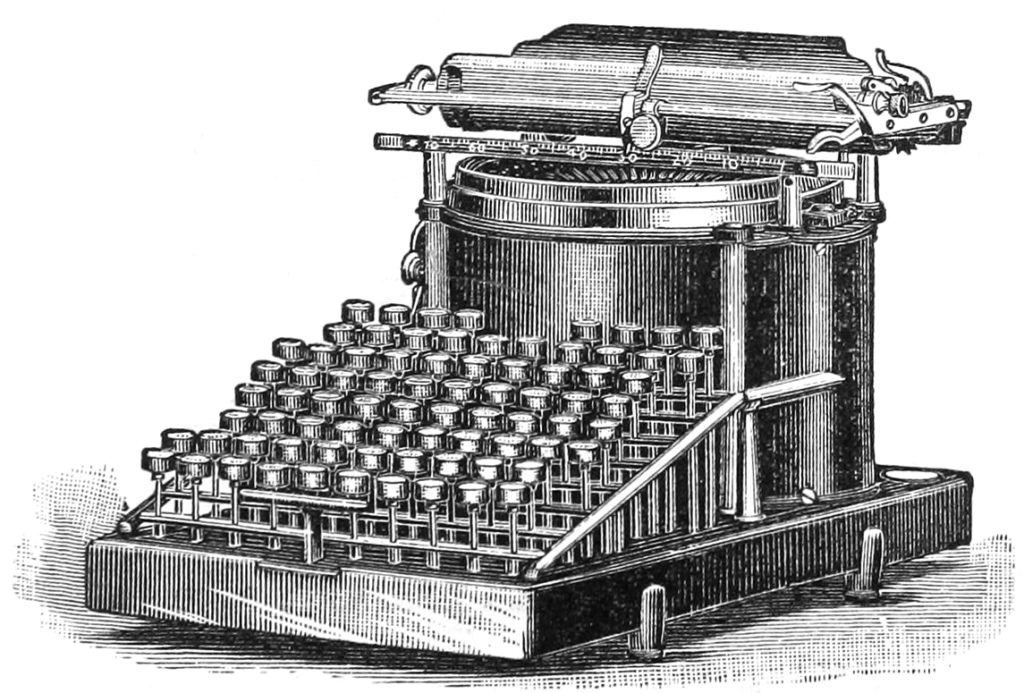
this letter, I’ve learnt to use the typewriter quite well. I’m to start lessons
on the telegraph machine next week. Learning Morse code seems impossibe, but
Mr. Edison says I’ve got the brains for it. Time will tell. I’m so happy to be
doing something besides sweeping and dusting.
I hope Thaddeus
and the children are well. It looks as if I’ll get a chance to see for myself
soon. Mr. and Mrs. Crane are going on a delayed honeymoon trip next month. She
says I’m to have a whole two weeks leave. The Grenvilles were never so
generous.
I’ve already saved up for the train fare, so
you can plan on having me at the first of the month. There’s no need to fret.
I’m happier than I could imagine. And wait until you see my new clothes! Office girls don’t have to wear stupid old
uniforms like maids do. I’ve got a smart new set of dresses to show you.
I can’t wait to
see you all. Your sister, the office
girl
Yost Typewriter 1890
About the Book
A woman who disdains love collides with a man who lives for passion.
Explosions ensue.
Ada Templeton believes in science. She believes in chemical reactions
and experimentation and old-fashioned common sense. She’s far too clever to be
seduced by a rake like Edison Sweet.
Over Ada’s objections, Edison agrees to guard her latest invention
from a mastermind willing to kill for it. He never expects to be intrigued by
the lovely widow whose body he finds as exciting as her mind.
Seducing the
Scientist and the other books in the Restitution League series are now
available in Kindle Unlimited.
In the
daylight, Ada’s laboratory was nothing short of spectacular.
It was
everything Edison’s own workshop was not. Beakers, test tubes, and glass
decanters, each in their proper place on mahogany workbenches, gleamed in the
bright autumn light. All neat and tidy and pleasingly arranged, not unlike the
scientist who worked there.
All the
more so as he suspected the effect was completely accidental.
And then
there was her scent. That light swirl of violets. Even in the midst of the
acrid, metallic odors emanating from every beaker and box in the crowded room,
it stirred him.
Delightful
perfume aside, the woman’s obstinance was beginning to grate. Badly.
Edison
rubbed a hand over his eyes. “I can’t keep your device safe if you don’t tell
me where it is.”
She raised
a beaker to eye level, frowning as she measured dry plaster of Paris to her
liking. “It’s well hidden. Have no worry about that.”
“Have no
worry? Are you addled?” He threw his hands up. “What do you think those men
were looking for last night? What about the men before that? They weren’t after
your excessive hoard of plaster.”
She
continued with her measuring. “You’ll have to trust me, Mr. Sweet…Edison. The
device is secure. What I do need your assistance with—and I am fully willing to
admit it—is protection for my family.”
“Yes, yes.
Of course. We’ll keep you all safe. That’s the easy part. I sent the stable boy
to gather the rest of the League before I came down to breakfast. My
reinforcements will be here before lunch, I’m sure. But I can’t protect your
device, unless—”
She
slammed the jar of powder down onto the counter. “You’re already taking a risk
to protect us. I won’t add to that. The device is safe. Even if it were not, I
won’t have you endanger yourself to save it.”
Unlike
most women, she didn’t resort to coquetry. She met him head to head. Any other
time, he would have found that profoundly appealing. Under the current
conditions, however, it was unduly aggravating.
He closed
his eyes, wishing he were contending with the sort of woman who liked to be
cosseted and protected. He understood
those women—how they thought, what they desired.
How to get
what he wanted in return.
Habit made
him lean close so his breath would caress her ear. He’d been told more than
once it made women shiver delightfully. “I’ll find it eventually, you know.”
Instead of
melting, softening, shivering, or sighing, she jerked away as if he reeked like
a fishmonger.
“Search
all you like.” She measured chloride into the beakers. “You won’t find it.”
Edison
ground his teeth. Dear God, he’d seen granite cliffs less stubborn. If charm
had no effect, intimidation might.
He lifted
the chloride from her hand and set it on the bench.
She glared
fiercely. “I beg your pardon?”
He ignored
her and closed in, backing her up against a filing cabinet. When she could go
no farther, he spread his arms wide, his palms flat against the cabinet front,
pinning her in.
She
squinted up at him. “What are your intentions?”
The
words did not match her tone, which was soft and sweet and—dare he hoped—welcoming.
He
smiled. “What would you like them to be?”
Her
mouth opened wider. Her chest rose and fell as her breath deepened and her eyes
dilated. “I believe I should like you to kiss me,” she said finally.
About the Author
Riley Cole writes sexy,
sassy historical romances set in the innovative, energetic Victorian Era.
If you enjoy high
adventure with your historical romance, delve into Riley’s version of late
Victorian London. Thieves, rogues, and love await.
Stay updated on
Restitution League news, exclusive content and new releases, subscribe to
Riley’s newsletter at http://bit.ly/rileynews
Letter posted from Cheltenham, England, to Morristown, New Jersey, 1832 leaked to The Teatime Tattler
My darling Earnestine,
We arrived in Bristol Wednesday, two days behind schedule,
much the worse for weather, and happy to be back on solid ground. My darling Howard’s
brother sent a carriage to convey us from the harbor, and we couldn’t leave
swiftly enough for my nerves I tell you. If England has a less salubrious port
than this one, I don’t want to encounter it. Nefarious appearing individuals
lurked along the docks and at every corner where seedy and disreputable
establishments abounded. One has heard frightening stories of civil unrest
about the place as well, but we saw nothing of that sort. Once quit of the
place, England’s green hills unfolded in front of us and I was able to put my
fears aside.
(c) Bristol Museum and Art Gallery; Supplied by The Public Catalogue Foundation
The voyage proved as tedious as I anticipated. Howard
devoted himself to cards in the common room leaving my Ellie and I to our own
devices. Not far into the journey a new acquaintance alleviated our boredom—thank
goodness.
Mrs. Gordon Melrose, the sister-in-law of an actual baronet,
regaled us with tales of society and the sites of London, whetting our appetite
for the capital I can tell you. She also enlightened us about one of our more
mysterious fellow passengers.
Ellie pointed the man out almost as soon as we embarked from
New York. The girl does have an eye for a fine specimen of manhood! Tall and
lean with thick auburn hair, he had the air of one of those frontier types
young girls find so romantic, yet he dressed like a gentleman. Oddly, he
carried a three-legged cat. We rarely saw him without the beast. When Howard
complained to the captain about the presence of a feline, he was told that
having a predator to keep vermin from the hold was in fact good luck. Ellie
pronounced it adorable, though I could not see how a deformed cat could hunt.
In any case our mystery man proved to have more to his
credit than good looks. Mr. Melrose informed us that Randolph Wheatly—the man’s
name so she said—possesses important connections. His sister, the Countess of
Chadbourn holds sway in the highest reaches of society, and is a friend of two
Duchesses no less. Think of it Earnestine, a countess! (That is the wife of an
earl in case you aren’t as fully
informed as we are).
I thought it prudent to encourage Ellie’s interest in the man, but the girl was profoundly disappointed by his curt refusal of any social overtures. Quite reclusive, he moped in solitude and scowled at all who approached, as if his troubles weighed him down. Ellie of course found his brooding good looks irresistibly attractive, poor girl. When we docked he moved rapidly off the ship and disappeared into the unsavory streets of Bristol, as though the horrid place had been his final destination, something I cannot believe.
Oh well. Perhaps we will encounter him in London. Perhaps
he’ll introduce us to his sister, the countess. Think of it Earnestine!
Your loving sister,
Eunice
About the Book
Rand has good reason to brood on the voyage and to hurray away. He has a people to rescue, and family conflict to face.
Two hearts betrayed by love…
Desperate and afraid, Meggy Blair will do whatever it takes to protect her children. She’d hoped to find sanctuary from her abusive husband with her Ojibwa grandmother, but can’t locate her. When her children fall ill, she finds shelter in an isolated cabin in Upper Canada. But when the owner unexpectedly returns, he’s furious to find squatters disrupting his self-imposed solitude.
Reclusive businessman Rand Wheatly had good reason to put an ocean between himself and the family that deceived him. He just wants the intrusive woman gone, yet it isn’t long before Meggy and the children start breaking down the defensive walls he’s built. His heart isn’t as hard as he thought. But their fragile interlude is shattered when Meggy’s husband appears to claim his children, threatening to have Rand jailed.
The only way for Meggy to protect Rand is to leave him. When her husband takes her and the children to England, Meggy discovers he’s far more than an abuser; what he’s involved in endangers all their lives. To rescue the woman who has stolen his heart, Rand must follow her and do what he swore he’d never do: reconcile with his aristocratic family and finally uncover the truth behind all the lies. But time is running out for them all.
Award winning author of historical romance usually set in the Regency and Victorian eras, Caroline Warfield reckons she is on at least her third act, happily working in an office surrounded by windows where she lets her characters lead her to adventures in England and the far-flung corners of the world. She nudges them to explore the riskiest territory of all, the human heart.