Because history is fun and love is worth working for

Tag: A Twist Upon a Regency Tale Page 1 of 2

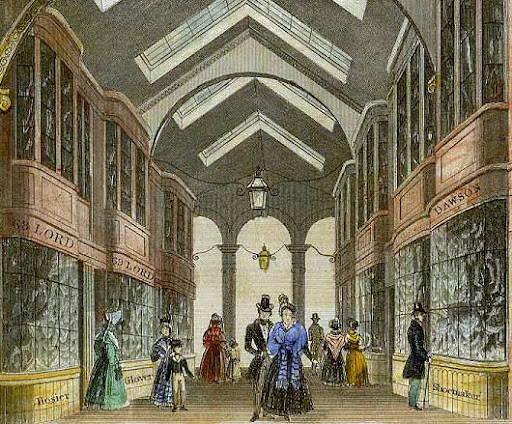
Dramatic Announcement in Burlington Arcade has London in a Tizzy

The whole of fashionable London is talking tonight about what happened at Burlington Arcade yesterday afternoon. Whispers that a particularly juicy piece of gossip would be revealed that afternoon had been circulating since the evening before, though no-one admitted to knowing what was to transpire.

Certainly, no one expected the drama to involve eight of the ten sons of the M. of T., who is well known for controlling every breath that his sons take, and every bite they eat. To see even one of the brothers out in public was surprise enough. But what happened next was almost beyond belief.

The arcade was full when the first act of the drama started, in the person of one of the brother, Lord C., whose wife was understood to be long dead. Some said suicide. Some said (but not where he could hear) murdered by her Papa-in-law. But there she was, on Lord C.’s arm, holding the hand of a little boy who looked so much like Lord C. that he had to be the man’s son.

Then three more of Lord C.’s brothers, all with ladies on their arms, arrived and Lord C. called “Well met, brothers and sisters.” And when the newcomers stopped to join Lord C.’s group, word quickly spread that what we saw was three newly-wed couples, and to brides that Lord T. had certainly never approved.

Then came Act two, with three more brothers, each escorting a lady. Two of them were known to be betrothed, and not to the ladies on their arms. The crowd held its collective breath as the ladies to whom they were betrothed stepped out of the glovers, only to be introduced by Lord B. and Lord E. to the ladies in question–their new wives.

Both brothers repudiated the betrothal as being forced, and Lord E. made a gracious apology to Miss F-S.

The third mother spied the Earl of K., the eldest brother, and demanded to know if he, too, was married, but replied that he was being forced into marriage by threats against his youngest brother, who was now on his way overseas. Since the threat was removed, he repudiated the betrothal.

The final act involved a speech from Lord K., who stood on a box to explain the situation to anyone who had not been close enough to hear.

The sons of the M. of T. have broken free of the parent’s tyrranous yoke, though it seems that seven of the ten have instead willing donned the yoke of matrimony in its stead.

What will Lord T. do? He is unlikely to acquiesce quietly to such a rebellion, but they are adult men, and this is a country under the rule of law. What can he do? This is, indeed, the question, gentle reader, and we shall watch with interest to find out!
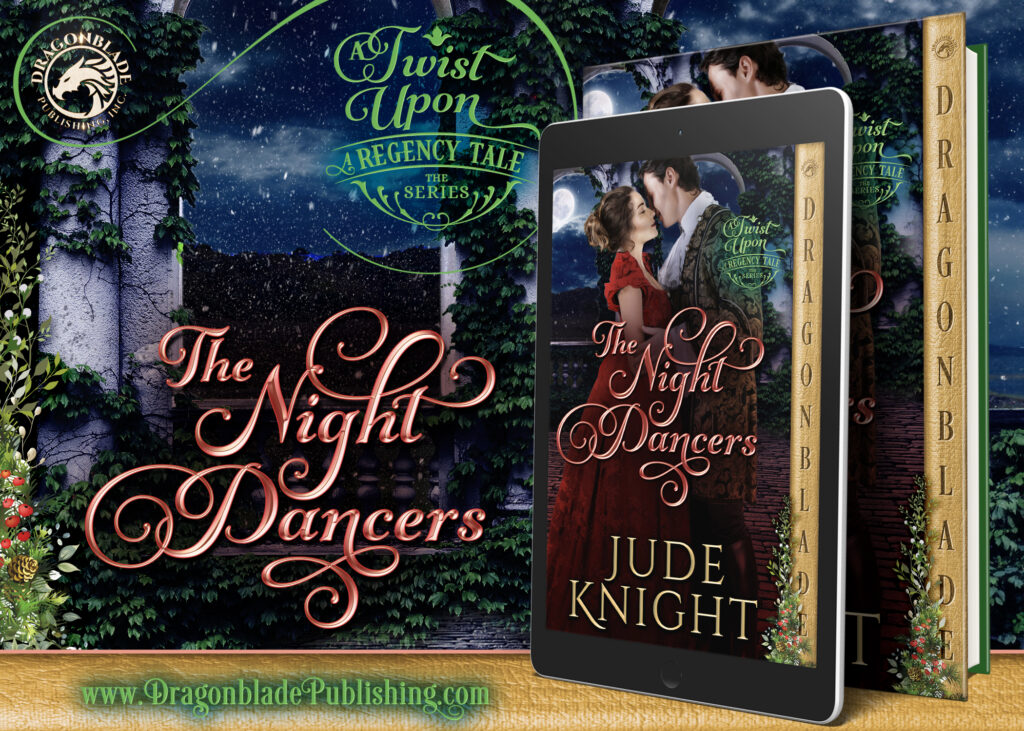
The Night Dancers

Certain that the Marquess of Teign is behind her cousin’s disappearance, investigator Melody Blackmore enters his mansion disguised as a man. Tasked with discovering how Teign’s sons are leaving their tower prison or having food and other items brought in, she soon realizes that the sons are also the marquess’s victims. As her interest in the eldest of the brothers grows, she joins them all in a campaign to bring Teign down.

Allan Sheppard, the Earl of Kemble, is the eldest of Teign’s ten sons. He is weighed down by his frequent failures to protect his brothers from Teign’s beatings and abuse, but determined to keep them as safe as he can until his youngest brother is no longer under Teign’s guardianship.

All they must to do is fool the most recent investigator sent to find out their secrets. But Mel Black is not like the others, and Allan finds that an alliance with her gives the brothers the chance to not only survive, but to thrive.

However, Teign will stop at nothing to punish his sons for escaping him. Only Allan’s and Melody’s growing commitment to one another keeps them steadfast as they uncover evidence of evil beyond imagining.

Buy on Amazon or read in KU.

An excerpt from The Night Dancers

The third mother had been looking around, and had caught sight of Kemble. “Lord Kemble,” she trumpeted, and surged toward him, drawing her daughter in her wake. “Lord Kemble, I suppose you are going to tell me that you, too, have married.”

She looked Mel up and down with eyes that spat contempt. Had she the power, Mel felt, she would have burnt Mel to ashes where she stood.

“Mrs. Blackmore has not yet done me the honor of accepting a proposal from me, Lady Spurfold. That, however, is not the reason I am refusing to wed your daughter. I was being forced into marriage by threats to my youngest brother. He is now on his way overseas, and will no longer be under our father’s malignant guardianship by the time he returns to England.”

He inclined in a shallow bow. “Be grateful. Coercion is grounds for annulment, which would have been far more embarrassing for your daughter than having me repudiate the agreement you made with Teign.”

“Come along, Felicia,” said Lady Farringford-Smyth. “We shall see about this. Lord Baldwin, we and our husbands shall be calling on Lord Teign.”

The six of them, mothers and daughters, hurried off along the arcade, brushing off questions and comments from the bystanders.

“A flock of silly geese,” said Kemble, with no sympathy at all. “They thought Teign would be their golden egg, but they should not have treated us as if we were of no account. Time for Act Three of our little drama.”

The rest of the brothers and their wives approached. A beadle hurried up with a wooden box that Kemble had organized earlier. He stepped out from the bookshop doorway, and climbed up on the box.

The brothers gathered around him, their wives on their arms. The audience stilled, waiting to find out what was about to happen.

“Ladies and gentlemen,” Kemble said loudly. “The Sheppard brothers are no longer subject to Teign’s tyranny, and he will no longer be deciding our social calendar, nor threatening our younger brothers to gain our compliance. Should you care to send invitations to any of us—my brothers, myself, our ladies—my sisters-in-law Lady Baldwin and Lady Donald have agreed to receive our mail. Thank you all for your attention.”

He stepped down, and offered his arm to Mel. “Finis,” he said.

It was not, in fact, quite the end. Continuing Kemble’s play analogy, Mel supposed she could compare the walk to a series of encores, as people claimed an acquaintance with one of the brothers, or one of their wives, and presumed on it to ask questions or offer an invitation to call.

They kept walking however, claiming another pressing engagement, which was true enough, for they all wanted to be somewhere else by the time Teign learned what had happened here this afternoon.

The people that Clara had hired—bodyguards from a firm called Moriarty Protection—closed around them as they left the arcade, and saw them to their carriages. The agency had assigned a team to each couple. One team followed Mel and Kemble when Winifred’s carriage dropped them at the mouth of the alley that contained the gate to the tunnel.

“We shall be safe from here,” Mel told them. “But I should like to reassign you, with Lord Kemble’s permission, to guard my daughter, sister, and nephew.”

“We could put another team on them, Mrs. Blackmore,” said the senior of the two bodyguards.

“I need a team on my daughter and brother-in-law,” said Kemble. “If Teign finds them, he will use them against me. But I agree that Mrs. Blackmore’s family are also at risk. Talk to your employer and arranged for both addresses to be covered. As for Mrs. Blackmore and me, we are heading for our beds. We won’t need guards until at least noon tomorrow, and can meet them here. I’ll cover any extra costs.”

The bodyguard peered at him with narrowed eyes and then nodded. “If I can have those addresses then, my lord, ma’am.”

Mel felt in her reticule for a notebook and pencil. “I shall write a note for my sister, and put the address on it,” she said.

“A good idea,” Kemble approved. “If you would be so good as to spare me a sheet of your paper, I shall do likewise.”

It took only a couple of minutes. Soon, the bodyguards had gone and Mel and Kemble were locked inside the gate and on their way down the tunnel and up the stairs.


The Black Sheep’s Grandson and the Cut Direct

Lady Fernvale’s ball took a remarkable turn last night with the sudden reappearance, after many years, of a young scion of the Satterthwaite and Thurgood families, and his brutal rejection by the earls who head each family.

Some of us are old enough to remember when the charming but feckless and penniless Reginald Satterthwaite ran away with Lady Cristobel Thurgood, the beautiful young daughter of the then Earl of Crosby. The families, of course, wiped their hands of the young pair, leaving Reggie to his own devices – or, as it turned out, to the questionable influence of his own father, Mr. Percival Satterthwaite, at least until the young couple sadly met their ends, first Christobel and then Reggie.

If Reggie was half flash and half foolish, Percival was a devil. No one was surprised when he left England one step ahead of the debt collectors. The question at the time was, what had happened to Christopher Satterthwaite, the young child of Christobel and Reggie? Was he dead, too? Had he fled with his grandfather?

Presumably his godmother Lady Fernvale has the answers, for it was she who introduced him to the ton, and to the head of the Satterthwaite family, the Earl of Halton, and the head of the Thurgood family, the Earl of Crosby. These two gentlemen immediately, and in unequivocal terms, refused the acquaintance, leaving Mr. Christopher Satterthwaite standing repudiated and folorn.

He was not alone, however. Lady Fernvale stood by his side, and so did Miss Clementine Wright, the merchant’s heiress, who went so far as to slip her hand into the young man’s.

We have so many questions, dear reader, and will be asking them of those who might have the answers. Where has Mr. Satterthwaite been and what has he been doing? What do his relatives the earls know to his discredit? What is Miss Wright’s relationship with Mr. Satterthwaite, and can we expect wedding bells? Rest assured, we shall report to you as soon as we are better informed.

The Secret Word

(Book 10 in A Twist Upon a Regency Tale)

When Christopher Satterthwaite rescues Clementine Wright from would-be kidnappers, he is offered an opportunity he can’t refuse. Clemmie’s father, a wealthy coal magnate, has been looking for a husband for his only child. Someone with aristocratic bloodlines and no family—someone who can give him the blue-blooded heir he craves, without the interference of noble relatives.

Chris figures he and Clemmie can work together to keep Wright from controlling their every move. As their partnership develops, they fall in love. Wright doesn’t stand a chance against them. Or does he?

And what about the other men who are showing an interest in the child who is soon on the way? Chris’s reprobate grandfather is hanging around like a bad smell, and clearly has a scheme in mind. Chris’s more respectable relatives have not disowned him after all, and are eager to show the as yet unborn child with every advantage—because they regret not helping Chris as a child? Or for purposes of their own?

And then there is Ramping Billy O’Hara, the most sinister of them all, and Chris’s patron.

Some are villains. Some are on the side of the couple and their child. Only time will tell which is which.

https://www.amazon.com/dp/B0FM8R25VP

Excerpt from The Secret Word

Chris waited anxiously in the private room at Miss Clemens’ Book Emporium and Tea Rooms. He was about to meet cousins from both sides of the family, and he was far from certain about the reception he was about to get.

Clem squeezed his hands and he smiled at her. He wasn’t at all certain he would be facing this if not for her. She gave him strength.

She had done so at Aunt Fern’s ball. Both his mother’s brother, the Earl of Crosby, and his father’s cousin, the Earl of Halton, were there. Later, he found that the public repudiation had been organized by Aunt Fern. But whether they meant it or not was the question.

Both reacted with the same disdain when Chris was presented to them.

Lord Halton said, “Reginald Satterthwaite’s son? I have no wish to meet anyone associated with that scoundrel.”

And Lord Crosby looked Chris up and down and declared, “No, thank you, Lady Fernvale. With all due respect, I see no reason to acknowledge this person.”

Chris wanted the floor to open up and swallow him, and then Clem had slipped her hand into his, and all was right with his world. He had not had their approbation before, and had not felt the need for it. He did not need it now.

Nonetheless, as the minutes ticked by, he acknowledged to himself his deep yearning for a family. He would have Clem, of course. Somehow. With or without Wright’s blessing. But, for as long as he could remember, he had longed for brothers and sisters or—failing them—cousins. Perhaps, if this meeting went well, his children with Clem might grow up knowing their cousins.

The first to arrive was Lord Crosby’s son, a tall man with that gaunt, stretched look of a youth who was still growing—one who ate like a horse and put on no weight. “Are you the son of Reggie Satterthwaite, who ruined my father’s sister Christabel and ran off with her to Gretna Green?” he asked. “I am Michael Thurgood, Lord Crosby’s son and your mother’s nephew.”

He held out a hand to be shaken, so Chris figured his somewhat hostile first question could safely be ignored. “Clem,” he said, figuring a female—and a non-family member at that—might help to keep the conversation civil, “May I present my cousin Michael Thurgood? Thurgood, Miss Wright has done me the honor of accepting my suit. I have yet to convince her father.”

“Miss Wright.” Michael Thurgood’s nod was perfectly polite, but his attention remained on Chris. “Is it true, what Lady Fernvale said? That your grandfather abandoned you in the streets after your father died?” he demanded. “Father says he would have taken you in if you had come to him.”

Chris was about to protest that his nine-year old self had had no idea where the Earl of Halton lived, and no expectation of being welcomed, in any case. But they were interrupted by another arrival. A second man, this one around Chris’s age, so perhaps five or six years older than Thurgood.

Chris would have known him for a Satterthwaite, even if he had not been expecting him. He look more like Reggie, Chris’s father, than Chris did, though his hair and complexion were fairer and his chin was firm and determined where Reginald Satterthwaite’s had been weak. He wore the flashy uniform of a horse guard. “If you’re Satterthwaite, so am I,” he growled. “Hello, Thurgood.”

Thurgood nodded. “Satterthwaite.” He gained a bit of respect from Chris when he then turned to Clem. “Miss Wright, may I make known to you Captain Satterthwaite of His Majesty’s 27th Regiment of Horse, and Satterthwaite, this is our cousin Christopher Satterthwaite and his betrothed, Miss Clementine Wright.”

As with Thurgood, Satterthwaite greeted Clem politely, but then turned his attention back to Chris.

“Is it true you did not go overseas with your grandfather? My father wants to know why you didn’t come to us. We would not have turned you away.”

“You did,” Chris said, dryly. “Or at least, your grandfather had me and my grandfather thrown out of the house, and when my grandfather sent me back on my own, the butler would not let me in.”

“You were nine or ten,” the guard’s officer said.

“I was nine.”

“You went back out into the road, and then what?”

“I ran back to where my grandfather had been, but he was gone. I called out for him. I asked other people if they had seen him. Then I ran down the street he’d left by. But I never found him.”

“I saw you,” Satterthwaite said. “I was watching from the schoolroom. You turned at the corner. Do you remember? You shook your fist at the house.”

“I did,” Chris said.  He had forgotten that detail until this moment. “I was angry with my grandfather and with yours.”

The scandalous bride returns

“You’ll never guess who was at the Stillwaters’ house party, Arthur,” said Lord Spense to his bosom buddy, Lord Gough.

The pair were in their favourite corner of their club, sharing a plate of oysters, a good port, and a chat. Or, as some might say (but not Spense or Gough), a gossip.

“Well, Phillip,” said Lord Gough. “Don’t keep me in suspense. Who was she? Or was it a he?”

“Both.” Spense announced the word with a gleeful chuckle. “That was the thing, my friend. Wouldn’t have expected to see them together, don’t you know. Not after last time. But they were. Daggers drawn at the start, but smelling of May and roses by the time they said their goodbyes and raced off to London. Wouldn’t surprise me at all if we hear wedding bells. Though it might end in tears again, as it did before.” He shook his head, sadly.

“Who, though, Arthur? You haven’t told me who!”

“Why, devil take me, I haven’t. Sorry, old friend.” Spense chuckled again.

Gough lost his patience. “Out with it, man. No more teasing.”

“Adaline Beverley, her who was Adaline Fairbanks back in the day,” Spense announced, and waited with a grin while his friend absorbed that piece of news. “You can probably guess the name of the gentleman.”

“It was never Kempbury!” Gough’s surprise and awe was everything Spense could wish.

Friends for over forty of their fifty-two years and confirmed bachelors, the pair were avid watchers of the ton, and a decade ago, they had had front row seats to the disaster that was the courtship by the Duke of Kembury of Miss Adaline Fairbanks, their betrothal, and the lady’s subsequent betrayal of one of the foremost bachelors in the realm.

“It was, indeed, Kempbury,” Spense confirmed. “And Arthur, I just happened to be in the corridor at night when people were all meant to be in their beds. You know how it is.” Gough nodded. He knew exactly how it was, since both of them enjoyed taking up a quiet observation post at a house party to see who visited whom. Spense took the nod as encouragement. “I would not tell anyone but you, but I saw with my own eyes that Kempbury visited Mrs. Beverley’s bedchamber one evening. And had left by the time I went to bed. Sadly, the bedchamber doors were disappointingly thick, but one can imagine! The very next day they announced their rebetrothal, and the morning after that, they left the houseparty! What do you think of that?

“Well!” exclaimed Gough. “Well I never. A man would think once bitten twice shy! I say, Phillip, it will be very interesting to see if they make it to the altar this time!”

The Lyon’s Dilemma

Felix Seward, Duke of Kempbury, does not want to be at a house party. Any house party. But the matchmaker Mrs. Dove Lyon has promised him that his perfect match will be there, and Felix yearns for a wife.

He is horrified to find that the woman who meets the matchmaker’s description is Adaline Beverley. His nemesis. His Achilles heel. The one woman on God’s earth he will never marry. Not after what she did last time they were betrothed.


Excerpt from The Lyon’s Dilemma

“You will be able to recognize your prospective wife,” Mrs. Dove Lyon had insisted. “Mrs. Beverley will be one of the maturer young ladies—she will be thirty years of age at her next birthday. She was widowed seven years ago and has been living a quiet life with her daughter. Her husband left few funds, and she has been supporting herself. I shall let her tell you the details.”

There were three possibilities. Perhaps four, but the fourth lady was turned away from him, so he was only judging by her back. As Mrs. Stillwater gave the signal to go in to dinner, she turned around, and Kempbury knew her immediately.

No! It can’t be.

It was, though, and if he had had any doubts at all, they would have been put to rest when she saw him, paled, then flushed bright red, and turned determinedly away.

Somehow, he managed to offer his arm to his hostess, lead her into dinner, and even carry on something of a conversation with her. All the while his mind was reeling and his heart was a pit of despair. Adaline Fairbanks.

Surely, Mrs. Dove Lyon did not think to match him with that lying jade. She had said “Mrs. Beverley,” but that was not reassuring. In a decade, Adaline might well have married, had a child, and been widowed.

He needed to find out, so he did something he usually found too difficult to contemplate. He engaged his hostess in conversation, asking about each of the guests with whom he was not personally acquainted.

He retained enough self-possession to ask about both men and women, but he doubted that small amount of camouflage fooled Mrs. Stillwater for a moment. She was much more informative about the ladies than the gentlemen.

One by one, her mini-biographies eliminated each of the ladies he’d marked as possibles. One was married. One betrothed. One was a devoted social butterfly committed to life in London, which would not suit Felix. Besides, she had turned down every proposal she had received in her eight years on the Marriage Market. “She has a private fortune,” said Mrs. Stillwater. “She declares she has no intention of marrying.” She shook her head at the thought.

“Then we come to Mrs. Beverley, who is a widow, Kempbury. She is attending with her daughter, who must be ten years old, or close to it. Our governess says she is a delightful child. That’s Mrs. Beverley sitting between Baron Thornwick and Mr. Thompson. I understand she has been a widow for seven years, and that she runs a business, which is very enterprising of her. I do not know much more about her. I sent her an invitation at the request of a friend, but have found her to be a very pleasant guest.”

Mrs. Beverley. Adaline Fairchild. One and the same person. Did she really have a child of ten? If so, the child must have been a baby when they were betrothed, so that had been something else she had hidden from him all those years ago.

There was no point in him being here, but it was too late now. He would not insult John Stillwater, his charming wife, and the viscount his father by cutting his attendance short. Still, he would write to Mrs. Dove Lyon tonight and tell her that Mrs. Beverley was not a possibility.

Shocking scene at Duchess’s ball. Duke discloses dirty secret.

What can one say about the shocking events at a certain important charity ball yesterday evening. The host is well known to our readers, not only for his loyal service to the Crown and his devoted care of his estates, but also for his scandalous behaviour with actresses, other men’s wives and, indeed, it is rumoured, many other females in every level society.

Much is forgiven a man who is wealthy beyond the wildest dreams of most people, and who holds, besides, one of the highest ranks outside of the Royal Family. Indeed, Royal blood runs in the veins of the man they call the Duke of Haveandhold.

Will this latest start be forgiven, we wonder? You will remember, dear reader, recent speculation in this newspaper about the identity of the man who was caught in the shrubbery with the mother of London’s latest reigning beauty. The lovely young wife of the Marquess of T. was born nine months the scandalous discovery and seven months after her mother’s hasty marriage to a man who had not been in London at the time. Until last night, no one knew who had taken the innocence of that young lady so many years ago. Taken her innocence and walked away, furthermore.

Last night, the mystery was solved. The Duke of H. informed the entire ballroom, including all the interested parties, that he was the marchioness’s father. Not, we grant you, in so many words, but his meaning was clear. As was his threat against any who spoke ill of the young lady.

Far be it from us to criticise any young lady for the sins of her father. We wish the marchioness well. That the duke will find forgiveness in public goes without saying. He is far too powerful to offend. We do wonder, however, what the Duchess of Haverford had to say about the matter in private.

***

The Sincerest Flattery

When Percival Lord Thornstead heads to the far north of England to meet the bride his father has arranged for him to marry, bad weather, the ague and a crooked valet disrupt his travel plans. Turned away at the door of the manor, he takes a job minding sheep to stay close.

Lady Aurelia Byrne sneaks away from the house dressed as a kitchen maid. She is angry at being told she must marry someone she has never met. She’d rather marry the shepherd she meets in the fields than the London fop her father has chosen for her.

Percy guesses who Lia is and is charmed. Lia discovers who Percy is and falls in love. If not for Lia’s overbearing mother all would be perfect.

Then Percy’s father intervenes to carry Lia off to London to make her debut with Percy’s sister. She is having the time of her life when her mother makes public accusations that call her reputation into question. A hasty marriage restores her to favor. Deep in the throes of love, the young couple are blissfully happy, and have fashionable London at their feet.

Until a former mistress of Percy’s comes seeking a boon that takes him away from Lia’s side, and old rumors about Lia’s mother are revived, causing Lia to be shunned by the highest sticklers. Their marriage will be tested to breaking point.

(This is a book in A Twist Upon a Regency Tale, and is inspired by The Goose Girl.)

Excerpt from The Sincerest Flattery

Lia felt her confidence slip two dances later when she and Percy stood out with his family for a dance, and the Duke of Haverford approached, escorting his wife with a raised hand under hers, as if they were about to approach the King or enter the dance.

“Lady Kirkland, Dellborough,” Haverford greeted them. The gentlemen all bowed and the ladies curtseyed. Gwen and Lia dropped into a full court curtsey in honor of the duchess. Even Aunt Enid’s curtsey was a little deeper than usual.

“This little puss must be yours, Dellborough,” said Haverford, putting his hand under Gwen’s chin and forcing her to look up at him. Lia, who was always conscious of her husband, saw him stiffen with outrage.

“Lady Guinevere Versey, my treasured eldest daughter.” The Duke of Dellborough’s voice was pure ice and Haverford withdrew his hand.

There was a glint of mischief in his eyes as he commented, “I do not know which is more likely to wound, on my oath, Dell. Your voice or your minx’s eyes. Both are cold enough to be lethal.” Then, in a change of mood, “You look like your mother, Lady Guinevere. She was a fine lady. Loyal and true, as well as beautiful. You can be proud to be her daughter.”

“I am, Your Grace,” Gwen said, with another beautiful curtsey.

Haverford turned his attention to Lia. “And whom have we here?”

Percy spoke up, addressing the Duchess of Haverford. “Your Grace, may I make known to you my wife, Lady Thornstead.”

Lia curtseyed again, and looked into kind hazel eyes.

“Lady Thornstead, I am pleased to meet you,” said the duchess. “I was a friend of your mother-in-law and have long taken an interest in her sons and daughters. From this day, I shall count you as one of them.”

The glint in her husband’s eyes sparked brighter. “The relationship is closer than you might think, my dear. Since you have seen fit to bring one reminder of my peccadillos under my roof, you can hardly object to me acknowledging another.”

At the flare of alarm in the lady’s eyes, and in her own father-in-law’s, Lia realized that the Duchess of Haverford had not been warned about the proposed announcement, but it was too late. The duke had already signaled the orchestra, and the room had fallen silent. They were close to the bottom of the stairs, and the duke leapt up three of them until he could be seen across the room.

“My friends, I have another announcement to make tonight. I am speaking particularly to those of you who have been tossing gossip around for weeks about one of this year’s debutantes—some would say this year’s most successful debutante, since she was the first married and to the undoubted catch of the season. Aurelia, come here.”

He held out his hand, and Lia saw no choice, but was glad when Percy clasped hands with her and came too.

“Ah! I get two for the price of one,” said the Duke of Haverford. “When my old friend Dellborough asked me to extend my influence and friendship to this charming lady, I wondered at the relationship myself, for a man of my age has many pleasant memories to look back over on a quiet evening.” He grinned at the audience, who were leaning forward in their eagerness to hear more.

“Some are unforgettable, however.” He kissed his hand towards the left, and Lia saw, to her horror, that her mother and Lord Harrowby stood there, a gap widening about them as the crowd drew away.

“So, it is my pleasure to announce that I freely acknowledge my special interest in this lovely young lady, daughter-in-law to the Duke of Dellborough and wife to Lord Thornstead here. The particulars are of no importance to anyone except those involved.” He stopped for the murmur that washed through the crowd as Mama’s face whitened and Lord Harrowby’s reddened.

Haverford changed mood again, the mischief disappearing and the arrogant autocrat rising to the surface. “That being the case, know this. Speak ill of this young lady or her husband, and face the wrath of two dukes, a marquess,” he pointed to Percy, and added in a confiding tone, “—who is a pup, but pups grow and so do their teeth—and an earl.” The last gesture was to Lord Harrowby.

“Not to mention the distaff side,” he added, nodding to Lady Harrowby, and then to Aunt Enid. He also held out a hand to Her Grace.

The duchess took the challenge, climbing the stairs and allowing the duke to bow mockingly over her fingers. “A wise man, or woman, would not discount the distaff side,” she said, her voice ringing clearly over the ballroom as her husband’s had before her. She then kissed Aurelia on the cheek, murmuring, “Welcome to the family.”

Dellborough and Aunt Enid joined them, adding their visual weight to the message. Defy the Haverfords and the Dellboroughs at your peril. As far as it went, that was a good thing, but the Duke of Haverford was a chancy ally. Lia could see he had used the opportunity to settle scores with the Harrowbys and his own wife. Probably with the Duke of Dellborough, too.

Heiress Jilts Earl’s Son to Wager on Lame Fiddler

From those who have much, we ought to be able to expect much. Thus, it is all the more outrageous when a well-born and wealthy maiden–if, indeed, she is a maiden–sets an example, not of prudence and propriety, but of recklessness and scandal.

Sadly, the latest news about a formerly well-respected lady of one of the country’s foremost families is just such a case.

Some five years ago, Lady L. B. entered into a most appropriate betrothal with a gentleman of similar standing—she, the daughter of an earl; Lord T. H., the younger son of a duke. It proved to be a long betrothal. Five times, the wedding has been postponed. The Teatime Tattler understands that the gentleman was the initiator in each case.

When Lord T. attempted to postpone for the sixth time, Lady L. had had enough. She declared the betrothal at an end.

Thus far, the sympathies of our readers—particularly our lady readers—will perhaps be with the lady. Or perhaps not. After all, for a lady to break off a betrothal is scandalous. Not just because of the assumption made by those with prurient minds that the couple have taken advantage of the looser supervision afforded to those who are affianced, but also because, and we dare to say it, the end of a betrothal is almost always held to be the lady’s fault.

If she is the jilt, the assumption is that she is too picky, or too demanding, or too nice in her expectations. If the gentleman refuses to wed, onlookers will seek the reason in the character of the lady, and the results of such a search will not rebound to the damsel’s credit.

Lady L.’s next move might clarify questions of fault. No sooner had she given Lord T. his quittance, that she approached a well-known personage whose income derives at least as much from her matchmaking services as from her gambling hell.

Yes, dear reader, Lady L. sought to purchase a husband through Mrs. D.L.

We understand Lady L. was offered four choices and asked to select two. Offered three gentlemen who are upstanding members of London society, and one violinist who works for Mrs. D.L. in said gambling den, Lady L. rejected the two men from aristocratic families and chose the remaining gentleman and one fiddler. A fiddler who cannot, furthermore, walk without crutches. Does this suggest that the lady has low tastes.

The two successful candidates will compete for the lady’s hand within the next few evenings. We wait with bated breath to discover the outcome. As, we are certain, does Lady L.

Will Lady L. be glad, in years to come, that she rejected Lord T. and gambled with her future happiness, placing it all on a long shot at a gambling den? Or will she have cause to remember the old saying, “Better the devil you know than the devil you don’t.”

Hook, Lyon and Sinker

When Lady Laureline Barker asks Mrs. Dove Lyons to find her a husband, she does not expect one of her choices to be the man she admired years ago, when she was still a schoolgirl—the man who rescued her from drowning. He is also a war hero, famed for trading his own freedom and health for the safety of others.

Laurel is committed to a contest, with the winner taking her and her dowry. Can she back out? And will he still want her if she does?

Angelico Warrington doesn’t expect Laurel to remember him. Even if she does, why should she favor him over other suitors? She is the respected sister to an earl, the only flaw on her reputation that she refused to marry a jerk who has been putting off the wedding date for five years.

Angel is a musician in a gambling den, unable to walk without crutches, and with no place in the Society to which Laurel belongs.

This apparently ill-assorted couple are a perfect match, but history must repeat itself and secrets be revealed before they can win their happy ending.

https://www.amazon.com/Hook-Lyon-Sinker-Lyons-Den-ebook/dp/B0CSF79RMD

Hook, Lyon and Sinker is part of the Lyon’s Den Connected World, and also a book in Jude Knight’s A Twist Upon a Regency Tale series. It is inspired by The Little Mermaid, with the roles of hero and heroine reversed.

Page 1 of 2

Powered by WordPress & Theme by Anders Norén