It has come to my
attention that your readership extends to nearly all of London, from the most
noble and high to those who must have your articles read to them. While I am
certain this gratifies you greatly, I would never sink to the moral quagmire of
writing to what is essentially a gossip rag, were I not in most desperate case.
For the past two years, I
have searched diligently for the heirs to the estate of a very wealthy
gentleman, a Mr. J. B., who has been my client, and whose estate I now
represent. It is of the utmost urgency that anyone believing he or she might
hold claim to the honorable J. B.’s estate come forward, via letter to me at
your papers address, and therein present a means for contact, as well as such
evidence of being a legitimate claimant as he or she may be able to provide.
The evidence so provided
will be investigated, and upon satisfactory proof that the claim is valid, I
will personally contact the potential heir or heiress with further
instructions. I give one warning, that spurious claimants will be prosecuted to
the full extent of the law on charges of fraud and conspiracy to commit fraud.
I thank you sir, for your
willingness to assist me in this matter. Your discretion is most sincerely
appreciated.
Sincerely,
Mr. T. C. Solicitor
NOTE TO OUR READERS: Obviously Mr. Solicitor is very concerned with discretion. While we cannot appreciate his opinion of our paper, it is his opinion, and his generous contribution compels us not only to publish his plea but to act (with the discretion he so values) in capacity of liaison. All replies to Mr. Solicitor received by this paper, will be forwarded to him directly and no information (not even initials) published without prior consent from those involved. The Teatime Tattler appreciates the support of all of its readers and thank you for your support.
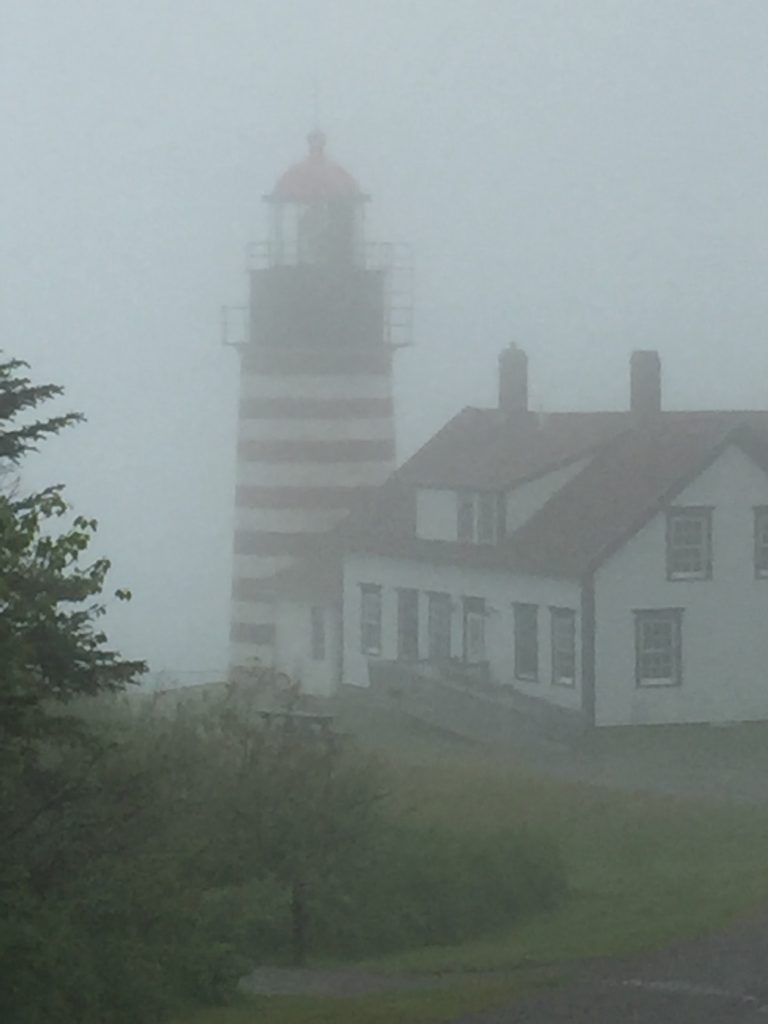
It has come to our attention here at the Teatime Tattler that in a certain town in Maine, there is a widow in charge of the lighthouse. Perhaps the population there is so sparse that they must press ladies into occupations better suited to gentlemen?
We have investigated this untoward circumstance thoroughly, to see if there is some suitable explanation. Perhaps she holds domestic sway while a son does the more — muscular, dare we say, — duties? While there is a son, he is to attend medical school, leaving the widow to attend the lighthouse, her home, and take care of the raising of two younger girls.
Those in town report the widow has taken the duties of lighthouse keeper upon herself. We can only imagine her grief at the loss of her husband has rendered her incapable of understanding her feminine limitations. Why, much mechanical work must be done to keep the lens in order. And much courage is needed to keep the light burning during stormsy weather. Reading the list of instructions for a lighthouse keeper, it becomes clear that only a man is up to the task.
You may suggest that we, who do not live in this town, have no business reporting on their lighthouse keeper. But you forget that the lighthouse is all that prevents ships from foundering in the dark, in the fog, and in stormy seas, where Mother Nature wreaks her bad temper on unlucky sailors. Do we want our sailors coming near a lighthouse where a widow is in charge? We think not. It has been reported, but we can scarcely credit it ourselves, that the widow had attended the lighthouse well, in all her duties and the town wishes her to remain in place. If so, we have a suggestion for them: please find that widow a husband, forthwith.
An excerpt…
The sight of her new home stole Betsy’s breath away. The lighthouse perched like an ancient warrior goddess atop the throne of rocks that acted as a bulwark against the relentless surf. The sound and scent and feel of the water permeated through everything, enfolding her in its powerful embrace. She breathed in, closed her eyes—then opened them and carefully picked her path up toward the entrance.
The front door was constructed of heavy, unpolished wood, as though it had been salvaged directly from the waves. Its austere beauty reminded her of the duke’s ancient manor home, stalwart and secure. The cracks and peels in the dirty white paint around the base of the massive structure became clear as she approached, but they only added to the picture of a home that would stand through a storm and show little damage for it.
She frowned slightly, looking around. Not that a woman’s hand wasn’t needed here, she was relieved to see. What scrubby grass had managed to pry its way through the stones was left untended. A child’s faded toy ball sat lonely in the center of the footpath, half-deflated. She would make her mark on her new home. Her husband would see that she was a worthwhile addition to his life.
Betsy paused. She gazed at the sun-bleached, wind-worn outer walls, at the two crumbling steps leading up to a bare stoop. The light above the doorway was clouded with grime. She glanced over her shoulder, but the driver was long gone. All she had left by way of companionship was the lighthouse and the sea. Where was her new family? Why had they not come outside to greet her yet.
She sighed, hoping that this lonely doorstep wasn’t the beginning of a huge mistake. Then she steeled herself once more, climbed the stairs, and knocked. It was cool in the shadow of the building; she felt a chill run through her. The crazy notion of running away, simply turning and bolting down the long ocean road, flashed through her mind—but right behind it was something Kate had said to her as they parted — the only impossibility is the possibility you fail to see.
The door began to open. In moments, it would be too late to flee.
Betsy squared her shoulders and plastered a smile on her face. Emile Laverdiere was a possibility she must see before she let fear chase her away.
A wraith of a man stood just inside the threshold, his pale eyes huge in the gaunt frame of his face. Betsy bit her tongue just in time to keep a gasp of surprise from escaping her lips. Though she had not chosen to follow the healer path her mother had taken, with her herbs and potions, she knew this man was gravely ill.
“Betsy Lawton?” he asked in a voice that matched the rest of him—thin, frail, reedy.
“Emile Laverdiere?” She looked into his eyes and saw that he had registered her dismay. No doubt he had been expecting it.
He smiled, and his cheekbones stood out like mountain ridges underneath his sunken eyes. There was humor there, despite the ravage of illness. “The one and only. We have been counting the minutes until your arrival. Though it may be impolite, we must ask what you think of your new home?”
Betsy somehow kept her smile in place as she took his offered hand and stepped into the lighthouse. Her soon-to-be-husband’s fingers were cold and bony against hers; she feared that if she squeezed at all, his hand would break. “You have a magnificent landscape at your command,” she answered honestly. He had said nothing of illness in his letters. Nor had those who had attested to his honest character and true desire to wed. Could it be recent? Or had she been duped?
His air of acute attention told her he waited for more. There was an air of patient acceptance in his waiting eyes, as if she could tell him the truth. That she did not want to wed a dying man. Did not know if she truly wanted to immure herself on an isolated jut of rock like Rapunzel in one of the duchess’s favorite fairytales.
But she had come all this way, she would not be her practical mother’s daughter to throw everything away without discovering all she could about this place. Her eyes roamed the interior of the lighthouse’s living space, and she found it plain but comfortable. The rounded room was cozy, softly lit, warmed by a small stone hearth. A spiral staircase formed its centerpiece, climbing up and up through the ceiling. Her eyes could not help following it upward into the unknown. She could hear a slight scraping sound, some rustling, a whispered exchange so low she could almost dismiss it as the sound of the wind.
She looked at her soon-to-be-husband. “What is up there?’ Her eyes swept back upward, toward the sound.
He seemed to approve of her question. “Take a look for yourself, if you like.” He gestured upward. “But forgive me for not accompanying you. I will only slow a young woman like you down. It takes me a while to climb up and down, thought I do it three times a day.”
Of course, Betsy thought. That was why he had not been down to greet her quickly. He had come from the top of the lighthouse. She felt a sympathetic ache in her own healthy joints at what he must endure to do his duty three times a day.
She looked upward, walked to the iron railing, and grasped the cold metal. She began to ascend. On the first landing, she paused at what sounded like sudden whispers, but she saw nothing, so she continued upward.
At the very top, she found her answer. The view that had seemed magnificent when she first arrived, had become almost godlike here, above the sea. She could see for miles. She could pick out the people in the village going about their business, but also the sea life in the ocean. Her breath caught. She leaned closer to look. A whale. She could see a whale in the distance, breaching repeatedly like a child at play.
She was careful not to touch any of the instruments that controlled the light. Emile would teach her to use them, she was certain. She had always been an apt pupil. Living in a duke’s household had exposed her to many lessons not always provided to a governess’s daughter. Living with the Fenster siblings had provided her with lessons that went beyond what was possible even in a duke’s household. She had seen one Fenster sister start a business making beautiful high fashion buttons with a cottager, another become an artist of repute, and one a card sharp that others admired. Kate, her best friend and youngest Fenster sister, had won prizes for the roses she created in her greenhouse.
The gleaming brass of the instruments called to her, but she did not touch, except for one, loving stroke. If she accepted the dying man downstairs as husband, this could be hers.
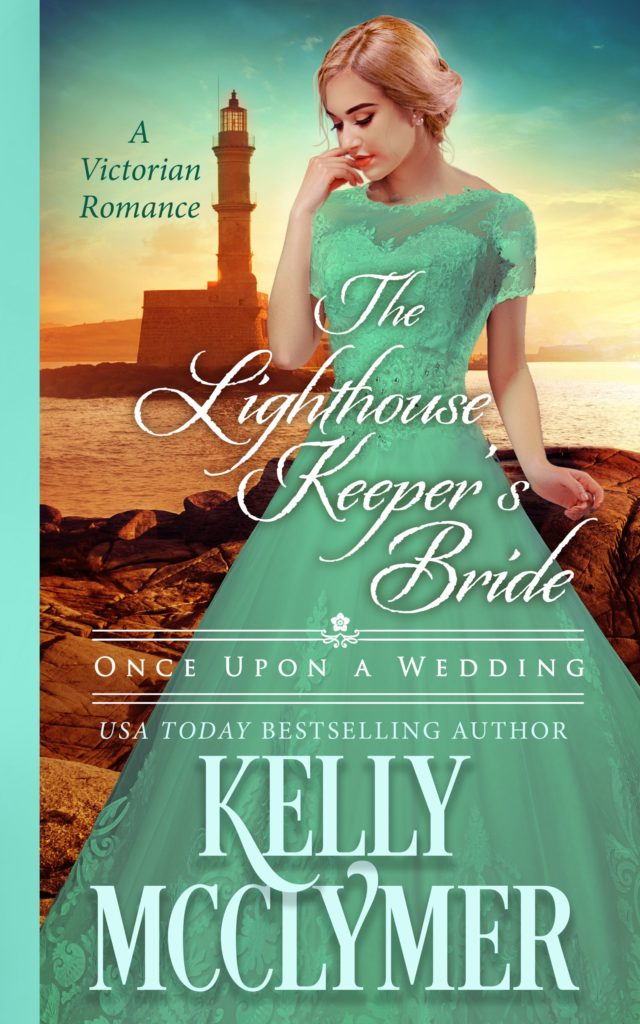
About the Book: The Lighthouse Keeper’s Bride
At long last, Book 8 in the Once Upon a Wedding series has arrived
Raised almost as a sister in a duke’s household, Betsy Lawton has let the duchess’ love of fairytale endings lead her to believe she has a chance at true love with a man far above her station.
Betsy Lawton, the governess’ daughter, dares to give her heart to an earl. When he crushes it under his heel to marry according to his family’s expectations, she turns her back on England and departs for America, where rank and station are no impediment to her dreams. Not that Betsy desires true love any longer. Instead she will be the mail order bride of a lighthouse keeper. It is the lighthouse she will love, she vows.
Matthew Thigpen, Earl of Battingston, had always regretted not fighting hard enough to marry the woman he loved, despite her lack of rank and family. But now he needs to find her. The woman he jilted is the only woman who will understand his predicament and keep his daughter safe.
Now a widow, Betsy must marry again to keep her job at her beloved lighthouse. Matthew offers her a devil’s bargain that will allow her to keep her job at the lighthouse she loves and keep his daughter safe as well. But is his bargain worth the lighthouse, if he breaks her heart all over again?
Kelly McClymer fell in love with Cinderella,
Sleeping Beauty, and Snow White as a child. Her most prized possession
is her copy of The Complete Tales of the Brothers Grimm. These are the
stories which gripped our ancestors as they huddled around the fire at
night, which taught countless children to persevere through hardship and
succeed against the odds. Her favorite fairytale remains “The Six
Swans” — where a young sister must not speak a word for six years in
order to save her brothers from their stepmother’s evil spell.
It has been heard about Auckland
Town that Mr. von Tempsky, that intrepid adventurer, (and don’t try to tell me that a man who has fought in the
jungles of South America would ever truly settle to such a staid existence as being
merely a newspapermen, even in as wild a place as the mining towns of the Coromandel),
a newly made commander in the Colonial Army, is currently involved in the
rescue of a female settler-to-be somewhere in the wild Hunua Ranges, to the
south of our good town.
This female, they say (and I hesitate to call her a lady, or perhaps even a person of womanly means), has made her way, alone, all the way from the feral East Coast of our fair land to Auckland, riding a wild Indian pony. It appears she had finally, after some searching, found Mr. von Tempsky, an acquaintance of her husband, after riding (swimming?) her Mustang across the large swamps between the town of Thames and Pukorokoro, (at the Miranda Redoubt). The good commander, in the middle of his preparation for war against the wild men of the Waikato, had rightly sent her north to abide in safety with his wife and children. However, after some bungling by the men sent to guide and protect her, it appears the girl has disappeared—and foul play is suspected.
Awaiting the news with bated breath, I remain,
Yours, etc.
Mr. Samuel Clemens
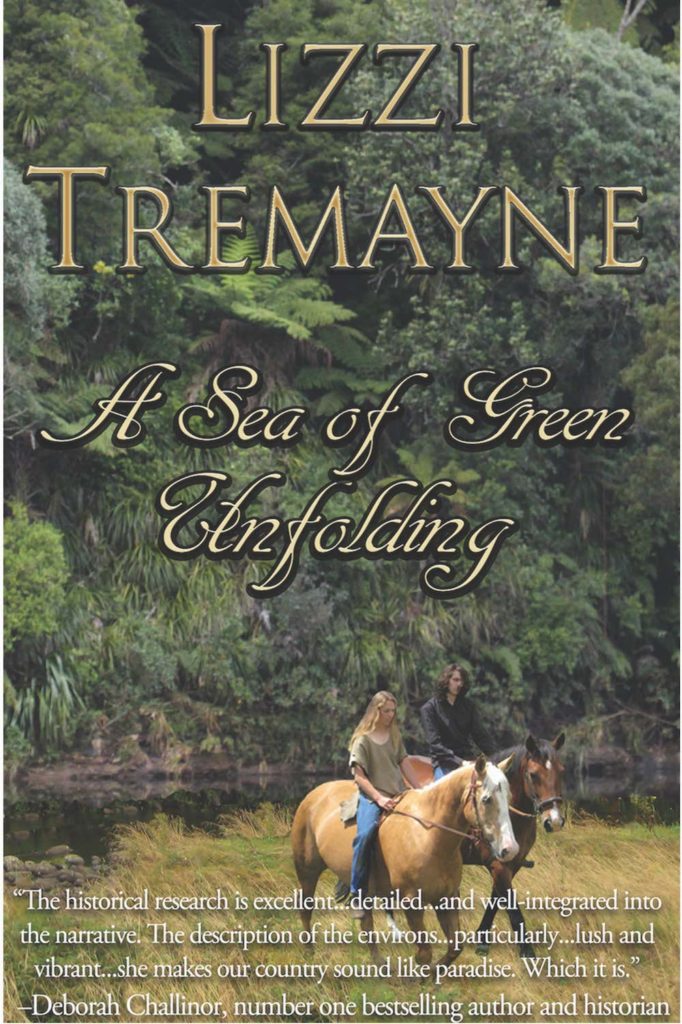
A Sea of Green Unfolding
December 1863, Maketu Pā, south of Auckland, New Zealand
“I
appreciate the Pākehā working so hard to help us.” Tangawai watched the
uniformed men in the distance to the southwest of his outpost, high atop the
Maketu pā.
“They
clear the bush beside the Great South Road to keep their supply trains safe
from us, not to help us,” Mahi replied in Māori, his brows drawing
together as he looked at the young rangatira from the corners of his
eyes.
“Their
stripping back of the bush from the road also lets us see who comes and goes on
their road.” Tangawai grinned and raised the telescope back to his eye. The
colonial army soldiers continued to toil and wear themselves out in the morning
sun. He wiped sweat from his brow with the back of his forearm. The weather was
already hot and humid for this hour, and he wasn’t swinging an axe.
As
he scanned the Great South Road northward from the loggers, three mounted men
came into view, trotting toward Auckland. Two wore military uniform and one was
clad in a ragged-edged leather tunic.
“Tangawai,”
a female voice called up to him from below.
He
handed the scope to his cousin and leaned over the wall. The woman was climbing
the steep side of the pā before him, a flax kete on her back. He
threw a coil of rope to her and she climbed the last bit with its help.
Tangawai
smiled as he took her hand and helped the slim, but heavily pregnant, young
woman over the last parapet. “It must be getting difficult to climb, my Tūī.”
He pulled her to him and kissed the top of her head on her glossy black hair.
“It
won’t be long now, and your son will be on my back instead.” She smiled up at
him and pulled his kai from the satchel.
He
sat and ate with her while his cousin kept watch.
“Tangawai,”
Mahi called over his shoulder, “weren’t there three riders heading north
before, from Williamson’s Clearing?”
“Yes,
two in uniform and one other.”
“There’s
only the one Pākehā now.”
“Can
you see the uniformed men?”
“No,”
he said, and watched for awhile more. “Ah, there they are…they’re going away
from us, toward the homesteads on the west side of the road. It might be a
trap.”
“We’d
better go spring it, then.” Tangawai frowned and pulled Tūī to her feet. “I’ll
signal the village to ready the riders, but you’ll need to get down there and
explain. The rest need to be ready to disappear into the bush. The Pākehā
won’t follow them there.” He gave her a quick hug and a kiss, then she slid
over the edge and lowered herself on the rope. Tūī waved from the bottom, then
turned and ran down toward the village.
Yes,
the Pākehā made it easy to see their road…and easy to see the figure on
a small buckskin horse. Alone, when he’d just had a military escort. Why had
they left him alone? This was a new trick.
He
signaled via mirror to the village below and four men made ready. They approached
Tūīwhen she reached the encampment and stood beside her for a few
minutes, gesturing, before they mounted up and raced from the encampment. Their
horses were gaunt and hard from their time in the bush on rough feed, now that
the Māori were beginning to be pushed from the lands of their ancestors.
Tangawai
returned to his telescope and scanned the horizon as his men galloped down the
hill toward the newly-cleared road. The dust cloud raised by their passing
diminished as the warriors settled themselves just inside the bush on both
sides of the track to await the lone rider.
He
was soon in their own trap. Tangawai gripped the parapet before him as his men
surrounded the Pākehā. The rider looked small and puny, now that his whanau
surrounded him. His men seemed to be speaking to the rider, then the little
horse made a dash to escape, but its way was blocked. The Pākehā’s horse
reared and sunlight glinted off metal near the hand of the rider as his men
rushed toward him.
The
rump of the gray horse was stained scarlet by the time the diminutive rider was
dragged off the buckskin by two of his remaining, seasoned warriors. The man
who’d been riding the gray crouched next to his horse, holding his bleeding
forearm, and the other lay face-down on the ground. Tangawai shook his head and
swore, while the men beside him on the walls stepped further away from him. He
watched as his men picked the rider up off the ground and shook him.
And
knocked his hat off.
Tangawai
took the telescope away from his eye and blinked, glanced at the telescope,
then peered through it again.
It
was still there.
The
blonde hair, down past his knees.
Pākehā men didn’t wear their hair that way.
The
man who’d just bested two of his finest warriors had blonde hair cascading down
past her knees…for it had to be a wahine.
This
wasn’t normal, by anyone’s reckoning.
A Sea of Green Unfolding
When you’ve already lost everything, the only place left to go is up…
Tragedy strikes in Aleksandra and
Xavier’s newly-found paradise on their Californio Rancho de las Pulgas and
newspaperman Gustavus von Tempsky invites them on a journey to a new life in
New Zealand—where everyone lives together in peace.
Unfortunately, change is in the
wind.
When they reach Aotearoa, they
disembark into a turbulent wilderness—where the wars between the European
settlers and the local Māori have only just begun—and von Tempsky is leading
the colonial troops into the bush.
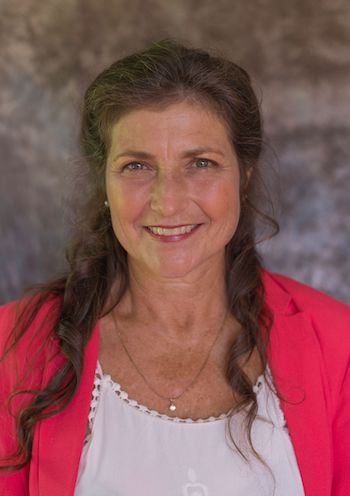
Lizzi grew up riding wild
in the Santa Cruz Mountain redwoods, became an equine veterinarian at UC Davis
School of Veterinary Medicine and practiced in the Gold and Pony Express
Country of California before emigrating to New Zealand. She is the proud mother
of two boys in that sea of green. When she’s not writing, she’s swinging a
rapier or shooting a bow in medieval garb, riding or driving a carriage,
playing in the garden on her hobby farm, singing, cooking, being an equine
veterinarian or high school science teacher. She is multiply published and awarded
in special interest magazines and veterinary periodicals.
With her debut novel, A
Long Trail Rolling, she was Finalist 2013 RWNZ Great Beginnings; Winner
2014 RWNZ Pacific Hearts Award for the unpublished full manuscript; Winner 2015
RWNZ Koru Award for Best First Novel and third in Koru Long Novel section; and
finalist in the 2015 Best Indie Book Award.
Stonehurst’s eyes shone with mischief. “Your wife came to my establishment earlier. She offered me five guineas to f**k her.”
Deanswood spluttered and almost spat out
his brandy. “She did what?”
Stonehurst leaned back and savored a
second sip of his wine. “Do you want me to repeat it? After you’ve drawn
everyone’s gaze? I didn’t take her money or screw her, of course. Let’s find
somewhere to talk.”
Anger turned Deanswood’s features
haughty and harsh. Fists curled, he glowered at his friend. Make that former friend. He’d rather
beat Stonehurst senseless than talk. “You keep your bloody hands off her.”
All Deanswood had wanted was an heir and
a spare. Instead, his wife barred him from her bed—unless a quick screw with no
foreplay or kisses once a month counted. He’d rather have stayed single.
He’d dreamed of a wife with a warm smile
and sweet nature. Curves that made his mouth water and his palms twitch would
be a bonus. Leg-shackling himself to Alethea Allerton was the biggest mistake
he’d ever made.
He should have made it clear that he
expected to bear his children and submit to the occasional spanking. In return,
he’d teach her about passion, bondage, and obedience. Until his mother-in-law
collared him in the library, he’d been looking forward to his wedding night.
His mother-in-law’s words had kyboshed that.
Stonehurst struggled to contain his
laughter. “So, what really happened on your wedding night?”
“It’s none of your business,” Deanswood
snapped.
Unabashed, Stonehurst grinned. “Your
wife made it my business. Her dress sense is shocking. Is that why you couldn’t
perform last night?”
Stonehurst was right. Alethea had
involved him in the tangled mess of her marriage. “Did Alethea say I couldn’t…
Of course, I could… Damn it, I don’t have to explain myself to you.”
“It might help to talk about it,”
Stonehurst suggested.
Deanswood sighed. “Nothing else seems
to. After I’d thrown Lady Babs out, my new mother-in-law collared me in the
library. She read me an endless lecture on the sins of marital sex. I’d rather
take a dressing down from Wellington than endure that again.”
Inwardly, Deanswood fumed. Why the hell
had his wife waited until after the ceremony to send her mother to tell him she
didn’t want sex? He supposed she was eager to get her grasping hands on his
fortune.
When he learned his wife planned to
cuckold him, his eyes narrowed and lips thinned in anger. A trip to Gentleman
Jackson’s boxing salon beckoned. Going a few rounds with the champion might
calm his soul.
Stonehurst’s teasing manner vanished,
and he held up both hands, palm out. “I never touched her. We’re attracting too
much attention. Walk with me.”
Deanswood had fought alongside Stonehurst in the Peninsular War and again at Waterloo. They’d shared too much to fall out over a woman. That said, Stonehurst enjoyed the earl’s discomfort far too much.
His Innocent Bride
Going about her mundane life in a small fishing village, Alethea never dreamed she would end up with a man like the Earl of Deanswood, yet when she caught the handsome gentleman’s eye he wasted no time in making her his wife. Unbeknownst to Alethea, however, her conniving mother has convinced Deanswood that she has no interest in the marital bed. Devastated by his seeming disinterest, Alethea searches for someone to instruct her in the ways of enticing a man.
When a friend informs Deanswood of Alethea’s plans, he decides to train his new bride himself. Soon enough, Alethea finds herself naked, blindfolded, and helplessly bound as she is thoroughly spanked and then brought to one blushing, quivering climax after another. But when Alethea’s life is threatened by her mother’s vicious scheming, can Deanswood protect his innocent bride?
Publisher’s Note:His Innocent Bride is a stand-alone novel which shares the Regency-era setting of Wickedly Used. It includes spankings and sexual scenes. If such material offends you, please don’t buy this book.
More about Kryssie Fortune.
Kryssie reads everything and anything, from
literary fiction to sizzling romance. Her earliest memory is going to the
library with her mother. She can’t have been more than two at the time.
Reading, especially when a book’s hot and explicit, is more than a guilty
pleasure. It’s an obsession.
Kryssie loves to visit historic sites, from
Hadrian’s wall to Regency Bath. The first book she fell in love with was
Georgette Heyer’s The Unknown Ajax.
After that, she devoured every regency book she could. After a while, they went
out of fashion, but part of Kryssie’s psyche lives in in in Regency London. She
longs to dance quadrilles and flirt behind fans. Of course, Kryssie’s heroines
do far more than flirt.
Kryssie lives in Bridlington on the Yorkshire
coast –about thirty miles from Whitby, where Bram Stoker wrote Dracula. She
enjoys gardening, travel, and socializing with her author friends. You’d be
surprised how many erotic romance authors live in the North of England.
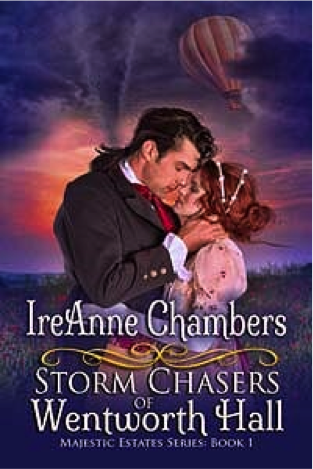
Have I got a story for you, my dear readers. Over here at the Teatime Tattler the ladies are a buzz. We’re excited to tell you about an event you will not want to miss. Storm Chasers are coming to Wentworth Hall, I tell you. What are Storm Chasers you ask? All I can say at this time is they’re very much what you might already be thinking. However, I’ve been warned by none other than the Prince Regent himself not to reveal a word to anyone. I’m taking his warning serious. However, what I can tell you is that everything you may be curious to know about can be found inside the pages of Storm Chasers of Wentworth Hall.
Yes. Your vision is not impaired. That is a hot air balloon.
It’s no secret that this correspondent was more than a little concerned when
this particular on dit was first
revealed. After a fair amount of research, believe it or not, there are
actually two types of balloons in competition with each other so to speak.
Hydrogen gas and hot air balloons. Research on the feasibility of hydrogen gas
balloons dates as far back as 1662. Hot air balloons date all the way back to
220-280 A.D. in China, no less.
Needless to say, the hot air balloon is this correspondent’s preferred choice. The first unmanned ascension was attempted by Joseph-Michel and Jaques-Etienne Montgolfier. The French! Who can believe it? And not too long ago either. September 1783 to be exact. The balloon was called Aerostat Reveillon. It took flight in Versailles and was manned by three non-human living creatures. Yes, you heard right. A sheep called Montauciel meaning “climb-to-the-sky,” a duck, and a rooster. Their journey lasted eight entire minutes with a safe landing. I say, they should have included a pig in the ranks. Or maybe a frog?
As diverting as this may be, these accomplishments are of the utmost importance. The first tethered flight also happened in 1783, one month later, in October. Those pesky Frenchmen powered on until the first untethered, manned flight happened also in France. That is Paris, France on November 21, 1783. This balloon was piloted by Jean-François Pilâtre de Rozier and François Laurent le Vieux d’Arlandes. How, you might ask, is all this possible? A smoky fire under the neck of the balloon in an iron basket. That’s how.
France refused to stop there because only a few weeks later,
the first manned hydrogen balloon
flight occurred on December 1, 1783. This flight was piloted by Jacques Charles
and Nicolas-Louis Robert. They carried a barometer and thermometer making this
the first balloon flight to provide meteorological measurements. Storm chasers
indeed!
Take a look at the photos this correspondent went to great
lengths to acquire:
Hot Air Balloon
Hydrogen balloon
Explaining the science behind hot air and hydrogen will have
to be left to the experts. It’s no wonder Prinny insists on complete discretion.
Readers be warned. The Crown has plans in the works.
And what about England? The first balloon flight in England actually
happened in 1784 not too long after France. This correspondent has reservations
on that account in any event. One cannot believe everything one hears regarding
the French.
Until next time…unless, of course, too much has been
revealed in which case this correspondent will be answering to the powers that
be.
Storm Chasers of Wentworth Hall releases on April 18, 2019. It’s currently on pre-order at: Amazon but soon to be available across all digital outlets.