It has come to this writers attention that a young lady from our very own town is getting married to the grandson of the Duke of Dunsbury. Savannah is in an uproar. It has been well known that Miss Tara Wellesley was a Union Sympathizer during the War Between the States. Some speculate that she was a Union Spy but no evidence was found to prove said scandalous behavior. Sebastian Stafford, the man she is engaged to wed, is said to have been part of a secret society called the Rakes and the Crown. No evidence has been found to ascertain the validity of this either, since records don’t exist on the group, itself. Readers, you can’t get this anywhere else!
Harry Fenn, View of Savannah from the River
Strange events have been happening at night here in Savannah. Sounds of musket shots, canon fire, and sword clashing could be heard from near the river. Some have noticed British flags flying from the redoubts, men dressed in Colonial garb, and some even in the bright red coats of the English Army. This humble writer, would love to know more about these somewhat bizarre events and would like to see them for himself. Maybe even write a future article about it.
In other news, the Wellesley twins are back from their adventures in the North. There is gossip saying that one of them has a secret child housed at the Whispering Oaks plantation. Oh la la, readers! The other twin is said to have fallen for an English girl whom no one has heard of before. How scandalous! The women of Savannah will surely mourn the presence of such handsome gentlemen.
Readers, this author will have more gossip for you in my next article. Until then, check out “A Sea Between Them” by Jessica A Clements and follow this link to find out more: https://www.amazon.com/dp/B082S2KVJH.
About the Book
Tara Wellesley, a Southern belle, knew her world was going to change. The only one in her family with the second sight, she could see what would happen to those around her. What she didn’t see, however, was the English Rake that befriended her twin cousins—dragging them into a deadly battle with a rival spy ring. Sebastian Stafford, the grandson of the Duke of Dunsbury, came to the United States to resurrect the Rakes of the Crown, a spy syndicate that once supplied information for the English Crown. Now, far from England, Sebastian takes solace in Tara’s love and renames his group The Rakes of Liberty. The Rakes have one mission—to keep the Union together no matter the price. That means engaging in their own battle with the Order. But, fate has other plans. When the Order launches an attack against Sebastian’s family, he races back to England to save what is left of them. With a sea between Tara and Sebastian, will the Order get the upper hand or will love be enough to conquer an old foe?
When last I wrote, I related the servants’ natter I overheard regarding the Marquess of Castlereigh and his Irish mistress, and the Duchess of Wiltshire’s new ward, her recently departed fourth cousin’s daughter, Lady Maris.
Lately the servants’ gossip has not been much more interesting then the boring gossip overheard at every ladies’ tea in London. But I have gathered a few more details on both accounts. One of our number, who shall not be named, was overheard in one of the more notorious gaming hells rambling on about the aforementioned Marquess of Castlereigh. It seems this habitually drunken earl had the occasion to meet the previously mentioned Irish mistress while in Ireland. According to my source, who is a servant in the household of one of the others in attendance that night at the gaming hell, the earl claimed the Irish woman, though common, to be a raven-tressed sorceress, whose beauty bewitched and beguiled the marquess so thoroughly that he humiliated a perpetually drunken earl’s daughter at a harvest ball by choosing to waltz with the beauty instead. That is all this maid could relay, as it seems her employer was much in his cups himself that evening. For my part, I must admit to being entirely beside myself with curiosity and hope beyond hope Lord Castlereagh brings a dash of scandal to this Season. As for young Lady Maris, she was seen recently being escorted to the seamstress’ shop by her dutiful cousin Lord Wellesley. Being that Lord Wellesley’s relation to Lady Maris is quite distant, and it being said he is overly protective of her, I had thought perhaps the two might make the Season interesting. Sadly, Lady Maris showed up on the arm of that scoundrel Archibald, the current Duke of Wiltshire, Friday evening past, dashing my plans to have news far more entertaining for you. It seems the marriage between Lord Wellesley and Lady Twila is still to be expected before this year closes Let us all pray Lady Maris finds a more worthy suitor than the duke. Yrs. Truly,Lady Doe
About the Book
THE LOCKET, Aidan, Marquess of Wellesley, and Maris’s story, which was to be released early summer 2020, has been pushed back too late summer/early fall 2020.
The author’s previous book, THE BRIAR AND THE ROSE, is available as an ebook.
THE BRIAR…One moment Raven is alone in the world and working as a maid in the gardens of a grand estate in Ireland; the next she finds herself handed the life of a lady by the dark and handsome Marquess of Castlereagh. Devan insists his intentions are honorable, and that he only wishes to help reunite her with her family. But Raven finds herself in a constant struggle to deny the smoldering attraction between them, and in her secret heart, wishes he wanted more.
THE ROSE…Devan, Marquess of Castlereagh, is tormented by his past and determined to live out his days in quiet solitude at his Ireland estate. That is until Raven enters his life. With the face of an angel, the body of Aphrodite, and the tongue of a drunken Irishman, he’s never met any woman so infuriating… so seductive… so… his match.
THE LEGEND…From historical Ireland and its mystical legends to the elegant ballrooms of Regency London, together Devan and Raven discover the truth of the past and a love so strong it cannot be denied.
Laura Mills-Alcott spent the first two months of 2020 with pneumonia and two flus, thanks to her beautiful grandchildren. In March, after Ohio locked down, she went through four quarantines back to back, having been exposed to three active Covid-19 cases and one employee whose wife had come down with the virus. With her husband using her computer so he could work remotely, and not being able to use it herself for fear she may have contracted the virus, she opted to stay at the house they moved from and take on a full remodel in the hopes of eventually renting or selling it.
Just for entertainment, because things get boring living in a house all by one’s self without books, a computer, or Wi-Fi, Laura put the house on Zillow for sale or rent, not expecting much interest as the pictures showed it torn apart and in the throes of a major remodel. As fate would have it, in early April, a couple 1500 miles away landed on the ad, toured the house via Facebook video call, and believed her when she bragged about all she planned to single-handedly do to the house. They signed a rent-to-own contract the same day. Then Laura found herself in the unenviable position of having to make good on her bragging. The couple moves in May 31st and she is still living on the job site, determined to get the house finished on time.
Laura recently learned she has the coronavirus antibodies and actually had the virus in January when she thought she had pneumonia, which explains why she was so sick for so long, and why since March she has not caught the virus even though she was exposed to it numerous times. Laura looks forward to using her computer soon and having WiFi, and getting back to writing on something other than her smart phone.
It should come as no surprise that her second book, THE LOCKET, Aidan, Marquess of Wellesley, and Maris’s story, which was to be released early summer 2020, has been pushed back too late summer/early fall 2020.
To the Esteemed Editor, The Teatime Tattler, London
Sir, it is with a heavy heart that I take up my pen to document the sad fall of a former ornament of our Society.
Your readers will remember Lady S. B., sister to the Earl of Hy., a lady past her first years, and with two scandals already in her past. She has been betrothed twice, and married not at all. On both occasions, the lady has emerged with her reputation intact, but after recent events, one must wonder if we have been over generous to a serpent in our midst.
Be that as it may, Lady S. has continued to enjoy the approval of Society, and has persisted in trading on that approval in pursuit of funding for one of her many causes.
Those enjoying the hospitality of the Duchess of Hfd have recently been treated to the less than edifying spectacle of the half-breed viscount pursuing the Earl of Hy.’s sisters. Or was the pursuit the other way? We thought he preferred the younger, but he was seen kissing the elder. Under the mistletoe, to be sure, but such a kiss, sir!
It takes so little to ruin a lady. One kiss, and a woman past her first years, who might be supposed to have more sense, has eloped with two rakes. Not one, sir, but two. Neither of them the man she kissed.
It is to be hoped her brother will cast her off completely for the sake of her sister, Lady F., though saving that chit’s reputation is probably already a lost cause.
Be that as it may, we can be sure that the worthy leaders of Society can loosen their grips on their pocketbooks.
Editor’s note: Our readers will be pleased to know that the lady who is the subject of this letter was safely conveyed to London, with her maid in attendance. Her wedding followed shortly after. The Teatime Tattler wishes to convey congratulations to the happy couple, now the Earl and Countess of S.
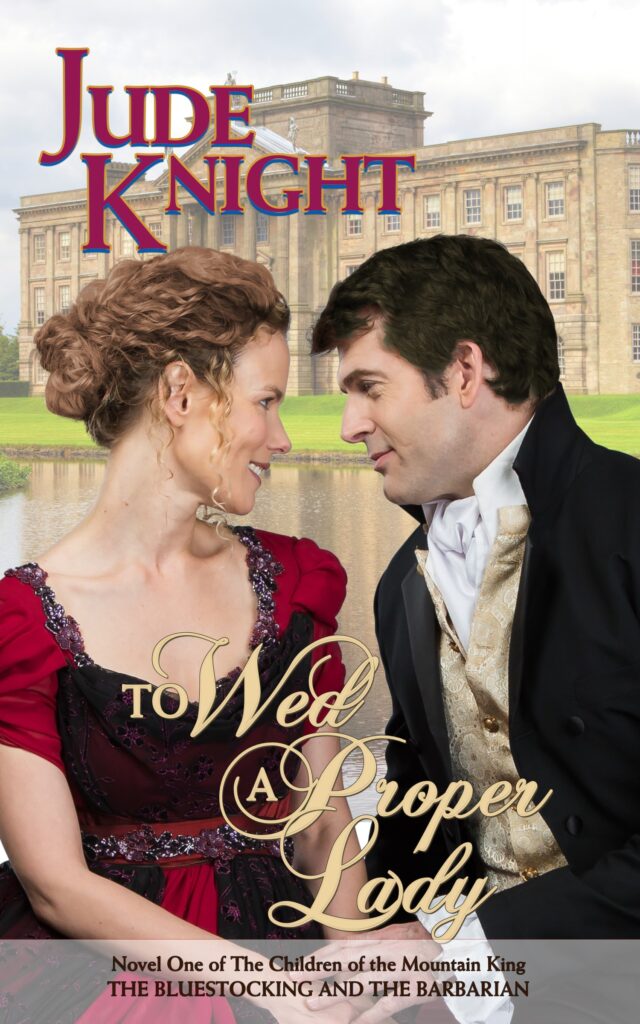
To Wed a Proper Lady
Everyone knows James needs a bride with impeccable blood lines. James needs Sophia’s love, more.
James, eldest son of the Earl of Sutton, must marry to please his grandfather, the Duke of Winshire, and to win social acceptance for himself and his father’s other foreign-born children. But only Lady Sophia Belvoir makes his heart sing, and to win her, he must invite himself to spend Christmas at the home of his father’s greatest enemy: the man who is fighting in Parliament to have his father’s marriage declared invalid and the Winderfield children made bastards.
Sophia keeps secret her tendre for James, Lord Elfingham. After all, the whole of Society knows he is pursuing the younger Belvoir sister, not the older one left on the shelf after two failed betrothals. Even when he asks for her hand in marriage, she still can’t quite believe that he loves her.
In the following excerpt, Sophia decides to follow James to London.
The duchess excused herself and left, to return after a few moments. “A messenger has come to fetch my son Jonathan. If you will excuse me, my friends, I will go and help him prepare for his trip. Please. Continue the celebrations. I will join you again as soon as I can.”
Sophia followed her into the hall in time to hear Aldridge say, “If you must go, use my yacht. It stands off Margate, but we can be there in two days, and she is faster than anything you’ll pick up in London. You will not have to wait for the Thames tide, either.”
“What you propose is not safe, my darling boy. The Grand Army is in your way. You could be shot as a spy,” the duchess said. “Why, this friend of yours cannot even give you assurance that the grand duchess will not behead you on sight. It is possible that…”
“Mama, all things are possible.” Gren was lit from within, bouncing on the balls of his feet as if his joy were too big to contain. “All things but one. I have tried living without the woman I love, Mama, and that, that is impossible. Anything else, I can do. Wait and see.”
“I have sent a message to the stables,” Aldridge said, “and another to my valet telling him to pack for us both. Mama, we shall rest overnight in London then leave at first light for Margate. If you have any messages, write them now.”
“Take me.” Sophia did not know she was going to speak until the words were from her mouth.
“Lady Sophia?” Lord Aldridge was frowning.
“You are right,” Sophia told Gren. “Only one thing is impossible, and that is living without the man I love. I should have said yes. I will say yes. Take me to London, Gren, and to James.”
Gren looked at his brother and then back at Sophia. “We shall be travelling fast,” he warned.
“All the better.”
“What will Hythe say?” the duchess asked.
“I hope he shall wish me well, but I am going, Aunt Eleanor. If Lord Aldridge will not take me, then I shall catch a mail coach.” The decision made, she would not let anything stand in her way.
Lord Aldridge spread his hands in surrender. “Say your farewells, then, Lady Sophia. We leave in thirty minutes.” He turned to his brother. “I’ll write to Baumann. You’ll need money, Gren. He’ll know who can supply it overnight at short notice at this time of year.”
Hythe was not happy. “Sophia, you cannot mean to go chasing after Elfingham. Why, he might already be wed to Lady Charlotte.”
“He is waiting for me, Hythe. He needs me at his side, and that is where I want to be.”
“I can take you to London after the New Year’s Eve ball,” he suggested. “In just a few days.”
“Aldridge and Gren can take me now, today. In a few days, the duke may be dead, and James will be in mourning.”
“The duke might be dead now, Sophia. This is a mad start, running off with two of England’s worst rakes. What of your reputation?” He frowned. “At least take your maid.”
“Theodosia gets sick in a fast coach. Besides, Felicity will need her.”
“Felicity. What of Felicity? You cannot just race off and abandon her.”
Cedrica spoke up. “Do not be silly, Lord Hythe. Her Grace will chaperone Felicity, you will protect her, her maid will take care of her, and I will make sure she behaves. Sophia, Her Grace will have a maid she can send with you to give you countenance. Let me speak to the housekeeper while you set Theodosia packing a bag for you.”
After one astonished look, Hythe subsided, and almost before she knew it, Sophia was on her way out the door. Felicity hugged her and wept a little on her shoulder. The duchess gave her an absent peck on the cheek, most of her attention on her own sons, but then had a sudden thought.
“Wait!” she said. “Saunders, fetch me paper, ink, and a quill. You will find some in the Gold Drawing Room on the library table.”
While the duchess wrote a letter in neat copperplate using her finest paper, others of the party, Cedrica among them, gave their best wishes for a safe journey, “and a happy arrival,” Cedrica whispered.
Then the duchess handed her the sealed and folded letter. “The Archbishop of Canterbury is an old friend of mine, dear Sophia. This letter will get your James in to see him. You will need a license, my dear.” She kissed Sophia again then went to kiss Gren and weep a little onto his shoulder.
At the last moment, Hythe caught Sophia up into a fierce hug. “Tell him from me that he is to treat you well, or he will have me to deal with. And you can always come home, Sophia.”
She hugged him back and allowed Aldridge to hand her up into the carriage.
I write to demand a retraction. Your unscrupulous newspaper printed a libelous letter from an anonymous source in Kirkwall maligning our recently hired organist and choir director. I know it to be false.
To begin with, I received an identical unsigned letter, claiming immoral conduct on the part of our beloved Miss Dunning, and questioning the judgement of one of our most prominent merchants, Sir Alexander Bradshaw. (Yes, I dare name the names spelled out in the letter. You, Sir, hid behind initials!)
However, I have an advantage over you. I have known the gentleman in question for many years, and I can assure you he is a man of great integrity. In addition to that—and more to the point—I have a perceptive wife. She read the letter, tossed it down, pronounced an unladylike oath (for which I did not chastise her), and named the culprit. She immediately recognized the handwriting as a long-time choir member who frequently quarreled with the previous director, and who has disrupted Miss Dunning’s work with demands regarding traditional services, hymn choices, desirable (and undesirable) members of the choir, and any number equally petty and inappropriate complaints and demands. My Maud has frequent dealings with the woman over bake sales, church flowers, and the like and knows her handwriting well. She also knows her as a quarrelsome baggage.
While I generally attempt to avoid getting in the middle of disputes between individuals, I was forced to call this woman to task. Though she denied writing the letter to my face, I made clear she will be expelled from choir and perhaps the parish if any further malice occurs.
Finally, Sir, I am pleased to report to you that Sir Alexander Bradshaw and Miss Ann Dunning were married in my presence this week past.
Kindly print a retraction, and I suggest you confine your deplorable reporting to more serious matters in the future.
The Reverend Edmund Salter, Bishop of Kirkwall, Orkney, Scotland
*****
Editor’s note: The editor of the Teatime Tattler believes the correct form of address of any clergyman of any rank in the Church of Scotland is in fact, “Mister.” However, we will forgive Mr. Salter’s attempt to impress us, leave any complaints to his church’s Assembly, and print his letter as the retraction he demands.
About the Book
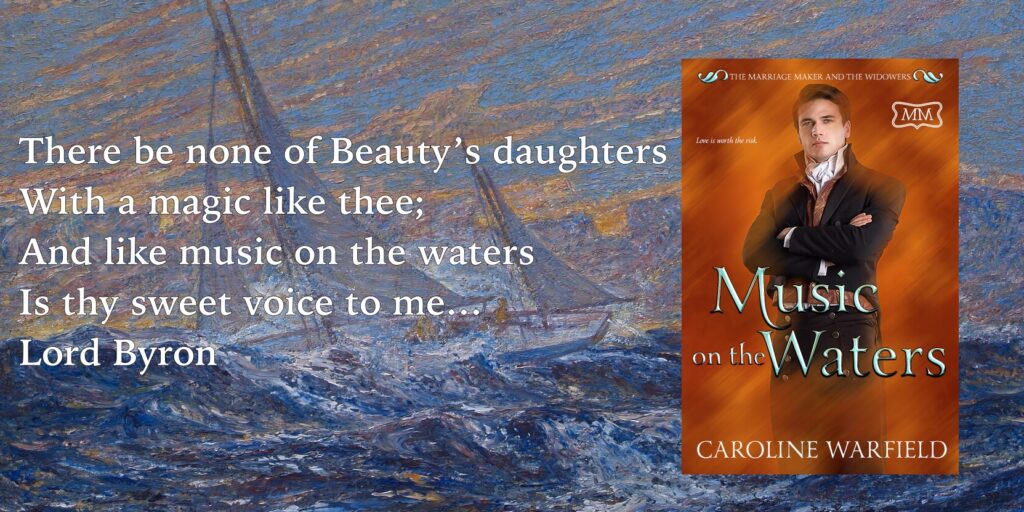
Sir Alexander Bradshaw, solid Scots merchant, needs to acquire a wife, a sensible woman who can manage his unruly sons and sullen daughter. As Orkney’s long, dark winter approaches with no suitable candidates, an acquaintance suggests a music teacher might occupy his daughter. He embraces at the idea.
Ann Dunwood let herself be lured to Orkney by the opportunity to play The Kirkwall Organ. For the beauty of the instrument, she can endure the tedium of choirs and parishioners who wish only for the most banal of hymns; she’s done it before. She knows how to fade into the shadows and keep to her place.
When Alec comes upon her filling the cathedral with a Bach fugue he is enchanted by the magical creature at the keyboard. The object of his fascination sinks into a demure young woman when the music ends. Alec determines to get the magical creature back, and quickly discovers she can fill his life with the music it sorely needs. How long before their solos become a duet?
About the Author
Caroline Warfield, a Bluestocking Belles, pens family-centered historical romance, primarily regency and early Victorian, from her office in the urban wilds of eastern Pennsylvania when she isn’t traveling.
The reporter we sent to investigate the rash of pranks and pratfalls that have plagued London today was unable to identify any single culprit. On the contrary, his report, reprinted below, implies this is a well known custom! Really? One can only shake one’s head!
S. Clemens. Editor
There
are several theories regarding this holiday, which encourages pranks and
mischievous behavior. One popular legend is that
April Fools’ Day began with France’s 1564 Edict of
Roussillon, which decreed that New Year’s Day be moved to January 1st.
Those who continued to celebrate the old New Year around Easter were called “April fools.”
Another
possible precedent is the Greco-Roman festival called Hilaria, which was March 25. The festival
honored Cybele, the ancient Greek Mother of Gods, and its celebrations included
parades, masquerades, and jokes.
And yet, a third idea suggests that April 1st became
the fool’s holiday due to Geoffrey Chaucer’s The
Canterbury Tales,
wherein he includes a playful reference to “32 March,” or April 1st.
However, most scholars consider it to have been a mere copying error.
Wherever it may have originated from, April 1st has become world renowned with practical jokes and amusement.
About the Author
This interesting report came to us from Tabitha Waite. Her sources: